This discussion has been locked.
You can no longer post new replies to this discussion. If you have a question you can start a new discussion

240V Male to Male Extension Lead supplied with motorised awning

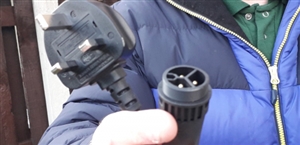
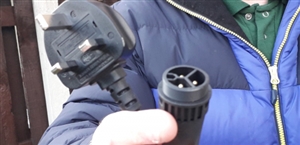
A friend has had a motorised awing supplied with a BS1363 plug approximately 4m in length with an IP rated male plug at the other end, this couple to the female end which is terminated in the awning. The exposed pins are readily accessible and do not meet IP2X.

My question is just what regulations covers this?

The Consumer Safety Act 1978 under which falls the Plugs and Sockets Safety Regs 1994

Or the Health and safety at work Act, under which falls the The Electricity at Work Act and the BS7671.


Its been purchased over the internet so it doesn't necessarily fall under the HASAW

Intention is to write a letter of complaint and advise a product recall, this is lethal!
a97c9ac5479163ba53e4c4bd7220d884-huge-male-to-male.jpg


Graeme Little

BEng (Hons) IEng MIET
  • Silverfox1972:

    A friend has had a motorised awing supplied with a BS1363 plug approximately 4m in length with an IP rated male plug at the other end, this couple to the female end which is terminated in the awning. The exposed pins are readily accessible and do not meet IP2X.

    My question is just what regulations covers this?

    The Consumer Safety Act 1978 under which falls the Plugs and Sockets Safety Regs 1994

    Or the Health and safety at work Act, under which falls the The Electricity at Work Act and the BS7671.


    Its been purchased over the internet so it doesn't necessarily fall under the HASAW

    Intention is to write a letter of complaint and advise a product recall, this is lethal!
    a97c9ac5479163ba53e4c4bd7220d884-huge-male-to-male.jpg


    Graeme Little

    BEng (Hons) IEng MIET


    Just one of many dangerous unlawful electrical items available to all via the internet shops. And it appears that effective policing is not in place to prevent such sales of this killer junk. Report to the local Trading Standards Dept. of your local authority if you can get through to them and wake them up.


    Z.


  • Does it have any kind of permanent locking mechanism on the awning end? I just wonder if they're treating it as an installer friendly version of bare-ended flex which should be safe once installed.

       - Andy.
  • AJJewsbury:

    Does it have any kind of permanent locking mechanism on the awning end? I just wonder if they're treating it as an installer friendly version of bare-ended flex which should be safe once installed.

       - Andy.


    Perhaps save for the case where it can only be removed with the use of a key or tool ... but:

    (a) What if it gets in the hands of a member of the public or a child?

    (b) Why put the installer at risk when couplers that meet IP2X are readily available? There are also couplers available that meet IP2X for bi-directional operation.


  • He's a homeowner with small children, this is my concern. But what is it contravening? HASAW or Consumers Act? If I was doing an installation it would be HASAW but its a purchased product not an installation. I intend to report this to trading Standards as well as the manufacturer, it needs a product recall before a someone suffers a fatality.


  • If that connector can be opened up and the pins exposed without tools once installed, then the equipment fails the low voltage directive, and should not be CE marked, so cannot legally be offered for sale in the UK.

    HASAWA is relevant if it is installed at a place of work, allowing the management to be prosecuted, while domestically, consumer protection is the correct course of action. Trading standards who you contact via the overworked Citizens Advice Bureau, is the formal, if rather feeble, route to kick off the legal process.


    Liability will rest with the maker or importer, being the first person who put it into circulation in the UK or anywhere in the EU. This  does mean if it is an internet order delivered direct from abroad,  that is the person who placed the order, as in that case the importer and customer can be one and the same.

    In reality a responsible  importer will not wait for the trading standards process, and will probably act as soon as contacted, but many are back bedroom operations with little technical knowledge of the rules that govern what they are importing, so may need it explaining in noddy steps.

    Let us know how you get on.


    Mike.
  • If it is in a domestic setting, HSWA 1974 does not apply.


    The Plugs and Sockets etc. (Safety) Regulations 1994 mention "appliance coupler" , but as far as I can see, they do not impose any limitations upon them.
  • mapj1:


    If that connector can be opened up and the pins exposed without tools once installed, then the equipment fails the low voltage directive, and should not be CE marked, so cannot legally be offered for sale in the UK.

    HASAWA is relevant if it is installed at a place of work, allowing the management to be prosecuted, while domestically, consumer protection is the correct course of action. Trading standards who you contact via the overworked Citizens Advice Bureau, is the formal, if rather feeble, route to kick off the legal process.


    Liability will rest with the maker or importer, being the first person who put it into circulation in the UK or anywhere in the EU. This  does mean if it is an internet order delivered direct from abroad,  that is the person who placed the order, as in that case the importer and customer can be one and the same.

    In reality a responsible  importer will not wait for the trading standards process, and will probably act as soon as contacted, but many are back bedroom operations with little technical knowledge of the rules that govern what they are importing, so may need it explaining in noddy steps.

    Let us know how you get on.


    Mike.


    Mike,

    Thanks for the advice/input. The pins can be exposed without the use of a tool and the product is also 'CE' marked.


  • gkenyon:
    AJJewsbury:

    Does it have any kind of permanent locking mechanism on the awning end? I just wonder if they're treating it as an installer friendly version of bare-ended flex which should be safe once installed.

       - Andy.


    Perhaps save for the case where it can only be removed with the use of a key or tool ... but:

    (a) What if it gets in the hands of a member of the public or a child?

    (b) Why put the installer at risk when couplers that meet IP2X are readily available? There are also couplers available that meet IP2X for bi-directional operation.


    I don't disagree - but the same arguments would apply to the sale of say This - and we wouldn't have any ojections to that - or indeed to someone chopping off and discarding a moulded plug. A lot depends on the context...

       - Andy.


  • The sale by RS and others of unterminated mains leads is not in my view comparable to the dangerous item featured in the O/P.


    A moments thought should show that the unterminated mains lead is clearly dangerous "as is" and is obviously intended to be connected to something by a qualified person, or by a suitably skilled member of the public.


    The item featured in the O/P is clearly intended to be USED as supplied, and an ordinary person might assume that it "must be OK or it would not be sold thus"

    Many SELV power supplies have connectors with exposed pins and are safe to use. An ordinary person may not understand the difference between a 19 volt laptop PC power supply, and this dangerous mains lead.
  • ~If it is CE marked, properly, not just bearing a sticker, then with the paperwork will be a declaration, and this must include  the contact address, and the name and signature, of the person declaring that as far as they know, it meets all relevant standards to allow it to be placed on the market at the time of declaration. As one who has prepared things for CE marking, I can say that it is quite a serious business to do well, and to be honest utterly beyond many smaller concerns who either do not do it at all or do not do it well.

    It is not helped by the fact that there are many, standards, they are expensive, and there  is no easy way to work out which ones do or do not apply to a given item.


    ~However, for this the LVD and EMC standards at least should be on the list, and probably some machinery related  standards as well.

    Contact  them and see what they have to say.

    Mike.