This discussion has been locked.
You can no longer post new replies to this discussion. If you have a question you can start a new discussion

Underground Cable Tracing.

An P.V.C./P.V.C.  cable is run in steel conduit underground from a farm barn to another location. It may run underground to some nearby concrete slabs previously used as a base for wooden sheds, or it may run for about 80 metres to some distant  derelict outbuildings.

I am not too familiar with all of the types of underground cable tracers available.

Which would be the best type of cable tracer to use to determine its run? There may be other buried metal to confuse some tracers. Will a signal injected into the cable be able to be detected by a cable tracer as the cable in inside steel conduit?

The cable is currently dead.

Thanks,

Z.


  • Well I`m certainly extremely sceptical about dowsing.

    However, remember Rumsfeld, known knowns, known unknowns, unknown unknowns, known Gnomes and unknown Gnomes etc etc.

    I personally find it almost impossible to consider there is not life (as we know it!)   on other planets. Surely there must be, loads of em, though probably any two will almost certainly never meet or even be aware of each other.

    However, there is just a tiny tiny tiny chance that we are alone.

    If we consider how transformers work, the maglev and many other things and the way birds migrate and again many other things then maybe, just maybe we might one day find something.

    as Kreskin used to say , things now considered ESP will oneday become PSE (Phenomena Scientifically Explainable) .

    • yes I know that he, like Uri Geller, were just showmen
  • I used to go to the Local IET Group meetings, there was a really good one at the Mount Pleasant Hotel in Malvern.

    The speaker was a guy in his nineties who worked on the team in the early days of research into radar down at the bottom of the road in Malvern. The room was absolutely packed it was standing room only for latecomers, I had managed to get a seat in the back row and was sitting by a couple of University Professors. 

    The speaker was explaining the vast distances they were bouncing signals across, down to South America and back again, then about how they were measuring to signals reflected off aircraft as they flew past the BBC Droitwich aerials.

    I raised my hand and asked a question “Presumably these planes were made from wood and canvas, so what was reflecting the signal?”.

    He laughed and said the propellers were wood as well! The reflected signal was from the engine, fixings holding the wooden frame together, other ironmongery such as door hinges, control cables and of course bombs in the bomb bays of bombers, making bombers easier to find then fighters.

    Honestly, in the early days of they were trying aircraft by locating its engine and assorted metal fittings from many miles away, the guy sat next to me passed comment that even from a few hundred miles away an engine is a surprisingly large target when it’s the only thing in the sky.


  •  

    If you have a buried metal pipe or conduit you should really be able to plot its course with your tester ?


    Apart from the first concrete section, yes I could use that method for the majority of the run which is just in soft soil. That is a very good idea.

    Z.

  • d4b74599da7ae20523e8635c2cbb16ce-original-image.jpg


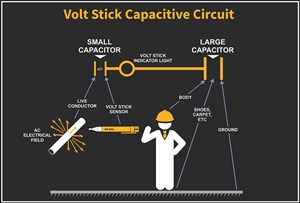
    You have to remember just how simple some of the principles are behind tools and testers that we use everyday, when you actually look at what is happening it’s really basic, this article is worth reading.


    https://voltstick.com/how-to-av/videos-and-blogs/how-does-voltstick-work

  • Zoomup: 


    If you have a buried metal pipe or conduit you should really be able to plot its course with your tester ?


    Apart from the first concrete section, yes I could use that method for the majority of the run which is just in soft soil. That is a very good idea.

    Z.


    It would be a lot easier to go to a hire shop to get a cat and genny, but if you are using them seriously you are supposed to have a training certificate.

    The Council are resurfacing the footways in our road at the moment, they have marked all the services having surveyed with a cat and genny, though some of the runs are fairly obvious, for example there’s a fire hydrant outside our house along with a water stop cock cover and a patch of tarmac in the slabs from when the gas main was replaced.

    It seems a pretty pointless exercise as they are only taking the slabs up and skimming off enough for tarmac, the chances of hitting a service pipe, cable or duct should be non-existence, but if they do they cannot said that no one had warned them that they might hit something, though who takes the blame if they hit something that isn’t marked could make for an interesting conversation.

    There a bit of a blame game going on up the road from us, the road markings have just be replaced after the road was altered and resurfaced, there’s now a huge 50 on the road rather than the anticipated 30, a councillor has already said it’s the contractors fault and will be replaced at no cost to tax payers, personally I would assume they were given a drawing to work from.

  • I think anyone who as either carried out, or ordered, an underground services services survey, will tell you, the only 100 % reliable method is to actually dig and see whether the CAT or Scan is correct. It really depends how accurately you need to trace the services as to whether a CAT & Genny or radiographic scan will do the trick for you for a particular purpose.

    For example,

    • receiving a CAT & Genny signal tells you that something conductive is underground, connected to the generator source, and approximately how deep (within the service accuracy of the equipment, give or take ground soil type). It doesn't tell you it's the cable you're looking for (unless you can properly disconnect it at both ends and are sure it's not connected to anything else conductive underground).
    • Not receiving a signal only tells you that it wasn't received (absence of evidence is not evidence of absence … a bit like “proving" dead).


    PAS 128 is the industry standard to be followed, which expressly covers accuracy issues.

  • @wallywombat it is accepted that when using a cat and genny to survey a site a third of the possible targets may not be detected, such as plastic pipes.

    I do not believe that in the experiment that you referred to with plastic pipes buried in a pit that there is any totally reliable means of detection from above ground without actually digging holes to find out; and in reality dowsing with rods is probably gives the only chance of detecting some buried utilities, how and why I cannot explain, but if it works don’t knock it.


  • Sparkingchip: 
     

    @wallywombat it is accepted that when using a cat and genny to survey a site a third of the possible targets may not be detected, such as plastic pipes.

    I do not believe that in the experiment that you referred to with plastic pipes buried in a pit that there is any totally reliable means of detection from above ground without actually digging holes to find out


    Either you have completely misunderstood my description of the experiment, or I am misunderstanding you now. The experiment wasn't about plastic pipes - the plastic is irrelevant. I'm not claiming that dowsers can or can't detect plastic.

     The experiment was to test the claim which some dowsers were making: that they could detect running water underground. To rule out as many variables as possible, the test involved building a “standardised” layout where an area of ground was divided into 10 strips, and it could be well controlled that water was running along under one strip and not under the other 9 at any one point, and that no water was running diagonally across, or any other such confounder.

    The way chosen to construct this rig was to lay plastic waste pipes underground, then run (or not) water through them. All the dowsers taking part in the experiment agreed that the presence of the plastic wouldn't interfere with their ability to detect water (nor not) in the pipes.

  • So the water pipe is only detectable if a tap is turned on and the water is running?

    That is very specific. A volt stick will indicate that there’s a voltage, it will not tell you if there’s a current.

    The whole thing sounds like an exercise in trying to prove a point that not many people would even consider trying to prove in the first place.

    The water board inspectors still carry listening sticks in the back of their vans as far as I know to allow them to lift a stop cock cover and place the stick on the stop cock and listen for leaks, there’s now sophisticated electronic equipment to do the same job, but those bits of wood work.  

    https://akrovalve.com/listening-sticks/listening-sticks/

  • Sparkingchip: 
    So the water pipe is only detectable if a tap is turned on and the water is running?

    No not even then by dowsing.