This discussion has been locked.
You can no longer post new replies to this discussion. If you have a question you can start a new discussion

Section 521.6 of BS 7671

Former Community Member

concerning 300/500V cables complying to IEC 60227-4, installed in 3phase system 230/400V, I know that it is acceptable to be installed as per  IEC 62440-2008 table 2.(which allows it for up to 320/550V system).

Actually my question is related grouped circuits in same cable tray, conduit , trunking or even panel boards enclosure, rather than the cable it self if it withstand the rated voltage. 

Section 521.6 of BS 7671, states that  " Two or more circuits are allowed in the same conduit, ducting or trunking system provided the requirements of Section 528 are met". Section 528.1 states that " Every cable or conductor is insulated for the highest voltage present". To comply with requirement one may say that in 230/400V 3-Phase system, each conductor of cables must be rated atleast U0/U=400/692 rather than U0/U=230/400V, and the reason consider we have 3x 1-Phase circuits grouped in same let's say DN50 Conduit, so if one of the conductors(say line  L1)  in the group had insulation failure, the other conductors (of lines L2 and L3) will be exposed to voltage between the conductor and its surrounding medium which is  denoted by U0 of 400V rather than 230V. So here my question is what is the philosophy of section 521.6, which protection it's trying to provide? or shall we use higher rated cables in order to comply? if we must use higher rated cables in case of different circuit, then I think it has some meaning to also mandate using  higher rating in case of conductors of same 3-phase circuit (knowing that  IEC 62440-2008 table 2 allows 300/500V cables to be installed for 230/400V 3-phase system).

Note overall sheath is not taken into consideration as a mean of protection in this section as it is usually doesn't contribute in the voltage rating of cable.

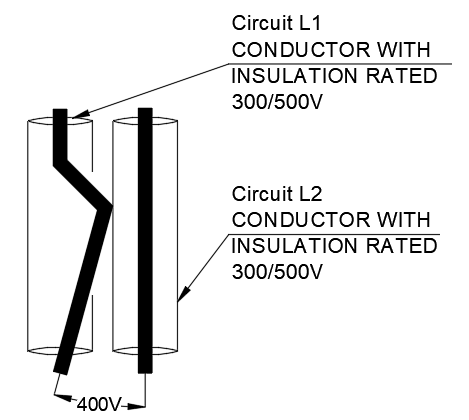
  • Mr.  below is an illustration of what I mean.

    I'm still not seeing the problem.

    Regulation 528.1 clearly says that each conductor must be insulated for the highest voltage present if there is no sheath. I believe the wording is clear for indent (i), because it follows immediately with the example of a multicore cable in indent (ii), so the following options to "share containment" for two circuits, one 240/400 three-phase, and one SELV, when using indents (i) and (ii) of 528.1 would be:

    • two separate insulated and sheathed cables each rated 300/500 V, one for mains, one for the SELV.
    • separate conductors in conduit or trunking rated for at least 400 V
    • separate conductors in a cable that would have to be rated at least 400/400 V

    Alternatively you could also use any of the options in indents (iii) to (vi).

  • Former Community Member
    Former Community Member in reply to AJJewsbury
    (as the unprotected conductors of  the smaller circuit may well not co-ordinate with the protective devices of a larger one)

    sounds very familiar for the specials  requirements of BS EN 61439 concerning the stringent requirements for installation of short-circuit-unprotected conductors.

  • Former Community Member
    Former Community Member in reply to gkenyon

     Mr.  below is an illustration of what I mean.


  • Could you explain how damaged insulation of one circuit becomes connected to the conductor of another circuit, with a single fault in insulation, with the present provisions of a standard?

    I think I can see the OP's point - if insulation on say L1 fails, then the insulation surrounding a L2 or L3 conductor next to it may then be exposed to 400V rather than 230V at that point - so if it's only rated for 230V to its surrounding it might in theory be then expected to fail as a direct consequence of the 1st fault (rather than due to a 2nd independent fault). Probably unlikely in practice (given most ordinary insulation is actually good for several kV - e.g. during surges or indeed routine 500V/1000V insulation testing) but I think I can concede the point in principle. I would even agree that the consequences of such a fault between different circuits might well have more serious consequences than between conductors of the same circuit (as the unprotected conductors of  the smaller circuit may well not co-ordinate with the protective devices of a larger one), but I don't see that BS 7671 demands we worry about it.

       - Andy.

  • Actually, my latest reply was just to clarify to Mr.  my POV that just a single breach in conductor may be risky to neighboring circuits and no need for two breaches to cause fault

    Could you explain how damaged insulation of one circuit becomes connected to the conductor of another circuit, with a single fault in insulation, with the present provisions of a standard?

    will be exposed to voltage between the conductor and its surrounding medium which is  denoted by U0 of 400V rather than 230V.

    I don't think you have explained why you think that the remaining phase now has a 'voltage to Earth' (which is what U0 is defined as) of 400 V. Are you assuming no protection has operated after the first fault, and if so, why?

  • Former Community Member
    Former Community Member in reply to AJJewsbury
    Like I said, I've seen no evidence (or even any suggestion) elsewhere that there's an intention to protect insulation of one LV conductor after the failure of insulation of a conductor of a different LV circuit.

    ,yes, as you previously explained your POV and it was well understood. Actually, my latest reply was just to clarify to Mr.  my POV that just a single breach in conductor may be risky to neighboring circuits and no need for two breaches to cause fault.  thank you for your thoughtful contributions to this discussion.

  • The basic question of this thread was query about the philosophy of Section 528.1 (item i and ii ), is it for protecting neighboring circuits from a single insulation fault of a line conductor of a given circuit?

    Like I said, I've seen no evidence (or even any suggestion) elsewhere that there's an intention to protect insulation of one LV conductor after the failure of insulation of a conductor of a different LV circuit.

    528.1 itself is all about mixing Band I (usually ELV) and Band II (usually LV) systems in the same wiring system - so where you only had LV circuits run together, it wouldn't seem to demand any extra precautions at all. (Although other parts of 528 may apply, depending on the circumstances).

    Some others here are closer to the committees' discussions and might be able to enlighten us further - although I suspect that wording goes back quite a time so the original thinking might have been lost in the mists of time by now.

       - Andy.

  • Former Community Member
    Former Community Member in reply to gkenyon
    BS 7671 (and IEC 60364) only considers single fault conditions wherein a fault between two lines requires there to be two breaches of basic insulation.

    Single damage in an insulation of line conductor(whatever the insulation rating of conductor) will  put the circuit of that conductor in risk of earth fault ,this will not affect neighboring circuits..   

    In a 3-phase system 230/400V if the conductors of all circuits installed in same raceway are rated 450/750V, a single fault of one of the conductors will not affect the other circuits as they can withstand the voltage that is applied on their insulation surface (400V ) because they can withstand 450V. whereas if the cables were rated 300/500V, they will not withstand the 400V applied on the insulation surface.

    The basic question of this thread was query about the philosophy of Section 528.1 (item i and ii ), is it for protecting neighboring circuits from a single insulation fault of a line conductor of a given circuit? if this is was the philosophy, then in 230/400V system, the conductors of different circuits installed in same raceway shall always be specified to be rated atleast 450/750V.

  • BS 7671 (and IEC 60364) only considers single fault conditions wherein a fault between two lines requires there to be two breaches of basic insulation.

    Indeed, but it could be argued exactly the same for faults between live conductors of the same circuit - yet to omit fault protection would typically be an immediate C2. Maybe faults other then within cables (e.g. at terminations) are more likely to be between conductors of the same circuit - but there are still situations (e.g. CUs and simple DBs) where wires of one circuit run close to terminals of another.

    Plus of course there's the possibility of a single event breaking both layers of insulation together - the old School classic being the floor board nail through a bunch of cables running in the same notch (although I can concede that these days that sort of thing should be mitigated elsewhere - e.g. cable depth/positioning).

       - Andy.

  • This section only considers the case of a fault between conductors belonging to the same circuit".

    Or, between conductors and Earth.

    This is not so problematic in general ... BS 7671 (and IEC 60364) only considers single fault conditions wherein a fault between two lines requires there to be two breaches of basic insulation.

    The requirements for appropriate mechanical protection (or, 522.8.10, an earthed armour etc.) help to redress this.

    One of the many "gaps" in BS 7671 (and probably IEC 60364 too).

    Given the above, is this really a "gap"?