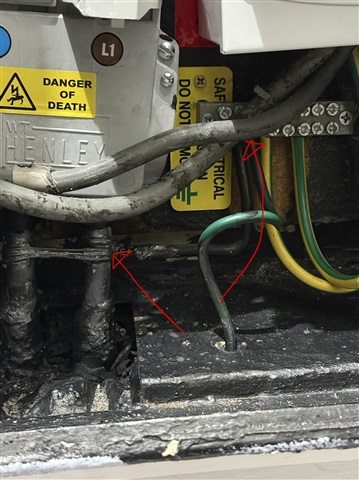
TNS Hybrid with PNB strap

Firstly I’d like to say, thank you for taking the time out of your day to reply!

Information about the property and installation:

2 core Live and neutral most likely 25mm2 because it’s protected by an 80A fuse PILC or PILS, looped supply, Semi detached 1968 build.

I’ve pretty much modernised everything in the property. Full Type A RCBO setup with CPN Cudis type 1+2 surge protection.

I’ve also installed an Isolator switch with an SPD too! Garo type 2 spec.

During my examinations and also bringing in my sparky. We’ve discovered that the system is no longer a proper TNS system. Essentially what’s happened from observation is that the lead sheath of the supply has lost its Earth. Most likely because of degradation and lifespan 40-50 years (BS6480) The system is now a hybrid of some sorts with a mechanical neutral bond to the sheath of the looped supply then wired to the MET terminal Earth block. There is also a tinned Earth CPC nave green that goes underneath somewhere I am assuming it’s an Earth rod…because of the tinned Earth copper configuration and the cable being dug deep down and no way to access it? The cutout also mimics 5-10 second buzzing/arching noises and then disappears?

I’ve contacted the DNO 4 times. First they said it’s “fine” 2nd attempt they just changed the meter tails that goes from the cutout to the meter. 3rd they sent two guys who only did a visual inspection, and I noticed both glared at each other? But didn’t comment? Like they were hiding something? (I could also be mistaken) this might sound picky or fussy or what not but…I don’t feel safe if I am being honest….I feel worried… they are refusing to replace the old PILC/PILS cable…

I don’t know what to do? I just brought this house? And I wish I did an EICR inspection before I brought it. The sparky lad said it would have most likely failed an EICR inspection because of the sheath bonding…

  • Good morning, Panic not, this situation is quite common.  Originally it would have been TN-s and the company earth would have been provided by the lead sheath of the cable, and neutral and the lead sheath would have been strapped at the substation. 
    However, the street cables maybe damaged or corroded, or just changed to add in a new house or a lamp post or something, and as the only new sorts of cable the DNO routinely carry are for PME supplies, the N and E junction moves from the substation to the point of repair. This can leave a short length of lead sheath serving as a long thin electrode for a house, but with no metallic connection to the original earth the other side of the repair... Its not supposed to happen, they are supposed to link round joints, but it can. 
    At this point the DNO can either convert to PME, by strapping neutral and earth at your incoming company fuse, or tell you they cannot provide an earth and  to treat the installation as TT.  
    The pair of incomers mean this looks like a looped supply, I presume your meter cupboard backs onto your neighbours ? 
    If test results show a low enough Zs, and for an 80A fuse you'd like to see low enough to blow it promptly, so less than half an ohm (DNO usually quote 0.3 or 0.35 ohms.) If not then double insulation on everything before the first RCD/ RCBOs and treat as TT.
     
    It is not too clear what is going on under the black grot on those feed cables- it looks almost like twist and pray, but I really hope it is properly soldered, as it is the neighbour's only earth connection linking those lead jackets, too, and it looks, politely, 'a little rough' -other pithier phrases are available!! 
    The green wire will be original, as green and yellow stripy became de-riguer from about 1970. Could it be going off to meet up with your water main or gas pipe from that location? In which case it is more of a bond than an electrode.

    I'd be more worried about the buzzing personally - but if the DNO have inspected and are happy, then it's their problem when it overheats and then has to be changed completely, instead of just tightened up now.
    Generally they don't like changing looped service heads if it can be avoided as it often means a new cable being laid in to make them two separate supplies - perhaps wait for the neighbour to get a car charger or solar panels and it will probably happen for free...
    So what is the measured Zs with that lot in place ? That decides if the earthing is adequate. Meanwhile treat as if TNCs /PME/MEN until you know otherwise.
    Mike.


    PS edited to add..

    Oh it wont be 25mm2 - at the time that got put in the world of cables was imperial, but it will be good for 100A or so, shared between you and next door ;-) 

  • Take a video of the buzzing and send it to them. Edited to say post it on here as well if you can.

    Gary

  • The system is now a hybrid of some sorts with a mechanical neutral bond to the sheath of the looped supply then wired to the MET terminal Earth block.

    I am not sure how you reach that conclusion. If the two cables which enter the bottom of the service head are the loop, their sheaths would have to be connected to maintain your neighbour's earth. The earthing conductor is the twists of copper from the supply to the MET. Although they may appear to be rather weedy, I would expect that there are 4 x 4 mm² bare copper, which seem to have been painted.

  • I'm not seeing a obvious N-PE link in the pictures either - but as Mike say such things aren't uncommon - and most DNOs these say will say if asked "PME conditions apply" to just about any earthing facility they provide, whether it was originally TN-S or not.

       - Andy.

  • That looks like a looped supply so the DNO probaly will not allow it to be used for supplying an EV changing point or a high current load such as a heat pump.

    Also it may have the appearance of a TN-S supply it wiil probably be a PME due to DNO cable reapirs. UKPN came clean some years ago and issued an earthing document to say if they have provided an earth from an incomming cable it is TN-C-S (PME).

    JP

  • most DNOs these say will say if asked "PME conditions apply" to just about any earthing facility they provide, whether it was originally TN-S or not.

    As Figure 2.1 of the OSG clearly shows, if the N-PE link is in the service head, the earthing conductor will emerge from the latter; whereas if there is no N-PE link, it is connected to the supply cable.

    For SIGINT's benefit (as I have mentioned previously), my earthing at home looks very similar. However, Ze was excessive a few years ago. This is, apparently, normally due to deterioration in the connection between the street main and the supply cable. Rather than digging a hole in the highway and fixing the problem there, the DNO dug a hole in my lawn and linked N and PE there. So whilst the installation appears to be TN-S, it is in fact TN-C-S. (Or perhaps that should be TN-S-C-S?)

    ETA: JP beat me to it whilst I was typing.

  • That looks like a looped supply so the DNO probaly will not allow it to be used for supplying an EV changing point or a high current load such as a heat pump.
    perhaps wait for the neighbour to get a car charger or solar panels and it will probably happen for free...

    I think that what crafty Mike meant was that because the DNO would not allow a looped supply to be used for an EVCP, etc., the neighbours would have to pay for a new supply from the street, and SIGINT's would no longer be looped. :-)

  • As Figure 2.1 of the OSG clearly shows, if the N-PE link is in the service head, the earthing conductor will emerge from the latter; whereas if there is no N-PE link, it is connected to the supply cable.

    I fear the real world is a little messier than the OSG might suggest. E.g. series 6 cut-outs (e.g. https://www.wt-henley.com/pdf/14688_series_6_house_service_cut_outs_2.pdf) had a removable link within the cut-out - so without opening things you're not supposed to open you can't tell if there's a link in there or not - hence it could be either combined N/E (CNE) or separate earth wire (SEW) as the DNOs say (or SEW to the premises but CNE to some common point outside, as is apparently now the fashion for multiple supplies to steel frame buildings).

       - Andy.

  • Hi Andy!

    Thank you for your reply!

    The NPE is mechanically attached to both of the sheaths of the looped supply. The bitumen I am guessing has started to leak or is leaking hence the lead sheaths colour of a dark gray or black look. I’ve also found a rod outside the property. It’s corroded (obvious reasons) that is also connected to the MET Earth terminal block.

    The “pine green” looking Earth from what I can tell is either 4mm2 or 6mm2 is also connected to something below the property where the PILC/PILS cable enters the property…I can’t verify because it’s very deep down and probably dangerous as it could damage the cable even further. 

    The neutral is the same either 4mm2 or 6mm2. But it’s been wrapped around the mechanical strap of the sheath of both the looped supply and is connected to the same MET.

    Theres parallel earth connects and a neutral altogether connected to the MET from my observation 

  • I'm still missing something I think... traditionally the lead sheaths were just PE. N was a separate core inside (just like L). I can see the two cable sheaths strapped together (which would ensure next door's cable is Earthed) and to your MET - but that's all typical of a traditional TN-S arrangement (when looped).

        - Andy.