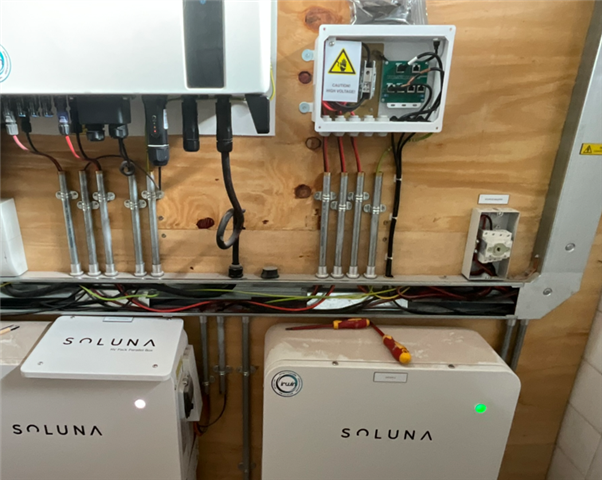
Wiring system for solar PV

Neat enough job and probably technically compliant, but is it sensible to put the DC side conductors in metallic trunking and conduit even if they do meet the class 2 or equivalent requirement? 

I am aware that there are SWA cables specifically for solar PV, so I guess there is not much difference if the SWA is earthed. However, on a slightly different point, if these SWA DC cables are buried, what is the point of earthing the wire armour?

  • You could consider the reverse, i.e., why shouldn't they be installed in metallic trunking? Because if it is simply due to proximity with conductive components then a) There is no trust in the principle of Double Or Reinforced Insulation, on which 99.9% of PV installations rely, and b) It would not be acceptable or safe to safely install DC cabling within the steelwork of the array framing system, which is done by the km on utility parks, or on traywork on commercial roofs.

    It used to be that guidance specifically instructed installers to use metallic trunking or similar for runs greater than 50m length, to reduce EMC and susceptibility to atmospheric surges.

    Personally I prefer to see PV DC and AC treated as separate voltage bands and provided separate containment, mainly because of the risk of confusion but also flashover etc if there's an LPS zone boundary being crossed.

    Leakage capacitance of the PV array is indeed a real effect and one that can cause assorted problems, but it's dominated by the capacitance of the PV modules to the framework (and hence by the weather, since if it's covered in condensation the effective plate has a greater surface area). It is possible (and necessary for large projects) to estimate the capacitance for an array. It is a requirement to earth the array framework in many cases as a result (NB: Very old rooftop installations from days when transformerless inverters were rare, and some edge cases, may not be earthed as the thinking at the time was that it was the lesser risk).

    Where there is armoured PV cable, as well as the EMC/LPS considerations, earthing the armour (properly) mitigates the hazard that an internal cable fault could present 1500V on the armour ends. Note that due to capacitance the array itself is likely to need bonding so the increased risk of promoting cross-array faults is minimal. It also means that the insulation can be continuously monitored, unlike unarmoured and unearthed cable which could have a pinhole fault (eg due to strimming or rodents... or just damp, if the cable's poorly spec'd for the location) waiting to bite maintenance teams.

  • If it's a solar farm, there are a number of cases where the earthing of the solar farm is intertwined with the HV earthing ... so you really might want to consider 'transfer potential' and the effect of earthing (or not earthing) the armour ...

  • Putting DC PV conductors in metallic trunking or conduit is generally allowed if Class II insulation is maintained, but it raises practical concerns. Metallic containment can introduce thermal issues and complicate fault isolation. SWA for DC is common, and earthing the armour is about touch-voltage safety, not circuit protection—especially if buried. The key is compliance with BS 7671 Section 521 and PV-specific guidance: maintain double insulation, manage segregation, and ensure bonding where required.