The car park

There are several main types of car park in the UK

Open air
Multi-storey open sided
Basement
Basement with dwellings or commercial space above

The UK is seeing a large move towards EV (Electric Vehicles) from traditional ICE (Internal Combustion Engine) there have also been several well documented Car park fires in the last decade.  Eg Luton Airport Car park October 2023 with over 1500 vehicles destroyed or damaged

Should all UK Car Parks apart from Open air have 
Fire detection with 24/7/365 monitoring with backup power supply
Increase amount of manual fire call points per floor and throughout stairwells to increase evacuation alert
EVSE auto shut off for power in the event of a fire or an alarm
Battery backup for emergency lights for a min of 6 hours
Increased amount of illuminated fire exits signs
Fire resistant cabling throughout
Fire restitant cable management/containment throughout
Increase IP rating throughout in case of fire due to the amount of water that may be used
Annual EICR
Technology/Mechanisms to assist evacuation of disabled and mobility impaired persons, this could include evacuation lift replacing the passenger lift


As always please be polite and respectful in this purely academic debate.


Come on everybody let’s help inspire the future

  • (Again, hence why the fallout from Grenfell is still rumbling on.)

    Grenfell was an awful tragedy where 72 people died.  It should never of happened if the people involved use due diligence rather than risk management or GREED.  They took a building than was made from rocks, and we all know that rocks don’t burn (credit to Joseph Lstiburek) and wrapped it in a Flammable PetroChemical derivative.  Then when a fire broke out for WHATEVER reason they tried to blame everyone and everything else.  Now I put it to you, a scenario if you will.  Take the home/dwelling of the persons/team making the decisions for Grenfell exterior cladding and ask them to wrap their own home/dwelling in a Flammable PetroChemical derivative and hope that a fire will never break out.  The Grenfell tragedy was due to poor management and poor engineering judgement.

  • If signage is compliant, I don't see a need to increase it.

    A little homework/experiment for the community.  When you are in the next mutli-storey car park have a look for the entrance to stairwells, there is probably one at each end of level then have a look for the illuminated emergency exit sign (The Running Person Sign).  Can or could you see that sign from a distance?  Then take a pause for thought and add some imaginary smoke.

    Primary Toxic Gases (Common to all vehicle fires) 

    Carbon Monoxide (CO): A silent, odorless, and deadly gas produced by incomplete combustion, acting as a chemical asphyxiant

    Carbon Dioxide (CO2).  Produced in large quantities, it acts as a simple asphyxiant by displacing oxygen, particularly in enclosed, poorly ventilated areas

    Hydrogen Cyanide (HCN): Released from the burning of plastics and synthetic materials, it is a highly toxic gas that can be fatal if inhaled

    Nitrogen Oxides (NOx): Including nitric oxide (NO) and nitrogen dioxide (NO2), these are respiratory irritants

    Sulfur Dioxide (SO2): Produced from the combustion of materials like rubber and tires


    SOME specific Gases from Electric Vehicle (EV) Fires

    Hydrogen Fluoride (HF): The most significant toxic concern in EV fires, produced when the battery electrolyte breaks down. It is extremely toxic, corrosive, and fatal if inhaled

    Hydrogen (H2): A highly flammable gas that can add to the explosive risk in a confined space

  • Can or could you see that sign from a distance?  Then take a pause for thought and add some imaginary smoke.

    Having experienced two workplace fires I know just how quickly things can escalate. One in particular was when workmen set fire to the roof of the building I was in. One moment everything was absolutely fine, and the next there was thick black smoke billowing into the room from the air conditioning vents. Within seconds you couldn't see to the other side of the room.

    All those nights out clubbing then creeping back into my parents house at 4am in the dark without switching the lights on so I didn't wake them up came in very handy that day!  Flushed

  • Hence - "If signage is compliant....". Viewing distances, viewing angles, changes of direction and obstructions should all be taken into consideration during the design, not just 'slap a running man above the door'. Oh, and if we could get the arrow direction correct too, that'd be wonderful. Pet peeve is a down arrow above a door.

  • *IF* a voice alarm system is installed, yes - cabling to be per the relevant standards.
    *IF* an evacuation lift is required, yes, cabling to be per the relevant standards.

  • Pet peeve is a down arrow above a door.
    yes, why on earth do folk think they always should have up for 'go though here' - why not like roadsigns, where 'go this way' can be down  or up depending where the sign is in relation to the route.

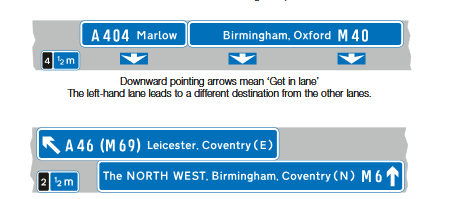
    Is the intention of one of these two equivalent styles road signs unclear ? If so which one makes you think you have to reverse ?
    The highway code allows for both kinds, and both mean go forwards and tell you which lane to move to. 


    And really the exit signs should not be someone running, which is risky, but someone proceeding without delay, not stopping to collect possessions or chat etc.

    wordless signs are always open to (mis) interpretation.

    Mike.

  • Especially when it leads to stairs where down is the exit,running up stairs would make things worse

  • Is the intention of one of these two equivalent styles road signs unclear ?

    I'd say no. The two different arrows have different meanings. The Up/left ones indicate the direction of travel, while the downward ones point to the lane to which the sign refers.  (Maybe horizontal curly brackets might have been a better choice instead of the downward arrows)
       - Andy.

  • Interesting interpretation. Personally in both cases I'd understand the arrows as telling me where to go if I wanted to get to the named place. On a 2D sign perhaps a dot or a cross to represent the point of the arrow coming towards you or its tail flights going away would be less ambiguous. That may be an undue influence from looking at field plots over the years.

    But maybe a down arrow above the door means something like 'aim for this door' as opposed to the up arrow for 'just keep straight on' to some readers. I'm still not sure that it should affect action taken in practice. And I fully take the point in a multi-story structure, perhaps a basement car park with an upstairs exit, a means of conveying an early  warning to prepare  for going up or down the stairwell could be useful. I'm also well aware its not what the instructions that come with the pack of stickers say you should do. 
    Mike.

  • Per BS 5266-1 & BS 5499-4 & BS EN ISO 7010 'up' arrows are "through and onwards from here". Down arrows should only be used at a change of level.

    You don't need to point to the door, it's usually pretty obvious it is a door.