


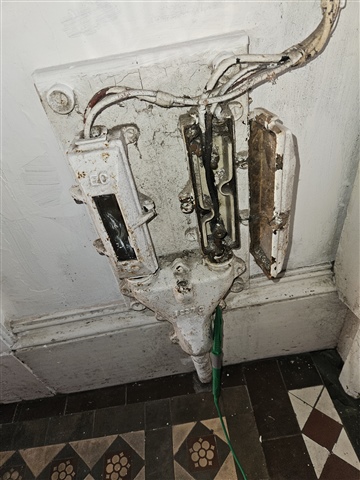
 hi
hi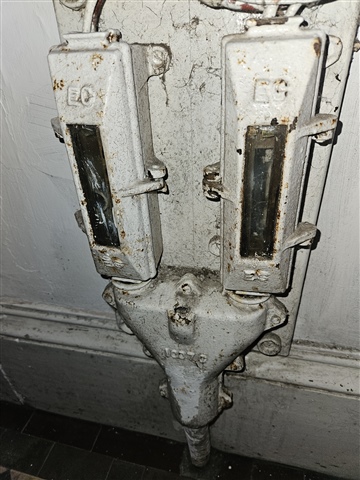
Hi
Can anyone tell me how old this is? Been asked to do and eicr in the property. Its an old listed building and its now empty. It was rewired around 20 years ago. Im get a ze of 22.5 ohms. Fused board it the old type asbestos flash fuses?
hi
Hi
Can anyone tell me how old this is? Been asked to do and eicr in the property. Its an old listed building and its now empty. It was rewired around 20 years ago. Im get a ze of 22.5 ohms. Fused board it the old type asbestos flash fuses?

Craig, thank you. Do please keep us updated. :-)

I cant see where they have taken the earth from to the property. There is certainly no spike around the outside of the building
The old tradition was to use the water supply pipe... in the day it would have already been there and made an excellent electrode - reliably metallic (if probably lead rather than copper) with excellent contact with the earth over a considerable distance and (mostly) buried sufficiently deep to avoid freezing.. Often the connection was a relatively thin bare stranded conductor (maybe as small as 1mm² equivalent) and sometimes connected to somewhere obscure like the back of a convenient socket near the stopcock rather than directly to the MET. The introduction of plastic supply pipes messed that up of course...
- Andy.

The way to test the water pipe earth from the same era was not a Zs meter, but simply to connect a test lamp between live and earth - if it came on, there was a respectable earth connection, and as all lead pipe joints were soldered back then, it would actually have been pretty solid and maintenance free, forming a horizontal electrode of hundreds of metres in length, at least as far as any compression type repair or joint to a cast iron main where there may or may not have been something insulating on the threads in the joint..
As I pointed out above, if it was early, the house earth connection probably came a few years after the electrical supply itself, when the sockets started to change from 2 pin to 3 pin and there was a need for something to connect it to. Note that the incomer may be lead sheathed, but that may or may not actually connect solidly to the service head, as there was often a wrap of hessian or crepe or something around the lead pipe to stop the tar dripping while it was poured.
Some but not all DNOs would then sweat (solder) a wire to the lead outer of the cable for to provide an earth in the vicinity of the supply.
Mike.

I remember my father-in-law talking about how the Manchester electricity board (EB) prohibited the connection of house earths to their (the EB's) earth at the board (CU) (~ late '40s, early '50s), and how it was only later that the hard connection between the EB's earth and the local house earth. Ahh, the good old days of lead sheathed cables.
Some but not all DNOs would then sweat a wire to the lead outer of the cable for to provide an earth in the vicinity of the supply.
Some of us still have that arrangement.
In my old house built and wired in around 1950 the main earth was a thin bare wire that was run from the DB to a copper pipe in the downstairs Khazi it was soldered to the pipe and certainly worked well enough to prevent any nasty tingles was replaced with a much thicker long length of green and yellow which was attached to the cold water intake pipe just the other side of a wall from the original point. A few years later the SEB converted the whole estate to PME every house but one had the water pipe earth in place so it really was multiple earth. The first house I lived at that I can remember had a 3 pin socket in the kitchen we used for the wash machine if we used the heater on the machine it would give a slight tingle so I'm guessing there was no earth even tho it was a3 pin 15 amp socket. I think the electrics were put in by a bloke from the pub the owner knew
It's a wonder that we all survived.
The first house I lived at that I can remember had a 3 pin socket in the kitchen we used for the wash machine if we used the heater on the machine it would give a slight tingle so I'm guessing there was no earth even tho it was a3 pin 15 amp socket.
I thought that you were going to say that if you used the heater on the machine, you could not use anything else. :-)
Youngsters who rely upon automatic washing machines don't know how fortunate they are.
First you had to fill it. Heat the water. Tangle up all the clothes. Empty the water. Spin (if you were posh).
When I was wee, Grandma still had a mangle in her wash-house in the back yard. Remarkably, the wash-house still appears on Google along with the adjoining privy and coal hole.
Another question: when did meter cupboards become the norm?
(I hate them just as I hate most plastic things.)
We were lucky the kettle and fridge were still usable from a 15 amp outlet on the cooker control that house was a bit mingy but good compared to some if the terrible rental properties you see on the telly news now
Only a few years ago, I came across a 20 amp service ! for a house. The "consumer unit" was an old MEM splitter with one 15 amp fuse for power and one 5 amp fuse for lighting. It dated to the 1950s, when electricity was first available in the area. I declined to add a 10 Kw shower !
We're about to take you to the IET registration website. Don't worry though, you'll be sent straight back to the community after completing the registration.
Continue to the IET registration site
