Bi directional rcd testing

I just read an article from voltimum where it talks about type B bi directional rcd testing .

it seem to say to test on the outgoing terminals as usual, and then test on the incoming terminals where it should also trip!

I have not fitted many type B and have only done the required test in BS7671 (testing as an AC type).

can anyone confirm this is how they work?

  • The way to verify a bidirectional RCD is to 

    test with the tripper on the input terminals, while supplying power to the output. 

    As well as the conventional 

    with the tripper on the output terminals, while supplying power to the input. 

     Maybe something lost in translation in the article, do you have a link to a web copy of it ?

    I'm not aware of any move to make this a standard test, rather its something done at the factory.

    Mike.

  • I have not fitted many type B and have only done the required test in BS7671 (testing as an AC type).

    Testing at ½IΔn and IΔn (0° and 180°) as a type AC is all that you are required to do.

    GN3 (pp 96 and 97) explains that further tests are intended, "for fault-finding and similar purposes only". This is because, "RCDs are only rated for a finite number of operations".

  • Here is the article.

    i know the regs dont require these test as described here : https://www.voltimum.co.uk/news/doepke/does-an-rccb-type-b-trip-on-dc%20?b=&utm_source=ActiveCampaign&utm_medium=email&utm_content=Verify+Type+B+protection+before+faults+strike&utm_campaign=UK_NL_26_230626_OW

    im just amazed the rcd works that way or perhaps i misunderstood ?

  • I think it's as Mike suggested - not only does the instrument have to be connected to the opposite terminals compared to the first test, the supply does too.

    I agree that article doesn't make that clear e.g. "Once complete, carry out the same test on the supply side to check the device is true bidirectional." and "Repeat the same test on the opposite side". But then it goes on "If it is truly bi-directional it will trip on DC irrespective of which side, you connect the supply." (In the first I suspect the author says "supply side" in the sense of the side that's conventionally connected to the supply (grid) - rather than the side that happens to be supply power in reverse move (e.g. from a local generator)- of course to test it we'd have to connect some sort of supply, which is probably most conveniently the grid ,.. which mucks up all the conventional assumptions.

    If an RCD could trip with a test meter connected to the same side that's fed the actual supply, not only would be understanding of physics be called into question, but any idea of discrimination between circuits would go to the dogs.

       - Andy.

  • I suspect that the author is confused between type testing and in-service testing.

    Generally, tests are performed with a voltage applied to the supply side and no load. I am unclear how this is to be achieved with grid-tied local generation when testing in the "wrong" direction. Perhaps a test-rig is required?

  • To measure RCD tripping current on a fluke 1654B

    1. Turn the rotary switch to I∆n position.

    2. press F1 to select the test current phase, 0° or 180°.

    3. press F3 to select the RCD test-current waveform: smooth – DC current to test type B RCD.

    4. press F4 to select the RCD current rating (10,30,100,300 or 500mA).

    5. press and release ‘test. Wait for the test to complete.

    Repeat the same test on the opposite side of the For a true bidirectional RCD it should still trip to the relevant parameters....
    ...
    If it is complex installation requiring Bi-directional RCD functionality you can verify the operation by repeating the Test on the reverse side...

    Hmm, not the clearest is it (!) I think either the author is confused, or there was some last minute cut 'n' paste editing to make something fit and a vital sentence has been deleted around the bits I have highlighted in red..  I'd have no qualms in quoting Matilda the musical and saying "and that’s not right"...
    Mike

  • Im aware of what GN3 advises on (RCD) Residual Current Device testing ,though i would make the point that hager rate the CDA 240T rcd at a minimum of 2000 electrical operations.

    the data sheet says:

    Endurance

    Electric endurance in number of cycles 2000

    Number of mechanical operations 4000

    even if the test button is pressed every 6 months and 2 more operations via rcd testing every 5 years in our rental properties it will take a while to wear out.

    in any case my point is about the rcd that will trip on the supply side as the article states, i can see how this would work especially with neutral and earth joined  at the service head.

  • the data sheet says:

    Endurance

    Electric endurance in number of cycles 2000

    Number of mechanical operations 4000

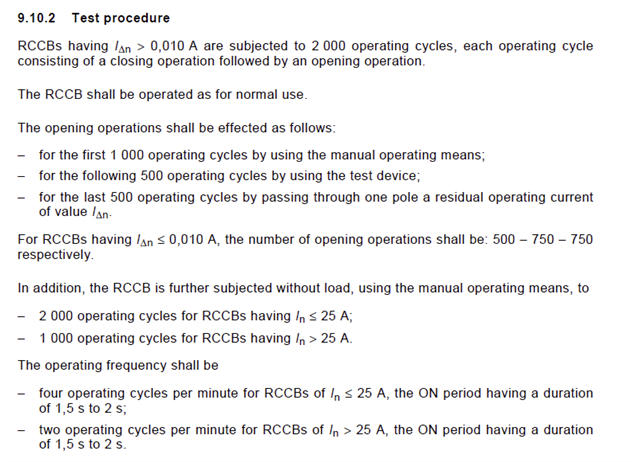
    That is twice the minimum specified in BS EN 61008.

    I agree that GN3 is perhaps being a bit pessimistic. Even if an RCCB is operated 20 times per year, it would still take at least 100 years to wear out.

  • That is twice the minimum specified in BS EN 61008.

    Is it? I don't think the actual number of cycles the RCD has to meet in service is specified, only the numbers of cycles that are tested during type tests.

    In BS 61008-1:2012+A12:2017, the current UK designated standard, the total number of cycles tested during type test is 4000 mechanical and 2000 electrical for devices with nominal (load) current rating up to 25 A, and 3000 mechanical and 1000 electrical for devices with nominal (load) current rating exceeding 25 A?

    I agree that GN3 is perhaps being a bit pessimistic. Even if an RCCB is operated 20 times per year, it would still take at least 100 years to wear out.

    Some RCDs are used in installations that have more frequent inspection and test periods than one year. The shortest periods between formal inspection and testing quoted in Table 3.2 of IET Guidance Note 3: Inspection and Testing are, effectively:

    • 3 months for construction sites, although it's reasonable to expect a "test button" check before each use if an RCBO is used for each socket-outlet on a site distro board (which could be multiple times per day, but to be pragmatic, say 20 times per week). For a Type A, if we do full tests, that would be a minimum of 4x4=16 operations per for formal I&T, 50x20=1000 operations per year for routine check before use (assuming a 2-week shutdown) ... might just bring this in at under 4 years usage. For devices rated above 25 A nominal current, this drops to under 3 years. C
      Pragmatically, these periods of a small number of years might be OK for some sites, but site distro boxes to get reused, and no-one keeps a log of exactly how many trips have been made in the mean-time. 

    • 'Each hire' for mobile and transportable units. this could be weekly ... certainly multiple times per year. Again, falls far short of 100 years.

    In a workshop environment, where SRCDs are used, they might well be manually tested each day... so similarly, we're looking at 4 years of mechanical operations for devices with nominal current rating not exceeding 25 A, similar to a construction site, without any additional tests for periodic inspection and testing.

  • Is it? I don't think the actual number of cycles the RCD has to meet in service is specified, only the numbers of cycles that are tested during type tests.

    Fair point. Some RCCBs might last well beyond the type test.

    In BS 61008-1:2012+A12:2017, the current UK designated standard, the total number of cycles tested during type test is 4000 mechanical and 2000 electrical for devices with nominal (load) current rating up to 25 A, and 3000 mechanical and 1000 electrical for devices with nominal (load) current rating exceeding 25 A?

    Not sure how you get that. For the 40 A device which Newfutile mentioned, there are 1000 mechanical operations; 500 each for test button and test rig = 1000 (presumably these count as electrical cycles); and a further 1000 mechanical. So 2000 mechanical + 1000 electrical.