Greener on the other side

I have seen an increase in enquiries from very well qualified people who want to achieve the NVQ L3 as a route into the practical side of the electrical installation sector. Many have degrees in electrical and electronic engineering and similar electrically biased third level qualifications. For example, one chap has a HND and held down a senior role in a consultancy practice. I didn’t ask but I should imagine that the salary is north of 50K.

At the moment we only offer a route via the experienced worker assessment, which, as an entry requirement, requires five years post training experience operating as an installation electrician. As with the chap in the example, most seem to want to move into a specific discipline within the sector, solar PV and battery being a popular focus. Whether one is intending to work in the microgeneration side or on the larger scale projects, having the right brace of qualifications is becoming increasingly essential. Unfortunately, some of the qualifications restrict entry to candidates with a NVQ L3, which, for those with the top class academic qualifications, means achieving accreditation for those practical skills that the NVQ demands.  Gaining such experience can be elusive, if not impossible. I am not at all convinced that some of  the practical skills, such as bending steel conduit, should prevent someone achieving a NVQ and thus prevent access to the renewable qualifications. However, I am not pretending that the answer to allowing gates to open to facilitate folk to move into the installation sector, with all its extensive disciplines, is an easy one.

As for the chap in the example, I met him by chance on a large solar project in an industrial site. He had ditched the suit for a pair of overalls and was helping to pull in long runs of fairly lumpy SWAs. He looked over the fence, decided the grass was greener and took up a job with a contractor who, erstwhile, he gave directions to! He tells me that in time, he will be seeking to enrol on whatever route will see him achieve the NVQ L3 and AM2 and ultimately, the electricians gold card.

Good luck to him, he will be an asset to our industry. I wish I could make it easier for other similar high quality individuals to climb over the fence. Perhaps the grass will not be as green as they thought, but at least we would have them on the right side!.

  • I recall a spate of work colleagues a decade ago, reading that there was a shortage of electrical installers, deciding that they wanted to retrain from there current role as engineering designers. I guess it could be the case again. There is a significant part of our engineering design industry that has been offshored (don't blame Brexit, it was happening before that, but it didn't help). Its difficult to offshore a role that requires you to be physically present at the clients location. But now there is noise that AI will replace jobs. Again, its difficult for AI to replace installer roles, but apparently easy to replace engineering designers.

    Personally, I feel this is a little sensationalist. AI can be a good productivity tool if you know what you are doing, But it can also be a great way to make errors in new and unpredictable ways.

    I would guess that if someone has the equivalent of a NVQ 5 or greater, achieving the educational aspects of a NVQ 3 isn't going to be the challenge. The challenge is the practical side, especially if you are like me and that isn't your strong point (OK, my last piece of DIY wasn't a disaster, so I run myself down).

    I wonder what the rules are in other countries. I know at least 1 person who decided to head to Australia to practice their craft, and has been successful.

  • Lyle, I was under the impression that to do the Experienced Worker Route (2357?) you now need a Level 2 qualification in electrical installation. Is that true, or does past experience count?

    After many years working on the tools, I've actually gone the other way. I finished on a site in April, then in June, started as an Assessor in a Further Education College, in charge of 30+ apprentices.It's a bit of an eye opener, but overall, I'm really happy to have made the change. It's definitely a pay cut (just under JIB rates now) but there are a lot of good points about it.

    On the mature point, we have 3 guys who are all mid-30's. They all say it's the easiest way to get into being an Electrician. They say they could have funded it themselves, and done it quicker than the projected 4 years, but are happy to get funding, and work at apprentice pay for 3 to 4 years. Our College course is 3 years at one day a week, the final year is getting the portfolio done, then the AM2S. Anyone who is sorted, can complete it in 3 years, which it looks like these guys will do. At the other extreme, I have one lad who has now done 4 years, but still not completed his portfolio, so it'll be near 5 years before ha has passed his AM2S.

  • I read this with interest - and to set the scene for me the day job is very much design authority stuff for electronic bits and bobs, with occasional look at how things will be installed, but the hobby and pro-bono side takes me into the world of real tools and power. On both 'sides'  I've often sensed a sort of snobbery /or perhaps inverted snobbery that puts the practical and theoretical skills at odds, and occasionally I must admit I like to puncture those balloons for fun. 

    But there is a serious point, as stuff gets more complex, and Electricians may find themselves staring at something that needs its IP address setting up or its wireless antenna locating sympathetically, much as the designers of the thing really ought to have thought about terminals for sensible cable sizes and how to fit it  one handed while on a step ladder,  that 'fence' really needs to become more of an increasingly low dwarf wall... 

    I see a need for folk with a foot in both camps even if that means a site boot on one side and a nicely polished shoe on the other  (!) Knowing how to use stuffing glands or bend conduit does not suddenly make your hands dirty and your knowledge in some way inferior, nor does knowledge of design software, network protocols or even partial integrals make you a hopeless geek, or purely an ivory tower academic incapable of being left alone with push taps and sliding doors without injury..

    It might do, as of course there are a few hopeless folk in all camps, but for those that can, a bit of cross-over working is healthy, and I think to be encouraged. 

    There may be an argument for tweaking the training routes in a way that will actually acknowledge and encourage more of that.

    Mike.

  • Lyle, I was under the impression that to do the Experienced Worker Route (2357?) you now need a Level 2 qualification in electrical installation. Is that true, or does past experience count?

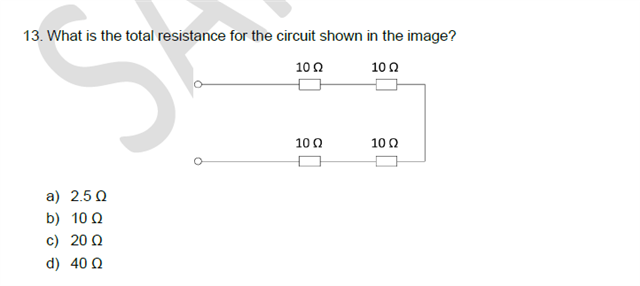
    The minimum underpinning knowledge qualification required for entry to the EWA is a recognised Level 2 qualification. That needs to be supported by a written determination by the assessor that the candidate has appropriate Level 3 underpinning knowledge, albeit not formally recognised. If the candidate has been in the industry for at least 10 years then they can sit a single online entry test where really difficult questions are asked such as the two from the sample below! 

    This is also an example of me being deliberately snooty as MapJ pointed out in his excellent post above, often exists between the theoretical and practical. It is quite amazing the number of really good practical sparks who have difficulty with anything related to theory, no matter how simple, that involves maths. 

    To be clear, I am not clever enough to be snooty and even if I was, I definitely wouldn't be! I prefer to build bridges instead.

  • I didn’t ask but I should imagine that the salary is north of 50K.

    How does that compare with a self-employed tradesman? All I know is that the day rates which I have been quoted for various building trades (c. £350/day + VAT) seem to offer a very comfortable standard of living.

    requires five years post training experience operating as an installation electrician

    I am bound to wonder what skills are aquired over such a long period. I thought about this in connection with the recent consultation on minimum learning period for driving. I came to the conclusion that it is all about tasks becoming second-nature: after all, you don't want to be thinking about what to do when the lights change.

    I have one lad who has now done 4 years, but still not completed his portfolio, so it'll be near 5 years before ha has passed his AM2S.

    Naturally - some people learn more quickly than others.

    I have to say that on the whole, I am not in favour of minimum periods of training.

  • Well  I don't know about anyone else, but I can answer both of those without resorting to hard sums. I hope that does not make me appear to be showing off or elitist ;-)

    I sometimes feel that there is a problem, with the teaching of maths, (and magnetism oddly) in that it is taught without context, as a stand-alone subject. 

    This makes it easy for the schools - this is a maths lesson, this is a PE lesson, or whatever, and allows the school to measure and assess and right reports by subject  (' e.g. [[mapj1]] expends great effort in his PE lessons, but sadly the achievements remain disappointing . This sort of thing may in part be why I went down the physics and maths path instead, and discovered cross-country running ...)

    The problem is that the 'by subject' and then the 'I cant do ' thing becomes ingrained and very hard to undo when people are older and really need to.

    Maths is not a distinct thing that can be put in a box - it is (and in my mind is only useful as ) a quick way of describing the world about us in a way that allows us to predict in advance what will happen next if we change something. E.g. How much hotter the resistor will get if we change the current or whatever.  In that sense what used to be called 'applied maths' should be taught first, then the pure abstract kind to those who want to pursue it, In real life this is how we use the maths, for engineering problems, but when we teach it, we do this the other way about then look surprised when it seems to match reality in a few places..

    How I think magnetism should be taught is probably better left for another post... 

    Mike. 

  • On both 'sides'  I've often sensed a sort of snobbery /or perhaps inverted snobbery that puts the practical and theoretical skills at odds, and occasionally I must admit I like to puncture those balloons for fun. 

    Obligatory reference back to "the Practical Man" 

    1
    Hunt, B.J.: ‘“Practice vs. Theory”: The British Electrical Debate, 1888-1891’Isis, 1983, 74, (3), pp. 341–355.   https://www.journals.uchicago.edu/doi/10.1086/353303
    Very much a "rock, paper, scissors" round robin of continual standing on the  shoulders of giants (EngTech, IEng, CEng, Yin yang ).
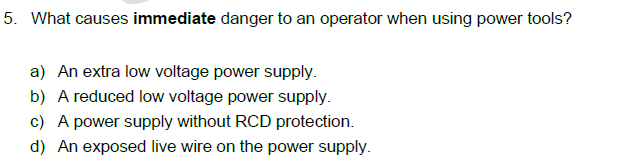
  • That Q5 had me thinking for a long while about all the possible devious parts to such questions (the curse of knowledge problem).

    Could they all be potentially dangerous? Is it multiple choice? Does an ELV supply actually have a 'live'? etc.

    Over-thinking, Under-thinking, and Wrong-direction thinking..

  • Of all the things in that test, rank them in order of how much you would like to touch it, even glancingly.

    If there is a live wire flapping about, my advice is not to touch it. Left alone maybe its not dangerous, as demonstrated by many rat-chewed examples exposed in lofts and cellars for years 

    Far better, when wrapped in 'site applied insulation' it can be made 'fairly' safe . For those who use paper roll and PVC tape for small cuts, the Elastoplast section of the 1st aid kit holds something that may be used as a good temporary insulation.

    For the rest of us there is a proper way to do it that involves replacing, refitting or isolating. 
    M

    PS sometimes I am 'tongue in cheek' , some of this post is. 

  • (c. £350/day + VAT) seem to offer a very comfortable standard of living.

    That's where the difference between cost of business and take-home wages (even before tax) comes into play ... the former having to include all the extras - tools, insurance, running a van, training, membership costs, sick pay, etc etc. It all adds up as they say.

      - Andy.