This discussion has been locked.
You can no longer post new replies to this discussion. If you have a question you can start a new discussion

Mains appliance disclaimer

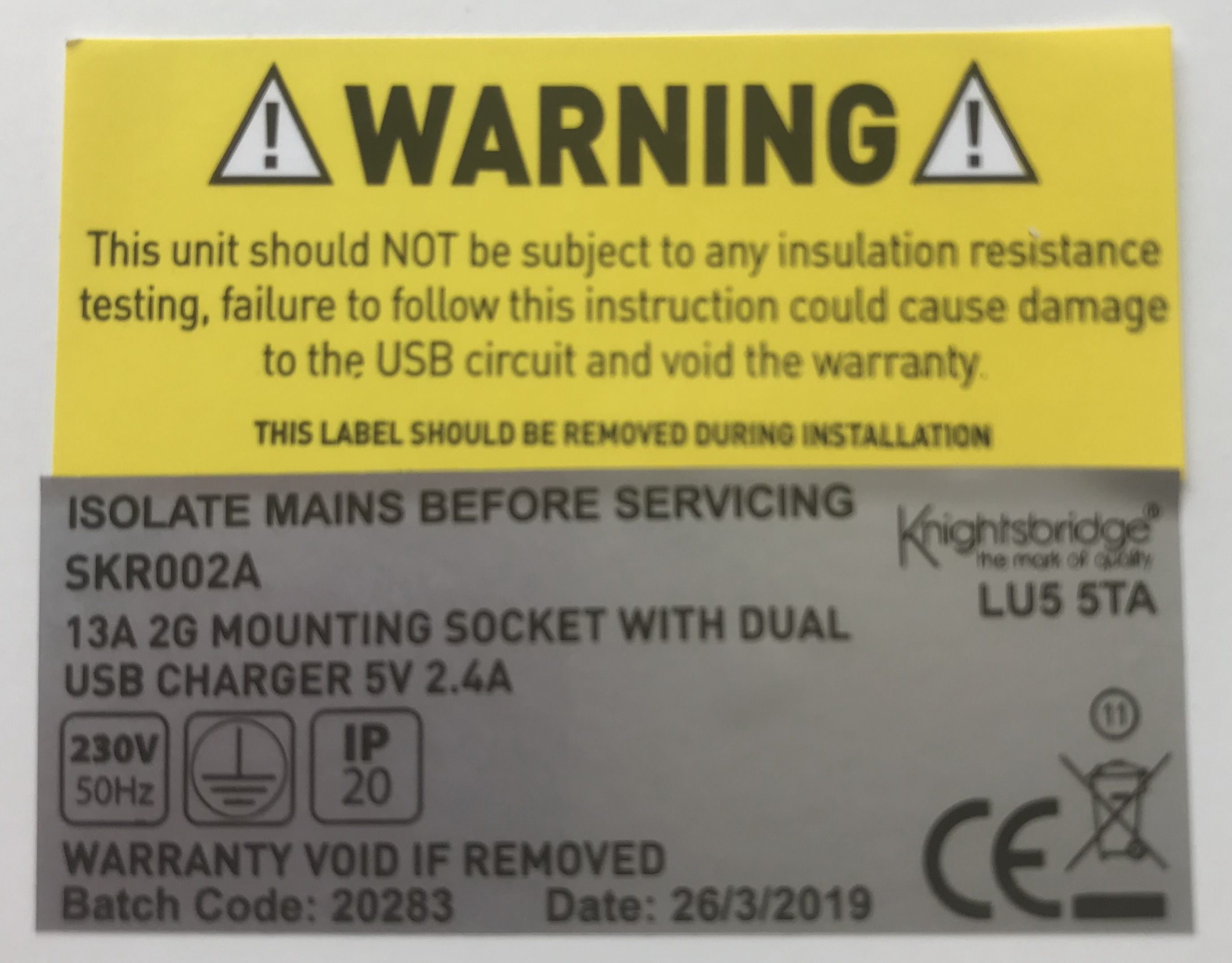
I recently bought a mains appliance, specifically worktop power outlets with USB chargers built in. On the back the label states "This unit should NOT be subject to any insulation resistance testing", and also "THIS LABEL SHOULD BE REMOVED DURING INSTALLATION".


Is this a legitimate constraint for a mains appliance? Shouldn't any device designed for mains power be able to cope with likely power line events?
  • Former Community Member
    0 Former Community Member
    Hi Alex,


    Good question and to be sure of the correct answer I might need to know some additional information however as a general rule it is likely that the initial and ongoing safety of this equipment would fall under the EAWR 1989 (amongst other Legislation) and the most relevant Code of Practice would be the IET In-Service Inspection and Testing of Electrical Equipment.


    Section 15.5 states:

    The insulation resistance test Insulation resistance is normally measured by applying a test voltage of 500 V d.c. and measuring resistance. This test, a so-called ‘hard’ test, may not always be suitable because it may damage IT equipment or other equipment containing electronic components. Therefore, a more appropriate alternative may be one of the following:
    •  the insulation resistance test at a reduced voltage such as 250 V d.c. (see Section 10.2)

    •  the protective conductor/touch current measurement described in Section 15.6 (a so-called ‘soft’ test)

    • the substitute/alternative leakage current test (see Section 10.2).


    I would therefore usually expect to be able to complete an appropriate IR Test at 250V d.c. without causing damage, however if the manufacturer is prohibiting this it would be possible to use one of the other two methods mentioned above.

  • My concern is that whilst an electrician might install this device and be aware of the issue, future electricians performing the tests, and certainly lay householders, will be unaware of this constraint. Does an electrician who is contemplating performing a site test do an exhaustive survey for susceptible devices before they commence? I'd imagined part of the design requirement would be withstand of such voltages without damage.
  • Former Community Member
    0 Former Community Member
    Hi Alex,


    I agree with what you say, most Electricians will make an assessment if there is any sensitive equipment that could be damaged but unfortunately sometimes damage does still occur from a test carried out at an inappropriate voltage.