Marking the end of Radio 4 Long Wave from Droitwich in September 2026

What programme will mark this closedown?

The BBC broadcasts Radio 4 on Long Wave from Droitwich Transmitting Station, which is owned and operated by Arqiva.

Plans for ending Long Wave broadcasts have been announced and postponed. Online sources suggest that a final date has been announced as September 2026.

I cannot find an authoritative source to confirm this.

  1. If you go in person to find a point of contact at Broadcasting House, you will merely get directed to a “WhatsApp” mailbox that is not monitored.

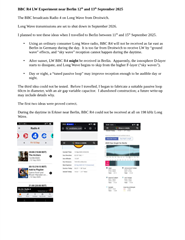
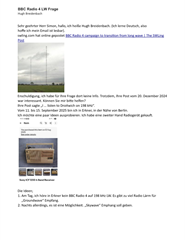
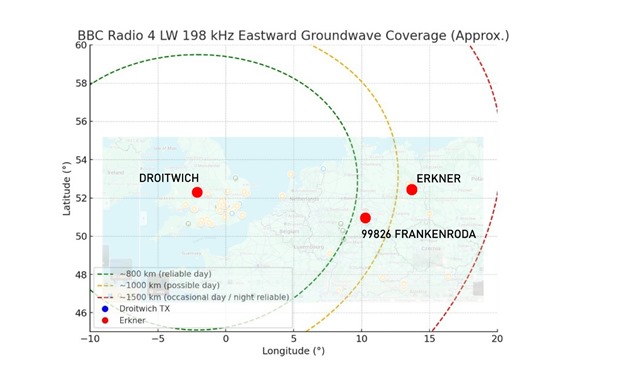
I am a volunteer for the IET Local Network Germany, where R4 LW has been a lifeline to ex-pats. I have also conducted a very basic experiment to measure radio reception in Berlin, with assistance and advice from amateur radio experts. This is detailed in the links below.

Nostalgia aside, BBC Radio 4 Long Wave has served UK business, culture, and defence, from maritime broadcasts to national contingency communication.  A programme to duly commemorate the closedown ought to be in the pipeline.  A number of people would like to contribute to it.

The professional engineering institution most closely linked with the BBC is the IET.  Can anyone recommend a BBC contact please?
PDF

PDF

Parents
  • I spotted this on LinkedIn where a retired RF engineer recorded the last few minutes of the broadcast from Droitwich. www.linkedin.com/.../

  • It is fitting that it should end with the forecast for shipping and inshore waters. At least the closure was marked in a small way. In the 1960s I used to get up very early in the morning, and the shipping forecast was a familiar sound. I learned to recite all the sea areas in the correct order. I can't do that now; several names have been changed. 

  • It is indeed the end of an era. In my schoolboy days, Droitwich was a name you often found on a radio dial, along with other magnificent names like Athlone, Kalundborg, Hilversum, Allouis, Munich, Lahti and Brasov. In those days it was the BBC Light Programme, on 1500 metres, 200 kc/s.
    Saturday afternoon at the barber's shop. The radio was always on, always tuned to the Light Programme, long wave. Nobody seemed bothered by the constant crackles and pops, depending on which electric trimmer was in use. The winter afternoon daylight would fade; the barber switched on another fluorescent light; the crackles increased.
    Then, when I started work, there were those very early mornings and I had to be up a crack of dawn, well before anyone else. I used to catch the opening of the Light Programme, with those lovely orchestral fantasies of Oranges and Lemons.
    Broadcasting arrangements changed. In the late 1960s, the Light Programme became BBC Radio 2. In the 1970s, the wavelengths were rearranged on various occasions, and Droitwich took over Radio 4 programmes. In 1988 the frequency changed from 200 to 198 kHz. (Which is 1515 metres, in case anyone is interested.) This was to conform with international standards; frequencies, which needed to be exact multiples of 9 kHz. (A similar adjustment of medium wave frequencies had taken place ten years previously.)
    I found a personal use for Radio 4 long wave when I was on holiday in northern France in 1997. I brought a small portable radio with me, but there were a couple of occasions where a mains radio was provided in the accommodation. I found one was already tuned to Radio 4 long wave! Not entirely a coincidence, I think.
    Nowadays, the barber's shop, and other types of shop, use their own source of canned music. Somehow I think that live radio was better. If we go abroad we can keep up with the UK using our mobile phones and Internet.
    So here we are. The station has finally closed, after more than one postponement and reductions of power in stages from 500 kW to 250 kW, thence to 150 kW. Switch your radio to the long waveband now, and that powerful signal which used to dominate the middle of the band is no longer there. In fact you will be doing well if you pick up anything at all.

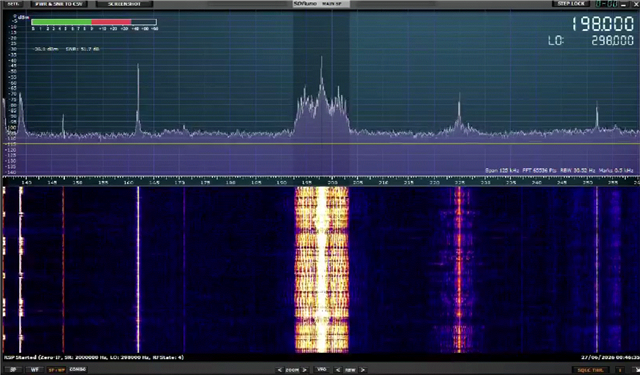
    We should be grateful to Simon Gauntlett for spotting on LinkedIn Peter King's recording of the last minutes of Droitwich, and particularly grateful to Peter King for his interesting video recording of his RF spectrum analyser. We see the 198 kHz carrier frequency, and the sidebands appearing in sympathy with the sound modulation. But let's look at what is happening elsewhere. At 162 Hz we see another carrier with little apparent modulation. This is the French transmitter at Allouis, no longer broadcasting sound radio but still in use for time signals. The bottom official frequency of the LW band is 153 kHz, which was the Romanian transmitter at Brasov, but it appears that this has now closed down. We see further carriers at even lower frequencies. I can only guess that these are for time signals or tele-switch control or that sort of thing, in various countries. Towards the top of the band we see a definite broadcasting signal at 225 kHz, from Poland, and further up, 252 kHz.
    Aha, 252 kHz! That is almost a short story in itself. Many of us will remember it opening in 1989 as Atlantic, an Irish station of easy-listening music. It seemed a novel idea at the time but lost popularity. After it closed, RTÉ took over the transmitter for a while. Now, according to my information, it is used by an Algerian service. Well done, Peter King, for picking it up from that distance with your impressive antennae.
    Those huge masts are an impressive sight, clearly visible from the M5, A38 and railway. I presume that they will be demolished in due course. I shall miss them. Goodbye, Droitwich Long Wave!

Reply
  • It is indeed the end of an era. In my schoolboy days, Droitwich was a name you often found on a radio dial, along with other magnificent names like Athlone, Kalundborg, Hilversum, Allouis, Munich, Lahti and Brasov. In those days it was the BBC Light Programme, on 1500 metres, 200 kc/s.
    Saturday afternoon at the barber's shop. The radio was always on, always tuned to the Light Programme, long wave. Nobody seemed bothered by the constant crackles and pops, depending on which electric trimmer was in use. The winter afternoon daylight would fade; the barber switched on another fluorescent light; the crackles increased.
    Then, when I started work, there were those very early mornings and I had to be up a crack of dawn, well before anyone else. I used to catch the opening of the Light Programme, with those lovely orchestral fantasies of Oranges and Lemons.
    Broadcasting arrangements changed. In the late 1960s, the Light Programme became BBC Radio 2. In the 1970s, the wavelengths were rearranged on various occasions, and Droitwich took over Radio 4 programmes. In 1988 the frequency changed from 200 to 198 kHz. (Which is 1515 metres, in case anyone is interested.) This was to conform with international standards; frequencies, which needed to be exact multiples of 9 kHz. (A similar adjustment of medium wave frequencies had taken place ten years previously.)
    I found a personal use for Radio 4 long wave when I was on holiday in northern France in 1997. I brought a small portable radio with me, but there were a couple of occasions where a mains radio was provided in the accommodation. I found one was already tuned to Radio 4 long wave! Not entirely a coincidence, I think.
    Nowadays, the barber's shop, and other types of shop, use their own source of canned music. Somehow I think that live radio was better. If we go abroad we can keep up with the UK using our mobile phones and Internet.
    So here we are. The station has finally closed, after more than one postponement and reductions of power in stages from 500 kW to 250 kW, thence to 150 kW. Switch your radio to the long waveband now, and that powerful signal which used to dominate the middle of the band is no longer there. In fact you will be doing well if you pick up anything at all.

    We should be grateful to Simon Gauntlett for spotting on LinkedIn Peter King's recording of the last minutes of Droitwich, and particularly grateful to Peter King for his interesting video recording of his RF spectrum analyser. We see the 198 kHz carrier frequency, and the sidebands appearing in sympathy with the sound modulation. But let's look at what is happening elsewhere. At 162 Hz we see another carrier with little apparent modulation. This is the French transmitter at Allouis, no longer broadcasting sound radio but still in use for time signals. The bottom official frequency of the LW band is 153 kHz, which was the Romanian transmitter at Brasov, but it appears that this has now closed down. We see further carriers at even lower frequencies. I can only guess that these are for time signals or tele-switch control or that sort of thing, in various countries. Towards the top of the band we see a definite broadcasting signal at 225 kHz, from Poland, and further up, 252 kHz.
    Aha, 252 kHz! That is almost a short story in itself. Many of us will remember it opening in 1989 as Atlantic, an Irish station of easy-listening music. It seemed a novel idea at the time but lost popularity. After it closed, RTÉ took over the transmitter for a while. Now, according to my information, it is used by an Algerian service. Well done, Peter King, for picking it up from that distance with your impressive antennae.
    Those huge masts are an impressive sight, clearly visible from the M5, A38 and railway. I presume that they will be demolished in due course. I shall miss them. Goodbye, Droitwich Long Wave!

Children
No Data