Why are some broadband routers emitting ultrasound?

I'd recently been cajoled into changing ISP and having FTTP installed. The new ISP quickly sent out their router and I've had chance to test it for ultrasound emissions before having the telephone line replaced with a fibre cable. I did this knowing that I'd been in a house where my tinnitus was being stimulated and found that the broadband router positioned a few feet away, was emitting a sharp 21 kHz signal.

Here's what the ultrasound app I use revealed for the new ISP's router once it had completed its boot up sequence:
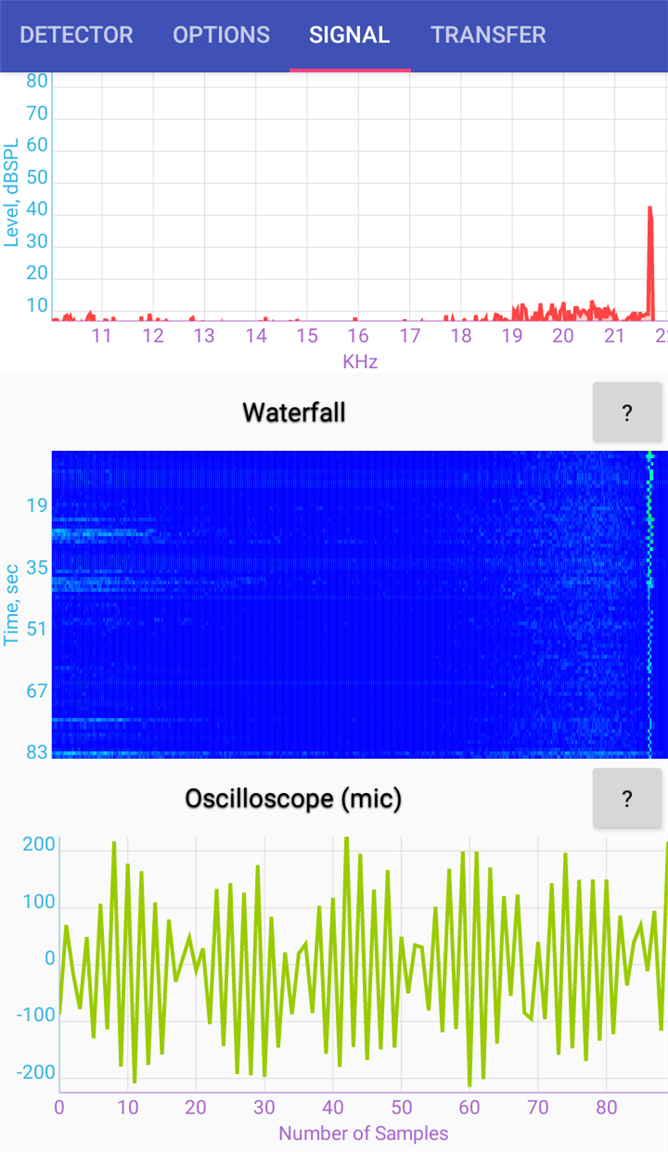
That's over 40 dB at 21.75 kHz, measured around 6 to 8 inches away. The ultrasound was being emitted by the router itself, not the power supply built into the mains plug a couple of feet away. When I'm exposed to ultrasound up to at least 30 kHz, it results in the perception of a high-pitched audible tone at approximately 14 kHz, my tinnitus tone, thanks to suffering from the "ultrasound hearing" phenomenon, as discovered previously. (See the discussion:Reasons why I suffered tinnitus, insomnia, chronic fatigue, and other health problems after having digital electricity meters installed ) (Also, I know the range as my dentist uses a 30 kHz dental descaler, painfully at times.)

Frequencies between 21 and 22 kHz are just over the top of the normal audible range for human hearing, particularly very young children, so for some people they may hear the exact tone. If these emissions are somehow accidental, then it may be possible that some routers emit sound just under 20 kHz. Cats and dogs have much more sensitive hearing than us and would have no problem hearing tones well over 20 kHz as normal sounds, probably very unpleasantly.

If you search online, you will be told that routers do not emit ultrasound, but this is clearly untrue. I've now found 2 out of the 4 I've tested doing so, subject to the microphone's limit of 22 kHz.

There's no purpose, at least not that I know about, for routers to emit ultrasound, so the simple question is; why?

Parents Reply Children
  • The video may be April first inspired with the camera, but there is no doubt that the y5V and to a lesser extend Z7R dielectrics are very micro-phonic ==piezo electric,. Late in the last century I worked on a (very)  cheap car alarm that used the milliVolts induced in a (for the time) high value surface mount ceramic cap on a small tongue of the PCB acting as a vibration sensor. Now between you and me that design was probably one of many that led to tighter  rules on false alarm rates and over sensitivity, but the effect was there and usable. 

    It would be no surprise that discharge banks click, and therefore that an electricity to sound mechanism exists, and further that some designs can set a PCB in motion, depending how thin it is an how it is supported.

    regards Mike

  • Just for interest, this reminds me of an unsafe failure mode we had on a piece of railway signalling equipment that had us scratching our heads for a while. It was a large polycarbonate film capacitor with braided leads, sitting between the rails, and operating at a couple of kHz. The failure was that the capacitor increased in value, which is not normally considered credible. What had happened was that the capacitor had vibrated, which had caused it to act as a pump, pumping water up the braided leads to between the film "plates"! (The equivalent capacitors today have a solid block where the braid passes through the equipment housing to prevent this happening.) Taught me that capacitors definitely vibrate...

  • Thanks Roger,

    Interesting video, possibly we all need a Crysound unit for finding kit that gives off ultrasound, but April Fool? At $899 I won't be taking a punt to find out. If it's real and lives up to its claims, it could be a very useful tool for all sorts of things, not just electrical. If not, maybe it will inspire an acoustics company to make such a thing.

    Shorting out my x10 oscilloscope probe contacts and seeing if it will pick up vibrations might be a free way of veryifing the content of the video - anyone have an opinion on this before I do?

    Obviously the guy who made the video is very much aware that SMPSs produce ultrasound as well as capacitors and inductors. Shame he never mentioned that some people and lots of animals can actually hear these frequencies and it drives them 'up the wall'.

    Regards,

    Andrew