


This step is essential for high-energy arresters used in applications such as HVDC converters, series compensation systems, or long HVAC transmission lines, where total energy absorption can reach tens of megajoules.
In summary, current sharing verification is not a formality—it is a critical requirement that ensures each column contributes equally to energy absorption, prevents local overheating, and ultimately allows the arrester to reach its full design potential.
Reference:
Philipp Raschke, P. (2025). Guidelines for Specification, Selection & Lifetime Management of Multi-Column High-Energy Surge Arresters for HVAC & HVDC Systems. Tridelta Meidensha GmbH, INMR World Congress 2025, Panama City.
Activate to view larger image,
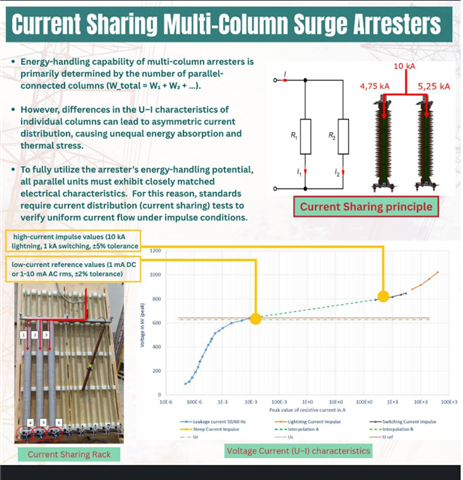
In a multi-column high-energy surge arrester, the total energy-handling capability is theoretically the sum of all parallel-connected columns. However, this is only true if each column shares current equally during an impulse.
In practice, no two metal oxide (MO) columns are perfectly identical. Small differences in their voltage–current (U–I) characteristics—caused by tolerances in manufacturing or assembly—can result in uneven current distribution. Columns with slightly lower electrical resistance will conduct more current, heat up faster, and absorb a disproportionate share of the total energy.
Over time or during a high-energy event, this asymmetry can limit the arrester’s overall thermal capacity and reduce its reliability.
To ensure that the arrester can safely absorb the specified energy, IEC standards require current distribution (or current sharing) verification tests. These tests are designed to confirm that the discharge current divides uniformly among all columns under impulse conditions.
The verification process involves:
- Low-current reference measurements (1 mA DC or 1–10 mA AC rms) with a tolerance of ±2%.
- High-current impulse measurements (typically 10 kA lightning or 1 kA switching impulses) with a tolerance of ±5%.
By verifying both low-current and high-current points, the test ensures that all parallel columns behave consistently across the entire U–I characteristic—covering both leakage and impulse regions.
Advanced testing setups, such as Tridelta Meidensha GmbH’s current sharing racks, allow all columns to be connected simultaneously and their individual branch currents measured under a single impulse. This simultaneous testing provides a true picture of how current divides in real conditions and helps confirm that the arrester will perform symmetrically in service.