Use of Type B MRCDR with no Neutral

We have Type B MRCDR's installed within our MDU/MDA assemblies. The manufacturer/model is Doepke - ELR-3BN+ residual current transformer.

They have been installed on supplies to VFD controlled equipment so we have followed manufacturers guidance.

My question is this.....The VFD equipment does not require a Neutral therefore only the 3 phases pass through the associated residual current transformer. 

We were able to test the device as both a Type AC and a Type A and the device operates, it does not however operate as type B when this is selected on the MFT.

I may be worried about nothing as they are operational.

Please share your thoughts

Parents
  • Focusing upon the actual question asked.

    Here is a conundrum for you.

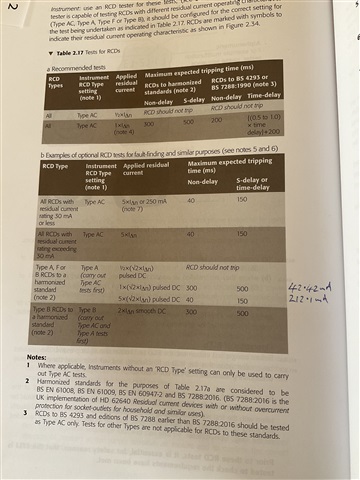
    The IET Guidance Note Three says the test current for a Type B RCD is 2x I delta n  smooth DC.

Reply
  • Focusing upon the actual question asked.

    Here is a conundrum for you.

    The IET Guidance Note Three says the test current for a Type B RCD is 2x I delta n  smooth DC.

Children
  • Beware of the confusion between 'regular operating conditions' and 'forced test conditions'.

    The forced test conditions are typically designed to be easily created in a lab or production test set-up. They, via theory, are as onerous, or worse, than the trip level operating conditions, and are often about some hidden quality control (*). E,g, the magnetic characteristics of the internal ferro-coils.

    I have heard of a manufacturer (another product) who for many years used incremental amounts from some stock 'steel'. Product worked fine. Then they ran-out, and re-ordered some of the steel to the same steel standard, but the product started failing.

    They had not specified (and didn't know) which magnetic characteristics were important to them, and it's not part of the standards for steels. It feels like the type A/AC is like that. Same for the HP and B types. Lots of finger pointing and little clarity.

    The test conditions are 'forcing', rather than representative (of the poorly known) operating conditions for the many and various 'nasty' loads..

    (*) there's a similar test case for regular cables that assumed PVC (IIRC), which didn't match operating conditions (Naval Application/Standard) which meant that a perfectly good cable (better insulation) kept be failed by this test - it took a lot of persuasion to 'clarify' the test, separating Quality Control from Quality Assurance.