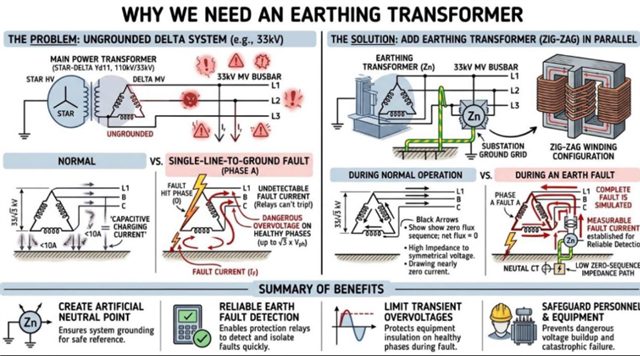
If you've spent time around grid substations or working with Medium Voltage networks, you know that standard Star-Delta power transformers are everywhere. The Delta secondary (like a typical 33kV bus) is excellent for trapping third harmonics, but it creates a massive protection headache: it is completely ungrounded. Without a neutral point, a single-line-to-ground fault has no return electrical path. The fault current remains dangerously low (making it invisible to standard protection relays), while the voltage on the two healthy phases instantly spikes to √3 times normal, stressing equipment insulation to the breaking point. Enter the Earthing (Grounding) Transformer—usually featuring an interconnected star (Zig-Zag) winding configuration. Connected directly to the MV busbars in parallel, it does something incredibly clever to safeguard the grid:  Normal Operation: The opposed windings cancel magnetic fluxes out. It presents a massive impedance to balanced 3-phase voltages, sitting quietly and drawing practically zero load current. During an Earth Fault: It presents a very low zero-sequence impedance. It creates an artificial neutral, giving the fault current a highly conductive path to travel from the earth, straight up the neutral grounding cable, through the Neutral CT, and back into the system. This closed loop finally generates a measurable fault current. This allows our 51N earth fault protection relays to actually "see" the imbalance and immediately trip the circuit breakers before catastrophic damage occurs. I've put together the infographic below to break down exactly how this parallel connection establishes a closed loop and why it's an absolute necessity for substation safety. What has been your experience testing or commissioning earthing transformers and neutral CTs on site? Let's discuss below!