


Have you ever walked past a transformer and noticed that steady humming sound?
Whether it's a distribution transformer mounted on a pole or a large transformer in a substation, that familiar "hummmm" is almost always present.
Many people assume it's a sign that something is wrong.
Surprisingly, that hum is usually a sign that the transformer is working exactly as designed.
So, where does the sound come from?
The answer lies in a phenomenon known as magnetostriction.
When alternating current (AC) flows through a transformer's windings, it creates a continuously changing magnetic field inside the transformer core.
As the magnetic field changes, the steel core expands and contracts by a tiny amount, far too small to see with the naked eye.
However, this process occurs many times every second, causing the core and surrounding components to vibrate slightly.
Those vibrations create the humming sound we hear.
What Can Affect the Hum?
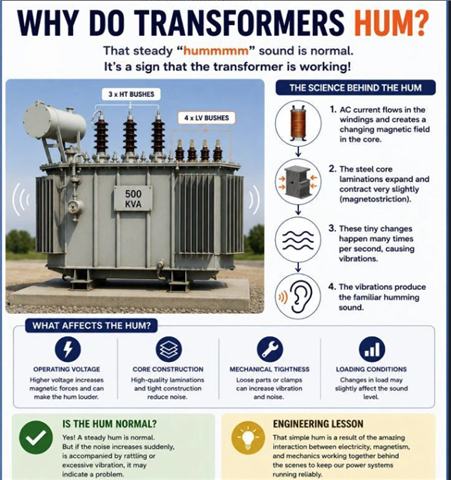
 Operating Voltage
Higher voltage levels can increase magnetic forces within the core, making the hum more noticeable. Core Construction
Well-designed transformer cores with high-quality laminations help reduce vibration and noise. Mechanical Tightness
Loose bolts, clamps, or internal components can amplify the humming sound. Loading Conditions
Changes in load may slightly affect the sound level, although the hum is primarily related to the magnetic field.
Is the Hum Always Normal?
In most cases, yes.
A steady and consistent hum is a normal part of transformer operation.
However, a sudden increase in noise, rattling sounds, excessive vibration, or unusual buzzing may indicate a developing problem that requires inspection.
Engineering Lesson
One of the most fascinating things about engineering is that everyday phenomena often have a scientific explanation behind them.
That simple transformer hum is a reminder that electricity, magnetism, and mechanics are constantly working together behind the scenes to keep our power systems running.


