This discussion has been locked.
You can no longer post new replies to this discussion. If you have a question you can start a new discussion

Farm earthing arrangements.

009a7dbbf62372ab469269cf2662d114-huge-20200425_145756.jpg


Some years ago I started doing electrical work at a farm, originally the farm buildings and house were both connected to the DNO earth terminal.


I altered it so that the farm buildings are TT , but left the house connected to the DNO earth terminal. The possible issues are that there is a steel clad switch fuse enclosure for the house inside a wooden cupboard in the farm workshop and the SWA cable for the house passes through the ground immediately adjacent to the farm building. But there was no physical connection between the house and farm earthing arrangements.


It had been like that for a few years as the house has not had any alterations at all, just a few repairs. So the house installation is effectively exactly the same as it was when the house and the farm buildings were thirty years ago and connected up as a new installation by the DNO.


However (you knew there was going to be a however!) a couple of years ago PV panels were installed on the farm building roof and the installers used the DNO and house earth terminal rather than the farm buildings earth terminal, despite the PV system being in and on the farm buildings and it having storage batteries that feed back into the both installations as they share a meter; and the storage batteries act as a supply to emergency lighting in the farm buildings when the installation is off-grid.


I am now reviewing the earth arrangements, the house is empty and needs tidying up, thirty two lights need replacing and odd repairs, there won't be any alterations it is just replacing fittings and replacing MCBs in the split load consumer unit with RCBOs to give additional RCD protection in the house. 


I will leave it at that and not express my thoughts, as it will be more interesting to see what your thoughts are rather than trying to get you to consider mine.


Comments please. 


Andy B
  • I am really late on this but anyway, will cast a stone in the ocean just in case it helps anyone out.


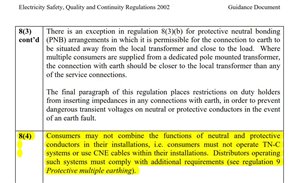
    As per the ESQC Regulations, a consumer is not permitted to combine the functions of neutral and PE within their installation- the DNOs however can and it is a different story.
    5973a99f178272af864f7aa655c799a2-original-capture.jpg
  • PME is not banned, but the supplementary bonding requirements are too onerous, I would be there running bonding all over the place, then there is the steel shipping container used for secure storage to consider in addition to the various requirements for the eight buildings.


    Andy B.
  •   


    There’s no distinction to be made.


    Well if there are animals there are different risks as compared with just an arable farm. That is why I asked. A four footed animal is more likely to be shocked, and the loss will be greater, than a sack of potatoes being shocked in a farm building. Is farm TT earthing just a traditional thing or a risk reducing solution. Does B.S. 7671 prohibit a TN-C-S supply on a farm?


    Z.


  • A farm with animals, does BS7671 differentiate between livestock and arable farms? How many animals are grown on horticultural premises?  


    There’s no distinction to be made.


    Andy B


  • He has declared it as a TN-C-s PME system, so any ideas of reconnecting the farm buildings to the DNO earth terminal have been blown away and I need to disconnect the PV installation earth conductor from the DNO earth and drop it into the farm buildings TT MET after I have checked the PV consumer unit out.


    Why is that then? Is it a farm with animals or just an arable farm? I did ask before but got no answer.


    Z.


  • A WPD engineer phoned this morning and said they don't have records for this property, so he drove there this afternoon to check it out.


    He has declared it as a TN-C-s PME system, so any ideas of reconnecting the farm buildings to the DNO earth terminal have been blown away and I need to disconnect the PV installation earth conductor from the DNO earth and drop it into the farm buildings TT MET after I have checked the PV consumer unit out.


    There wasn't an opinion offered on what to do with the house one way or the other. 


    Having declared TN-S was maybe a bit of a long shot, but would have made life easier, but the fix isn't too complicated.


    Andy Betteridge
  • Sorry but I'm completely confused now  this all seems overly complicated am I right in thinking that if the neutral between the intake and the transformer breaks then the whole lot will go off but if the earth come off of its rod at the house then things will continue to work and be protected because of the link at the head also the barn supply will be ok because it's still connected properly. Most of the houses in my area are earthed via the metal cable sheath but at 2 property's rewired a few years back there is a neutral earth bond  which is connected to the MET and also to a metallic water pipe is this what the farms got?
  • And that is the nub of the problem I think - when is TN-S not TN-S ?

    In terms of the broken PEN risk, and all the attendant  'not suitable for livestock, caravans, building sites, cars, or anything else that worries regulation writers  of a nervous disposition '  , the answer is very simple, when there is a multiplicity of NE links, instead of just one.

    Sadly in terms of sensible definition, this is not always the one used, so we find we can have.

    PNB -TNC-s or

    PNB TN-S


    To me in terms of the true risk, this sounds more like TNS and until another property is added to the transformer with an NE link at the cut out, it will remain immune to the rise of earth potential risk associated with PEN failures.


    You can have add many and various buried electrodes to TN-S of course, so long as you do so to the CPC, and not to the neutral.

  • On the subject of PNB, it seems there are a number of variants.


    In the simple case - one transformer feeding one consumer with the electrode connected on the earth side of the N-PE link at the consumer's cut-out it is a nice simple TN-S system.


    There do seem to be other possibilities however. Engineering Recommendarion G12 (which is what think most DNO's policies are based on) seems to suggest that up to 4 consumers may be permitted to share the same transformer - but as there is still only one point where the N is deliberately earthed - there can't be an electrode at every one of the consumer's cutouts - but must presumably be at some common point upstream. There's no suggestion that there needs to be separate N and PE conductors downstream of the point the N is Earthed, so there would be a CNE or PEN between that point and individual consumers which then have both their N and PE connected to the supply CNE. This would seem to be TN-C-S (but not PME as there's no multiple earthing). Some DNOs seem to limit PNB to a single consumer - but not all it seems.


    Even when there is a single consumer there is also the possibility of the N earthing point being upstream of the consumer's cutout where the N-PE link is - which again would be TN-C-S rather than TN-S.


    WPD's document https://www.westernpower.co.uk/downloads/3293 seems to give a pretty comprehensive overview (especially appendix B) and seems to sum things up nicely with "Depending upon whether the earth connection to the customer is taken from the transformer neutral earth or from the neutral direct this can be viewed as either TN-S or TN-C-S.".


       - Andy.
  • There  is no reason why you cannot put as many rods at various places if you like on a TT installation. The only requirement is that the total Ze from the CPC meets the 50V criterion for the RCD. In general several spaced rods and some structural steel will reduce the Ze significantly which is what you want. There is no sense whatever in making the various TT sections separate from the others CPC, in fact this is often difficult anyway. Have you contacted the DNO yet?