This discussion has been locked.
You can no longer post new replies to this discussion. If you have a question you can start a new discussion

TT Earthing Systems - Interest by New Zealand

Former Community Member
I am the chair of a Standards NZ committee charged with the production of a technical report to the NZ regulator regarding the possible use of the TT earthing system in NZ.   Currently, NZ uses the MEN earthing system (as does Australia), being similar to the PME earthing system used in the UK but with an earth electrode being required in each electrical installation to assist in keeping the voltage to earth of the neutral conductor of the LV reticulation close to zero.   Otherwise the MEN system is TN-C-S and relies on the PEN conductor as a return path to clear earth faults by the operation of OCPDs.   The use of RCDs is now required for most sub-circuits to provide additional shock protection.  


As is well known, TN systems are not perfect and a broken or high impedance PEN conductor causes the livening of earthed and bonded surfaces, including the chassis of EVs when they are plugged in to EV charging equipment.   It is noted that the IET Wiring Rules do not permit the use of PME systems to supply EV charging equipment unless the voltage on earthed surfaces is held to a non-lethal value.  


Without going into further detail, the committee, in preparing a report, remains concerned about and seeks information on two possible problems.   


The first is how to attain at reasonable cost a TT earthing electrode system that does not exceed 100 ohms to earth in many NZ locations where the soil resistivity and the seasonal variation of this is high.   Does it cost a fortune to do this in the UK?    We have difficulty at many sites in reducing substation earthing mat and rod systems to less than 10 ohms and sometimes that is not achievable.


The second is how to be reasonably sure that the RCDs in any TT installation will be regularly tested every six months or so by the users of the installation?  RCDs are not perfect but are much more important safety devices when used in a TT installation than in a TN installation.   Therefore regular testing appears to be important to maintain safety.    With non-domestic installations this should not be a problem as their regular testing (by pushbutton) can be linked to annual building inspections or included in maintenance schedules.  However, how does the UK ensure - if it does - that the occupants of domestic TT installations regularly check the operation of their RCDs?   One sensible suggestion made by a committee member was that the regular RCD checking could be linked to the six-monthly call by our Fire and Emergency Service to check the batteries in fire alarms installed in houses.   That might prompt a few people to check their RCDs.    


Since I was intending to ask about the practicability of 100 ohm earth electrode systems in the UK, I thought that I should also enquire about the regular testing of RCDs in domestic installations.  


I should be grateful for any comments or suggestions.


P M R Browne BE(Elect) FIET FENZ

  • For rods, I should have thought that a spacing of over 1.2 x rod length should be applicable to obtain more benefit from the additional rods.

    Can depend on the history of the site - the 2nd rod might be intended for a replacement for the first - perhaps being longer (often one deep rod works better and more reliably than the same total length in many shallower rods) - but then the original rod was left connected as it does no harm and might even help a little.


    As for testing there's often no need to have two (or more) separate electrode systems - at least for typical domestic/commercial where the installation can be disconnected for testing - most often an ordinary L-PE loop test is done (using an instrument with a suitable range) - isolate the installation, disconnect the electrode from the earth bar and test between supply L and the loose end of the conductor to the electrode. Admittedly that gives a whole loop impedance rather than just the resistance of the consumer's electrode - so includes the supply/MEN electrodes (and the L supply conductors) but these are usually small compared to Ra - and errs on the side of safety anyway, so if Zs is low enough to meet Ra requirement that can be no doubt that Ra will be fine.


    Separate electrode systems can be useful if you need to keep the installation live at all times - so each part can be tested independently (perhaps even without disconnection if you use one of the new fangled clamp-on earth testers) - but you'd really need each rod (or group of rods) to be fully independent of each other for the tests to be valid - which might mean tens of metres apart.


        - Andy.
  • The advice is indeed to place electrodes 1 to 2 electrode lengths apart, but this is only advice, and sometimes the choice of location is cramped, or maybe the installer is in a hurry and having a bad day - if the reading is low enough it may not really matter.

    There is a general recommendation that all fixed wiring is re-inspected at an interval initially specified by the original installer, though that interval is then often varied by the most recent inspection. Typically that may be re-inspect after five years or ten, with shorter times for sites with a lot of exposed wiring outdoors (catenary supplies to outbuildings etc) and TT supplies with earth rods, or other site specific factors that increase the risk of deterioration or damage - being near the sea greatly increases the risk of salt water induced corrosion for example. The regulations do not make a distinction between a visual inspection example forms and a full 'instruments out' job example form, even though NICIEC (a large trade body) do, but clearly if the intention is to only walk around look for damage to cables or enclosures or evidence of damp or corrosion, then this is a less onerous task. An 'full' inspection may sample a small fraction of equipment on the site, or require  total dismantling, rather depending how it looks, and previous reports being available.


    At the cheaper end of the market, especially domestic, like the RCD tests, the advice on regular inspection is routinely stretched or just ignored, in preference to calling someone out only after there is a problem, but more up-market customers and businesses with valuable livestock to lose etc,  take it very seriously indeed, not least because their insurance company tells them to do so.Again , at the lower end of the market some of the cheaper (so called 'drive by' ) inspections (not looking in lofts, not verifying insulation resistance, not looking at Zs etc) are of little benefit except perhaps as a liability transfer exercise, as it is all so fast that very little is actually inspected.
  • Former Community Member
    0 Former Community Member
    Andy, thank you for your additional comments on TT earth electrode systems and the photos which are interesting.   


    Our report to the NZ regulator is just about to be submitted.   This is with a view to further work on a couple more work-streams that will be necessary being commissioned to be carried out in the new financial year commencing on 1 July.    One will be to look at the necessary changes in our regulations and in AS/NZS 3000 to permit the use of TT earthing systems and TT installations and another to identify installations where TT will present a lower level of safety risk than MEN.   


    However, your note on TT earths is interesting as I would expect a much greater physical separation of electrodes than your photo indicates.   For rods, I should have thought that a spacing of over 1.2 x rod length should be applicable to obtain more benefit from the additional rods.   


    On another point, are you able to advise if the UK requires the periodic re-inspection and retesting of TT earth electrode systems?    We have suggested constructing the earthing system in two separate parts and bringing both back to the earth bar with separate main earthing conductors for testing purposes but we are not sure if the systems should be revisited every 5 or 10 years to ensure that they remain operational and effective.   Maybe a bit like the "regular" testing of RCDs! 


    Regards


    Peter Browne


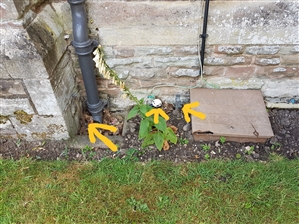
  • Three earth rods at a local church probably installed over the last sixty years or so. 


    The standard of installation has not varied much over that time. 


    There is one thing that begs a question. 
    df5aa6e35af92e0be36db261bcc32f74-original-20200623_222952.jpg
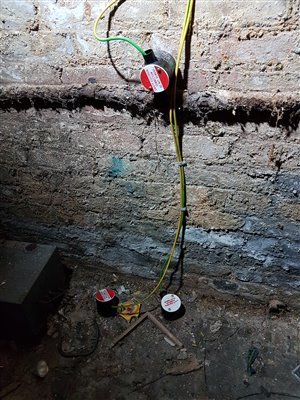
  • af4084ed11465c3a9dd47bbc5bf4f5ec-original-20200623_094636.jpg


    Three rods in a cellar,  two into the floor and one out into the front garden,  I measured 224 ohms combined with a loop test.


    I guess they they are all four foot rods and the one with the white box lid was supplemented by the two with the red and white lids.


    As you can see TT earthing in UK homes is not over engineered.


    Andy B.
  • Former Community Member
    0 Former Community Member
    It is indeed a concern when politicians get into the act for "social" reasons and apply "solutions" that are completely against the economics of the generation, transmission and distribution of electricity to consumers.  The ESI has a large proportion of fixed costs, which ideally should be recovered by a fixed daily charge that is as high as the market will bear (without consumers disconnecting from the grid in droves and forcing the remainder of consumers to bear the costs).   However, in NZ, consumers have the option of paying a low daily charge and a higher / kWh charge, with a break-even point of 8000 kWh.  You have a choice of one or the other.   Those with their own generation like the low fixed charge option it as their generation is effectively valued at the higher avoidance cost - but of course they are not contributing.adequately to the infrastructure costs that provides their make-up energy import.   The ESI is hoping that the Government will remove the lower fixed charge option but there is resistance from the distributed generation owners.  


    Don't get me started on capacity and peak charges v energy charges, which remain a bone of contention.   At least,many distribution companies are now offering time of use charges, which is at least a recognition that network capacity is expensive to provide and it is correct to signal to consumers that they should avoid increasing the peak demands placed on the network and so delay the need for its reinforcement.


    By the way, NZ is a long narrow land in the antipodes of Spain and its climate runs from the "winterless north" to the deep south.   We do use space heaters!   Dunedin had -10 degrees C the other day!   


    At least we have a lot of renewable generation.    


    I'm getting well off the subject of TT.!


    Regards


    Peter Browne.      

  • It should be remembered that Sark is highly exceptional.

    It is an island with a small local population (about 600) - to put that  into scale that is less  than the number attending  most secondary schools in England (about 1200). Total consumption is ~  1MVA , and there are two 600kVA transformers to step up from the 230V generators to drive the 6.6kV HV distribution to local transformers in the community. 

    1MVA is the size of transformer normally found in the basement of a large block of flats, and the total capacity is not much more than the size of genset normally seen in a container in a field at a pop festival.


    In the absence of a 10km extension lead to plug it into it's nearest neighbour (Guernsey), itself connected to the French HV grid via Jersey, all generation is local and from diesel fuel - with corresponding costs dependant on the world oil price.


    But I agree, the politics is very silly- a fixed standing charge and 'all you can eat' may be a better way to go to get an income to maintain the system..
  • If you want to see how everything can go wrong with operating an electric generation and distribution company when politicians get involved you need to have a look at the recent history of the Sark Electric company on the UK Channel Islands.


    If too many consumers disconnect and go off grid the financial burden increases significantly on those who are left. It would probably make more sense to have a higher standing charge and virtually unlimited usage in a country where people don’t need space heaters.

    https://www.itv.com/news/channel/2019-12-05/hotel-in-sark-is-to-produce-its-own-electricity-after-price-rise/
  • Former Community Member
    0 Former Community Member
    Andy and Mike, thank you for your informative comments,   We do have in NZ what we term distributed generation where installations with PV are not only able to supply their own appliances at light load periods but are to feed back into the local reticulation and be paid for the electrical energy exported.  I'm sure the electricity retailers like this as they just sell the export at a considerable profit to the neighbouring installations rather than have to import it from a much more remote transmission grid export point.  The distribution network companies are less thrilled since they have to keep an eye on the voltage of the reticulation when injection to it occurs- I believe that this is a problem in sunny Australia where many houses have PV panels on their roofs.   


    It's fairly standard to shut down the inverter whenever the grid connection is lost because of the risks of back feed into a fault or livening reticulation or HV that is being worked on. 


    Currently, the distributed generating installations will all be MEN and there may be no strong argument that they should be TT instead, other than the "standard" reasons of remote supply, risk of EPR imposition on the LV, or broken PEN conductors.   


    There are many consumers with their own generation who wish to disconnect from the grid altogether to avoid the daily rate charged by distributors - so the distributors need to avoid being too greedy with their daily rates!     

    I can see that islanded systems would need to have their own earthing system such as a TN-S so there would be no need for a TT system to safeguard against EPR imposed on a PEN conductor or a broken PEN conductor. 


    I can also see that for a "transformerless" converter, as Mike describes, the DC system would need to float free of earth.  I note that BS 7671 requires the use of a Type B RCD on the AC sub-circuit linking the AC busbars to the converter and that appears to be sensible in view of DC current content- one might argue that a RDC-DD plus a Type A or Type F might suffice in its place.   


    Regards


    Peter Browne
  • An interesting situation on which I should welcome UK comment as to which is the safest system, PME or TT, is where a domestic installation has PV panels, a battery for energy storage and a (two way) converter that is run in parallel with the local grid supply or, at times, free of the grid supply and relying on its converter and battery only to supply its AC appliances

    Generally we treat it as two distinct situations - call them grid-tied and islanded if you will.


    In grid-tied setups the inverters will shutdown on loss of mains supply - in in effect they behave like a 'negative load' and don't require anything special at least as far as earthing is concerned.


    Islanded systems will usually be configured as their own little TN-S arrangements so will need an earth electrode and a N-PE link in the same was as a LV supply transformer.


    It is possible to have one system that switches between the two modes - typically when switching into islanded mode all live conductors (L & N) are disconnected from the grid and a N-PE link switched in. Typically the local earth electrode is left connected even in grid-tie mode - being treated as just another extraneous-conductive-part with no particular function but does not harm (or might even be beneficial in your case as a extra MEN electrode). Likewise the supplier's Earth connection is often left connected in islanded mode (for the sake of not having potentially unreliable switching in it) - so remains tied to Earth via the installation's electrode (in the same way bonding to gas or water pipes would) but doesn't form part of normal earth fault loops.


    Graham might even be able to point you to a recent publication that covers this very subject in quite some detail ?


      - Andy.