This discussion has been locked.
You can no longer post new replies to this discussion. If you have a question you can start a new discussion

4mm2 twin and earth cable

Former Community Member
regarding 4mm2 cable was it ever available in the old colours with solid conductors rather than the 7 strands version? Ive just done a pre - inspection of a property before doing an EICR and found 2 radial circuits fed from 32A MCBS. The cables appear to be  larger than 2,5mm2 . I'm going back to inspect this property with a view to reducing the MCB's to 20A if if they are 2.5mm2. I'm also taking  a Vernier  gauge to measure the cable diameters and compare to reference tables.

The installation is approximately 30 years old but is in very good condition.
  • Former Community Member
    0 Former Community Member
    davezawadi (David Stone):

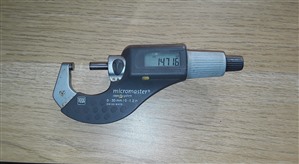
    OK ebee, fair enough to suggest that a vernier is not really accurate enough, but is accuracy the problem, it more likely to be resolution. Here is a picture of a fairly modern digital micrometer, resolution 1 microm (1/1000 mm). Its accuracy is usually +- 2 or 3 microns.

     
    1d9bbe643cd5d58420a2bb86d88fb58b-original-20210225_140857-new.jpg


    Now we need the diameter of the wire, the number of the cores:


    BASEC 4mm LSF  Dia 0.819mm radius 0.4095mm

    BASEC 2.5mm PVC Dia 1.721 radius 0.8605mm

    Earth core of 2.5 dia 1.340mm radius 0.67mm


    Lets work out the cross sectional area. pi r2 sq mm.

    4mm 0.4095 squared times pi times 7 (wires) = 3.687701202 sq mm.

    2.5  0.8605 squared times pi times 1 (wire) = 2.326224482 sq mm.

    1.5 0.067 squared times pi times 1 (wire) = 0.1410260942 sq mm.


    Do you notice anything interesting? It is not that the micrometer is inaccurate, it is that cables are "nominal" sizes and manufactured to a resistance specification. If the copper is purer than the size in sq mm warrants the diameter may be reduced to get to the specification. This is purer copper than the spec, so the sizes are reduced because copper is very expensive yet easily drawn to any needed size. I have deliberately made a mistake with the above numbers, can anyone see what it is? (The measurments are correct).


    Doing the same measurments with a digital caliper high quality, expensive, gives (diameters)


    4.0mm  0.79mm 1 core

    2.5mm  1.70mm

    1.5 mm  1.30mm


    A Powerfix digital caliper from Lidl < £20, sometimes £9.99, but these may be the less good ones:


    4.0mm  0.79mm 1 core

    2.5mm  1.74mm

    1.5 mm  1.29mm


    Not too bad really, but making the measurments depends on also measuring a dead straight part of the cable, or taking multiple readings 90 degrees apart (Real wires are not quite round) and averaging. One should not peasure with the "knife" end of the caliper, but the wide flat part. The knives are thin and varying the pressure will change the reading due to the spring in the copper.


    One should correctly identify each of the above cables, but knowing if they are metric is more difficult. That is why the marking is of use, usually impressed on the sheath. Now the question for Stuart, no offence meant BTW, is the aparent cable diameter more than a guide, and how much does it really matter? I outlined above why it may not talking about the EICR, and unless you accurately know the cable resistance and length (not often for an EICR) it is very difficult to decide if it is really undersized. Careful use of a digital vernier (it takes a lot of skill to work to the resolution of a mechanical vernier one, even if it is absolutely accurate which if not new it it is unlikely to be, wear of 100th of a mm does not take long, we can usually get an idea of a cable size. Oddball ones may also me manufactured too small, which is why the "evidence of overheating" is very important.


     I hope all that was of some interest to all.


    David


    David many thanks for this information its much appreciated. I will take your comments on board.My original post was a bit misleading. At the time all I saw was the cu with the cover off and the cables terminated into the MCBs and noticed that the radials fed from 32A mcbs. Its a MEM Memera unit so I assume the installation will be older than the 30 years my friend told me. 

    again many thanks

    Stuart


  • Ebee

    The spring clutch on the thimble is there to give repeatable "feel" the big grey diameter on the picture above, the little knob is direct drive to make big movements quicker. An 1/1000 resolution micrometer (mechanical) is unlikely to be more accurate than 1 thou, probably less, that digital one measures inches to 1/100,000 of an inch, accuracy still +_ 2 or 3 microns, about 1 10,000th of an inch. You can see why a vernier is less accurate, the "feel" is just controlled by the thumb, not awfully repeatable.
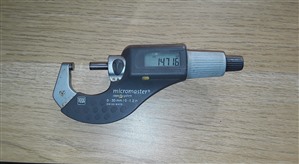
  • OK ebee, fair enough to suggest that a vernier is not really accurate enough, but is accuracy the problem, it more likely to be resolution. Here is a picture of a fairly modern digital micrometer, resolution 1 microm (1/1000 mm). Its accuracy is usually +- 2 or 3 microns.

     
    1d9bbe643cd5d58420a2bb86d88fb58b-original-20210225_140857-new.jpg


    Now we need the diameter of the wire, the number of the cores:


    BASEC 4mm LSF  Dia 0.819mm radius 0.4095mm

    BASEC 2.5mm PVC Dia 1.721 radius 0.8605mm

    Earth core of 2.5 dia 1.340mm radius 0.67mm


    Lets work out the cross sectional area. pi r2 sq mm.

    4mm 0.4095 squared times pi times 7 (wires) = 3.687701202 sq mm.

    2.5  0.8605 squared times pi times 1 (wire) = 2.326224482 sq mm.

    1.5 0.067 squared times pi times 1 (wire) = 0.1410260942 sq mm.


    Do you notice anything interesting? It is not that the micrometer is inaccurate, it is that cables are "nominal" sizes and manufactured to a resistance specification. If the copper is purer than the size in sq mm warrants the diameter may be reduced to get to the specification. This is purer copper than the spec, so the sizes are reduced because copper is very expensive yet easily drawn to any needed size. I have deliberately made a mistake with the above numbers, can anyone see what it is? (The measurments are correct).


    Doing the same measurments with a digital caliper high quality, expensive, gives (diameters)


    4.0mm  0.79mm 1 core

    2.5mm  1.70mm

    1.5 mm  1.30mm


    A Powerfix digital caliper from Lidl < £20, sometimes £9.99, but these may be the less good ones:


    4.0mm  0.79mm 1 core

    2.5mm  1.74mm

    1.5 mm  1.29mm


    Not too bad really, but making the measurments depends on also measuring a dead straight part of the cable, or taking multiple readings 90 degrees apart (Real wires are not quite round) and averaging. One should not peasure with the "knife" end of the caliper, but the wide flat part. The knives are thin and varying the pressure will change the reading due to the spring in the copper.


    One should correctly identify each of the above cables, but knowing if they are metric is more difficult. That is why the marking is of use, usually impressed on the sheath. Now the question for Stuart, no offence meant BTW, is the aparent cable diameter more than a guide, and how much does it really matter? I outlined above why it may not talking about the EICR, and unless you accurately know the cable resistance and length (not often for an EICR) it is very difficult to decide if it is really undersized. Careful use of a digital vernier (it takes a lot of skill to work to the resolution of a mechanical vernier one, even if it is absolutely accurate which if not new it it is unlikely to be, wear of 100th of a mm does not take long, we can usually get an idea of a cable size. Oddball ones may also me manufactured too small, which is why the "evidence of overheating" is very important.


     I hope all that was of some interest to all.


    David

  • As a tool a micrometer is better than a vernier for fine measurements. Both are cheap these days. With a micrometer you need to have a bit a practice not too apply too much pressure. Back in the day I did know an engineer who use a micrometer and always declared that round bars always measure about half a thou smaller than flat plates of the same size. His peers used to measure to 1/10ths of a thou approx and some of them without a one tenth thou vernier scale on their mics. I think they used to say that this bloke had the feel of a baby elephant. That was on steel, copper is a bit softer
  • I've a feeling aluminium tended to be solid to a larger size than copper - it's always possible that the cable could be older than the installation (someone had a reel spare...) - it would be very obvious if it was plain Aluminium, so +1 for it possibly being copper clad aluminium. A look at the cut end of the conductor (perhaps after a stroke of a fine file to remove any oxide first) should confirm or deny.

       - Andy.
  • Former Community Member
    0 Former Community Member
    Davezawadi

    I was asked by a friend to have a quick look at his consumer unit (i had no tools etc with me). I noticed that the 2 radial cables were physically slightly larger in diameter than the 2.5mm2 cable next to it. 

    He asked if they were 4mm2  but I told him that as far as I could remember 4mm2 cable was always 7 core stranded. And I'd never come across 4mm2 solid twin earth cable in my 40 years plus in the industry.

    I did say that the mcbs  might have to be changed and that an EICR should be conducted.- maybe  my post was badly scripted.

    That is why I asked the question regarding the cable was for information only. 

    Regards

    Stuart Ba
  • Normcall:

    Don't forget 7/029 is nearly equal to 3mm


    I think that the concern was with a solid conductor cable Norm.


    Z.


  • And fake cable is still about....

    https://www.voltimum.co.uk/articles/counterfeiting-fighting-fake-and


    Z.
  • Former Community Member
    0 Former Community Member
    Zoom

    again thanks for the information I this is why I was considering changing the mcbs.

    I'll have to retreive my old regs book from the attic!

    me

    thanks SB

  • Don't forget 7/029 is nearly equal to 3mm