This discussion has been locked.
You can no longer post new replies to this discussion. If you have a question you can start a new discussion

Fuse change danger

d753e1ed64a844dd527054313b8c5d0e-huge-d23067ea-3b3f-40ba-9771-d4927b159f95.jpg
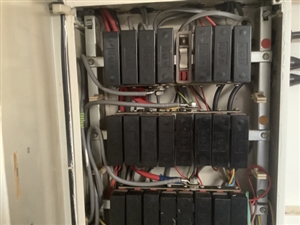
  • The second fuse board pictured is no worse than many others, and not as bad as some.

    Provided that the door could be made secure so as to restrict access, then the risks are not that great. As has been said, where are the bodies"


    I have seen much worse.

    The worst that I recall was a live front fuse board, about 100 years old with no form of enclosure whatsoever, at waist height in an entrance hall. Probably intended for 110 volts DC, and once fitted with a glazed door.

    That was one of the few times that I HAVE pulled the cut out fuse to make safe as children were playing nearby.
  • "Reasonably safe for now" and "I've seen worse"  said by somebody else, will not provide a good defence in law when an employer/duty holder grips the bar. Employers have a duty to themselves, to employees and to visitors. If somebody was injured or killed because of an accident with the touchable live parts of this dangerous distribution board then the full force of the law would fall upon them.  There is no use saying that the door can be secured. It is NOT SEURED NOW, and LIVE parts are touchable. 

    Health and Safety at Work etc Act 1974 – legislation explained (hse.gov.uk)


    "Employer's responsibilities


    Under the law employers are responsible for health and safety management. The following provides a broad outline of how the law applies to employers. Don't forget, employees and the self employed have important responsibilities too.


    It is an employer's duty to protect the health, safety and welfare of their employees and other people who might be affected by their business. Employers must do whatever is reasonably practicable to achieve this.


    This means making sure that workers and others are protected from anything that may cause harm, effectively controlling any risks to injury or health that could arise in the workplace.


    Employers have duties under health and safety law to assess risks in the workplace. Risk assessments should be carried out that address all risks that might cause harm in your workplace.


    Employers must give you information about the risks in your workplace and how you are protected, also instruct and train you on how to deal with the risks."


    Z.


  • Please click and read.

    Top 10 health & safety prosecutions of 2020 (shponline.co.uk)


    Z.
  • And more electrically pertinent...

    Electrical safety (hse.gov.uk)


    Z.
  • It's all very well saying that such a device would only be opened by skilled (or at least supervised) persons, and hopefully after isolation, but if there isn't some form of interlock, the box could be opened live. Then somebody trips. ?
  • Some years ago we had a couple of Saturday night meet-ups at a pub in Chelmsford, one of the forum members who came didn’t have any eyebrows or eye lashes on the second occasion.


    There had been a bit of mickey taking on the forum, but it wasn’t until I saw him that I found out what had happened.


    He was working in an engineering workshop with a dodgy fuse board similar to those in the pictures with exposed busbars and connections in it, so he was being careful as you would, however he knocked off some of the dust that was on top of the enclosure and it fell down into the fuse board.


    As this was an engineering workshop where there was cutting and grinding being carried out most of the dust was actually iron filings, when it fell down into the fuse board it ignited creating a big flash and a bang burning the hair off his face.


    There are times when you think you know what the risks are, but in reality the biggest issue is the thing you have not spotted. 


    I have been told off on on this forum a few times because I have said those most at risk from fuse boards like these are those who think they know enough to work safely around them, those with no skills or knowledge will generally look at something like this and think “that looks dangerous, so I won’t touch it”, working electricians will generally look at something like this and see and know the risks, it’s the engineers who will look at it and go rushing in without taking sufficient care, because they think they have the knowledge, but often lack practical experience.


    Mind you, you can just get caught out by a pile of iron filings lying on top of the board.
  • The biggest risk here is the asbestos behind the fuses especially if replacing a blown fuse wire. Asbestos is a well known killer and every electrician should know the risks and what to do. This needs replacing as it poses a real danger since you can not safely test or replace the fuse wire without the risk of asbestos. Please don’t believe there is no asbestos risk!

    https://www.hse.gov.uk/pubns/guidance/a30.pdf
  • Colin Haggett:

    The biggest risk here is the asbestos behind the fuses especially if replacing a blown fuse wire. Asbestos is a well known killer and every electrician should know the risks and what to do. This needs replacing as it poses a real danger since you can not safely test or replace the fuse wire without the risk of asbestos. Please don’t believe there is no asbestos risk!

    https://www.hse.gov.uk/pubns/guidance/a30.pdf


    Some more reading material..

    http://s.telegraph.co.uk/graphics/projects/Asbestos-the-killer-that-surrounds-us/


    Z.


  • Christopher Booker the journalist did not help matters when he described white asbestos as like talcum powder.

    Christopher Booker And Asbestos | NES Asbestos


    Z.
  • There is asbestos dust in the air and that may be the cause of some mesotheliomas. Intact asbestos, be it in old garages, pipe lagging, or even car exhausts, is not dangerous - you cannot get mesothelioma just from walking past it. It is when it gets broken up that it becomes dangerous, so if you must handle it, do so with great care.