This discussion has been locked.
You can no longer post new replies to this discussion. If you have a question you can start a new discussion

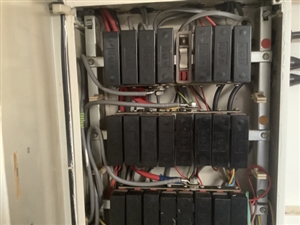
Fuse change danger

d753e1ed64a844dd527054313b8c5d0e-huge-d23067ea-3b3f-40ba-9771-d4927b159f95.jpg
  • This thread reminds me of a few things.


    dis boards like those above are still really common in industry, I follow a facebook group for electrical photos, and many electricians are horrified by them, even when installed well and no covers missing, but they tend to be the domestic and commercial electricians, older ones arent phased at all. When I call an electrician, I always explain if it includes work on a cartridge fuse board


    The asbestos isn't that hazardous unless its disturbed, perversely, mostly when the boards get changed. 


    We had someone point out that grinding dust had settled above some busbars and a manager wanted to get the compressed air on it, and poke it through the screw holes, I pointed out the error of that choice before a Turkish shave was performed. 


    I do think its a bit naughty changing fuses in these, the last board of this sort that I had changed was because someone had changed a fuse and welded it half way in. I was always taught to line it up, stick it in the bottom, look away and push it smartly in. I think attitudes may have changed now, however.
  • I was always taught to line it up, stick it in the bottom, look away and push it smartly in. I think attitudes may have changed now, however.


    To add to that 'safe use of old fuses' advice, from more than one old sweat sparks, (more or less from the era of hot riveting by hand when such attire was common), a flat cap used as a mitten will catch the arc products in the unlikely event of closing onto a fault and liquid fuse wire spraying out of the holder ends.  The difference between a singe mark on the cotton twill and what may become a 3rd degree burn to the ungloved hand is worth the few seconds of precaution.

    It's not really that the older electricians were more careless per-se, or unaware of the risks, just that  you may not recognise their idea of  safe working and  PPE.

    The risk may be higher now is that some one with more modern era education may not realise that the exposed bars are live and may lean on them - like unguarded machines of any kind it is nowadays unfamiliar. I can well remember being told to put one or both hands behind my back, 'like royalty' when looking into any strange/ unfamiliar machine, to reduce the risk of that childish 'I wonder what this bit is for ?' prod and  loss of finger.

    Mike.

  • now you say it, im sure he mentioned a flat cap, we always wear gloves so that's probably why I forgot that part.


    He also taught me to keep one hand behind my back, advice I always take when looking at something with the door open.


    This chap was time served in the steel works in the days of bare catenary lighting, arc furnaces and danger money - I do miss him
  • I remember seeing a DNO faultsman replacing a fuse in a roadside distribution box he di as was said above put the bottom of the fuse in first then banged the other end in quickly  there was a a flash and a bang the fuse had gone again another try and it held . I learnt a new swear word whilst I was there
  • Ah yes - the blowing of the fault to clear by repeated thumping...  Not nice, but recognised in certain circles.

    There are machines that more or less do that for you, and you can use acoustic searching - think some microphones listening for the bang at the fault end..  Knock yourself (or anyone near the faulty end) out .. . 
    Example here
    "Accurate pinpoint fault location is achieved using the “Thunder & Lightning” method whereby the 500 Joule surge generator (thumper) and an acoustic/electromagnetic receiver is used. ."  Yep, look for the flash, listen for the bang!

    Mike

    edited for link funnyness
  • I have seen one of those in operation at work, could feel it through the concrete slab, everyone stand clear! 


    It did not blow the fault clear but it was fun trying!
  • mapj1:

    Ah yes - the blowing of the fault to clear by repeated thumping...  Not nice, but recognised in certain circles.

    There are machines that more or less do that for you, and you can use acoustic searching - think some microphones listening for the bang at the fault end. . . 


    It is actually more scientific than that. If you can get the fault to flash over when you discharge the tester into the cable, at the fault you will have an acoustic pop and a magnetic impulse (from the current flow). The acoustic signal travels at the speed of sound, the magnetic impulse travels more or less at the speed of light. At our location, if we can measure the time difference between the magnetic and acoustic signals arriving, we can calculate the distance we are from the fault to within a cm or two. 


    Regards,


    Alan.