This discussion has been locked.
You can no longer post new replies to this discussion. If you have a question you can start a new discussion

Launch of our new factfile on arc flash risk management

Former Community Member

We published a new factfile on Arc flash risk management.
e44cfbb534ed373d69072e74a6988bf1-huge-arc-flash-risk-management-fact-file---front-cover_page_01.jpg

This factfile seeks to set out the key principles of arc flash risk management using a risk-based approach. It is aimed at persons with responsibility for the management of safety in the control and implementation of work on electrical power equipment. This factfile provides an assessment process and there is also a commentary on recognised standards and test methods for PPE in Appendix 2.

We are interested in your thoughts! Please read our factfile and ask any questions or share your thoughts below.


  • gkenyon: 
     

    I still don't see the point of using units that are different to the clothing data you see on the market at the moment. . .m

    I agree. We are restoring power to an area after the thunder. I am sitting in my van wearing a boiler suit marked 12 cal/cm2. I am also wearing 25 cal/cm2 trousers, and no synthetic materials at all. ?

    Regards,

    Alan. 

  • And that is very good to know your outfit will indeed stand about 20 times the flash intensity that bare skin would (well the  trousers part anyway, more like a protection factor of 10 for the boiler suit), but a consistent set of units makes it easier to see how close you can get to a fireball of a given energy and volume before something bad happens - and also should make the formulations easier to say how close to circuits protected by what fuse size that fireball might actually be.

    I realise that an arc in a box compared to an open one, much like shaped explosive, has some directivity or gain in terms of the irradiance in the main  direction, as the exits in other directions are blocked, but for the safe over-estimate one could assume a simple numerical magnification factor for a few typical geometries. Power arcs are not really my thing, but I have dipped my toes into the worlds both of pulse power and things that detonate, and it seems to me there is much in common. 

    Mike.

    PS late edit. 

    Some numbers to conjour with.

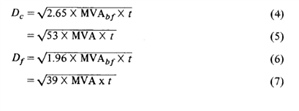
     The distances for an open air arc suggested by the Lee approach are below,  where MVAbf is the ‘bolted fault power’  (PSSC * supply voltage), and t is the ADS breaking time.

    Dc is the distance for bare skin to be heated to a burn that can reasonably be expected to recover. (in feet of all things )

    Df is the distance for bare skin t be heated to temperature that it dies. 

    On a 16kA assumed max PSSC domestic 230v main,  the MVAbf becomes 3.6,  so if we assume a breaking time of perhaps 0.01 second (really we need to work back from the I2t curve of the chosen  fuse to a notional breaking time) we get a Dc of ~ 0.35' or ~100 mm. 

    But if we take a larger slower fuse, so the breaking time is longer, then suddenly it all goes ‘Pete Tong’ , and the safe distance goes up by a touch over 3 for every order of magnitude increase in arc power, so a 0.1 second break time the recoverable burn range is more like 300mm, and a 1 second break time is more like a metre. At this point we should wonder about those 5 second trip times…

    An arc in a box may be worse in the direction of firing if the box forms a hall of mirrors as far as the arc is concerned and reflects the energy towards the unlucky victim. I suggest it could be equivalent to an arc energy of  3 times higher if you are in just the wrong place.

    66f3eeb1732492787b70276736b2c49e-original-lee_arc-figures.png
    Df, Dc in feet, t is ADS time bf - bolted fault..
  • This reminds me of a story which I may have mentioned before.

    Modern practice in RN is for the individual's designation - CO, WEO, etc. - to be written on the flap of a breast pocket of the white action coveralls. That gives two extra layers of protection where the black ink will absorb more flash energy.

    In the Falklands War, the practice was to write it on the anti-flash hoods with the result that where there were flashes, the foreheads of those concerned were branded.