This discussion has been locked.
You can no longer post new replies to this discussion. If you have a question you can start a new discussion

Fixing a small motor

I want to fix an ancient 1/8 hp motor (Carter Electrical Co Ltd). As far as I can tell, the centrifugal switch has worn out, so that will be fun making a new one.

My question is what resistance seems reasonable for the coils. IR is good (well into the tens of megaohms) but they are a little dark and I would like to be confident that there has been no internal shorting.

The main coil is about 18 ohms and the starting coil 33 ohms. My maths tells me that the running current should be around 0.4 A. I cannot remember a lot about motors, but I realise that the impedance of the coils will be higher at 50 Hz than the (DC) resistance and that back EMF reduces the current. I hope therefore that the resistance values are about right.

Grateful for any reassurance!

  • 1/8th hp? If we say that 1 hp is roughly 750w, then 750 divided by 8 gives something in the region of 90-odd watts, so work current back from that and see what your winding resistance readings say, or, is there a rating plate stating full load current etc still on the motor?

    Very rule of thumb I know, but to me your resistance readings don't asound far off in terms of future serviceability.

  • Run it up in series with a light bulb or other resistive load to serve as a current limit and visual fault indicator, and measure voltage and current across the windings. You can then deduce the XL. By pass the start switch for this, so it turns and never pulls out of start but do not keep it powered up for more than a few seconds. 

    Or to run it longer put the start switch to a real switch, like a spare light switch from the junk box to test it, and use your judgement as to when it starts spinning, flick the switch & disconnect the starter winding. Again, do not do this too often, allow time to cool between starts.

    Oh and clamp it down to the bench firmly.


    Mike

  • Mike, thank you, but perhaps I didn't make myself clear. The motor and its centrifugal switch are in pieces on my bench and the wear is evident. I was just concerned that the effort of making a new switch (or part thereof) would be wasted if the coils are damaged.

  • Hi Chris

    The coils are probably fine. The varnish used in older items is often very dark, but you can tell if overheated as it tends to flake off easily if burnt, and it smells pretty bad. Most of the current is controlled by the winding inductance, not the resistance, so those figures sound fine. The start winding is probably thinner wire as it does not operate very long, and so will not overheat. I presume the start capacitor is OK, this along with the start winding inductance phase shifts the winding current to be as close to 90 degrees as possible, allowing the first bit of rotation which then continues although only the run winding has current. These motors have fairly poor response to excessive torque, is it a suds pump or similar?

    Regards

    David

  • OK, what you are concerned about then is not the winding resistance, that only sets in-rush, nor the exact value of static inductance too much, that has more to do with the presence or absence of the rotor and the air gaps in the iron work, but the Q - this is the parameter that takes a dive in the event of a single shorted turn, but is also the hardest thing to detect if the motor is not turning. (only once the motor is more or less up to speed and generating do you know if the current draw is meaningful).

    One  can measure Q (essentially ‘ringing’ the coils, either with a pulse and looking at the after shocks, or with  steady AC at the resonant frequency) but it is ‘involved’, even for an electronics lab, and you would be easier with a good one to just compare resistances to, which is probably where you came in.

    If there is good reason to suspect the windings, then I might be  tempted to put it together without the centrifugal bits and just spin it up.

    Mike.

  • Looking further, I note that the modern carter company     only makes AC DC brushed and  traditional DC motors. - I'm assuming you have a capacitor-less induction design (where the starter coil phase shift is done by magnetic shunt or shorted turn - rather like the old fan heater motors and record deck motors with one winding and a shorting link to distort the magnetic flux.) ? If not some of what i said is not relevant.

    Mike.

  • Gentlemen, thank you - I am reassured.

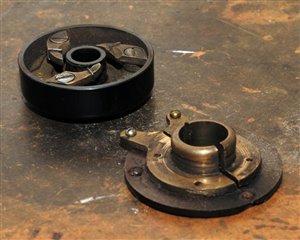
    Here are the two parts of the switch. The depth of field is poor, but I think that you can see the wear on the fixed side of the switch. The range of travel of the 3 pawls (or at least one of them) is limited and I think that it no longer makes contact adequately.

    The switch connects (and disconnects) the starting coil. No capacitor.

    The motor powers a Tiplap lathe tool grinder - Google it to find out more.

    ee467a937d54d90cc3d3015cee3d87c7-original-20210809switch.jpg
  • Looks as if you could file a touch off the back of the weighted pawl to allow it to swing in a bit further and with a bit of brasso and old sock rubbing perhaps  get another 50 years out of it (!)

    Maybe some wet and dry to take out the grooving.. It may not have been pulling clear at full speed as it should. A lamp on the starter winding will tell you that.

    Some designs have pinhole to allow a wire, or thread  or similar to hold the sprung pawls out of the way until it is assembled, and then this has to be withdrawn and they click into contact position. Cannot see that in the pic here, but if assembly seems impossible that is a clue to to look for.

    Of course for each start it only gets about five seconds of rubbing before pulling clear so the starter contacts and winding are not heavily worked electrically speaking.

    M.

  • mapj1: 
    Looks as if you could file a touch off the back of the weighted pawl to allow it to swing in a bit further and with a bit of brasso and old sock rubbing perhaps  get another 50 years out of it (!)

    There'd be no fun in that and I am under doctor's orders to take it easy this week.

    The curved lip to the fixed contact allows the pawls to slip over it.

    What is bizarre is that there seems to be no way of disassembling the motor without damaging the paxolin plate because the force required to pull off the tail bearing is greater than it can withstand. By contrast assembly will be no problem - the bearing will be fitted to the case, the switch will go over that, and then the armature may be fitted.

    Better get it right first time!

  • seems odd. Is the bearing a bronze bush knock-on or a ball or roller race ? sometimes things would be put on warm. I have used offcuts of glass fibre PCB material with the copper all etched to clear on both sides as a paxolin/tufnol substitute in cases needing a bit more strength.  While it is a bit odd the online PCB places are quite happy to do PCB cut outs in funny shapes without any copper.just needs to be drawn as a gerber outline.

    Mike.