This discussion has been locked.
You can no longer post new replies to this discussion. If you have a question you can start a new discussion

DC light switches ?

Can anyone suggest a supplier of domestic light switches suitable for 250 volts DIRECT CURRENT.

I asked this in the old forum, and IIRC a respected member suggested a supplier of “heritage looking” switches but these were in fact still AC only.

Have previously obtained NOS switches from fleabay but these are now hard to find.

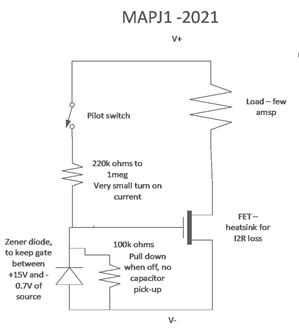
  • Cannot directly help but you may be able to switch a pilot signal to operate a power transistor in a box, or even a relay, but they have a similar contact derating problem. 

    (there are many possibles, but just  an example. would need a turn on resistor and Zener to protect the gate-source junction from blow-out.)

    267ce29ecbb221e1cfdee1842312e9d7-original-fet-power-switch1.png
    A high voltage FET as a switch/solid state relay for DC

    What is the load current and is the polarity fixed ?

    I'd only use that for cases where if the transistor failed and it came on by accident it was not the end of the world.

    The arc damage is a function of the current flowing and the breaking time the old DC switches had a very fast contact separation, 

    If you have both supply poles available you can even do the electronic equivalent of the big circuit breakers and have “load contacts” and “breaking contacts”  where the breaking contacts are in parallel and only carry the load when the switch proper is opening, so no volts across it at the moment of opening.

    Mike.

  • Dont really want anything other than a switch because the supply is AC from public mains most of the time, changing over to DC from a battery in the event of a power cut.

    Load is only a fraction of an amp.

    Emergency lighting for a very large house.

  • Ah OK, ignore the above then. Tumbler switch of the old fashioned kind - sadly rare


    could you get away with one of these mounted on a blanking plate ? lloks a bit grim, but up for the dc amps..


  • Not easy.

    Most of the standard accessories for electrical installations are specified for AC use only.

    Even if you were to get a blank faceplate and fit an appliance switch (often a non-starter because of overvoltage category anyway, they are CAT II not CAT III required for the fixed installation), you run into the problem that 250 V AC rated switches are only rated for 60 V DC.

  • mapj1: 
     

    Ah OK, ignore the above then. Tumbler switch of the old fashioned kind - sadly rare


    could you get away with one of these mounted on a blanking plate ? lloks a bit grim, but up for the dc amps..


    Probably only Installation Overvoltage CAT II, and limited in DC voltage rating for the most part I'd guess.

  • Those Carling EK or DK ones are particularly good, with an insulation rating 1000VDC to the frame or across open contact  ( and you could earth the toggles)  

    But at nearly 2 inches long they are quite bosky.

    More info  

    “The quick make/quick break contact mechanism is ideal for high voltage DC applications.”

    But  I agree, most normal AC switches are not good at DC above a few tens of volts.

    Not sure about over-voltage category II/III in the case of battery powered lights, you could put a plug and socket in the way and magically lower the category ;-) 

    Mike


  • mapj1: 
     

    Not sure about over-voltage category II/III in the case of battery powered lights, you could put a plug and socket in the way and magically lower the category ;-) 

    Mike


    Absolutely - or connect downstream of an FCU to magically attenuate those impulses ?

  • Not too worried about surges or peak voltages, much less of a problem than in the good old days of DC mains, when vacuum cleaners and other electric motors were connected to lamp sockets.

  • broadgage: 
     

    Not too worried about surges or peak voltages, much less of a problem than in the good old days of DC mains, when vacuum cleaners and other electric motors were connected to lamp sockets.

    No, but joking aside, insulation coordination still important when you are connected to the grid (for the AC operation).