This discussion has been locked.
You can no longer post new replies to this discussion. If you have a question you can start a new discussion

End of Fault current for Parallel lines in Ligting

How to find the end of line fault current for the second case,

If this is a straight forward like below. I calculate all the resistance and reactance of cables in series and arrive at the end of fault current.

However if there are two parallel lines from the JB like in the below image, how do I find the end of fault current?
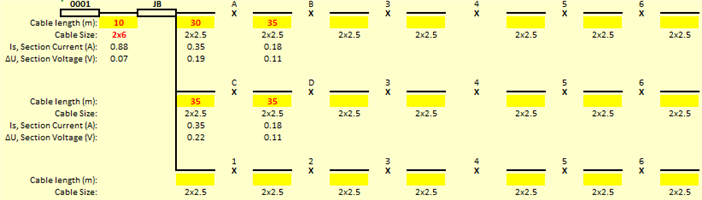
How do I calculate the combined resistance and combined reactance value in this case?

Should I take the maximum resistance which comes out of the three parallel lines for calculating the end of fault current? Also, In general the resistance and the reactance value decreases when connected parallelly

Parents
  • If I've understood your setup correctly then the you don't have anything in parallel - they're just three branches of the same circuit. A single fault can only occur in one place - if it's at the end of one of the branches then the fault current won't be flowing in the other branches, so they can be ignored. So yes, just pick the worst case - i.e. the one with the highest impedance - usually the longest.

    Cables in parallel are connected together at both ends - so current is shared between the distinct cables (sometimes in strange ways if there's a fault part way along just one of the cables) - but that's a different kettle of fish.

    If the cable is of the same type throughout, the calculation is usually somewhat simpler - just use the overall length (to the furthest point) and the per metre characteristics of the cable - usually no need to split it down into each individual section.

       - Andy.

  • Thank you! your understanding is correct. I just need to split it down with individual section. The question arise because I'm working on the spreadsheet created by some one. What is baffling me is, that some one averaged the resistance and reactance in the equation. I could not paste the excel equation here as it runs long. In simple terms, they summed up the resistances based on the individual section and divided it by the total length (summing up all the lengths from individual sections). Similarly done to reactance values. Why would someone do it?

  • Also a top up question is, do I calculate  Voltage drop for each branch separately by taking individual section's resistance and reactance. (or) again the reduced resistance and reactance due to parallel branches?

  • I am a bit confused by what you are trying to do here. Are you trying to find out what the maximum fault current should be? In which case you need to consider a fault close to the supply rather than at the far end.

    If you are considering voltage drop you need to consider the voltage at the far end load so the furthest light from the supply.

    These ought to be two completely separate calculations, though they will use the same basic information of cable resistance/reactance.

Reply
  • I am a bit confused by what you are trying to do here. Are you trying to find out what the maximum fault current should be? In which case you need to consider a fault close to the supply rather than at the far end.

    If you are considering voltage drop you need to consider the voltage at the far end load so the furthest light from the supply.

    These ought to be two completely separate calculations, though they will use the same basic information of cable resistance/reactance.

Children
  • I am a bit confused by what you are trying to do here. Are you trying to find out what the maximum fault current should be? In which case you need to consider a fault close to the supply rather than at the far end.

    I might also add that you need to calculate the PSSC at the far end to ensure that it is high enough to trip the OCPD.

  • Hi Anderson,

    I'm trying to calculate at the fault current at the far end of the circuit to verify whether the breaker trips or not at that fault current and also trying to find out the voltage drop