


How many times have you seen this? 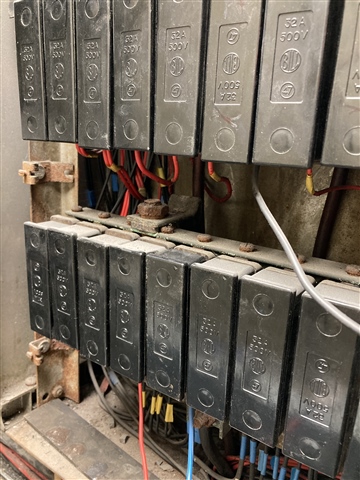
I'd not be very surprised you cannot get a good contact to a bus bar covered with a layer of oxides and general grot built up over the years - it is however quite impressive if it reads totally dead. In terms of the live/dead test it is perhaps an argument for checking with a non-contact 'volt-stick' type indicator, although that is not without potential to mis-read also.
The microscopic version of the same problem allows folk to get voltage drop and Zs/PSSC readings that do not reconcile, this is just a rather spectacular example.
The saving grace is that the adventitious insulation of the bars in this way may actually make it safer, if a spanner is dropped in the works it may act as some kind of primitive current limit. Mind you I'd prefer a design with some sort of cover, it is funny how your standard of what is reasonable to work in / on changes over the years.
Mike
PS a thought
The comments about flat caps may be a bit tongue in cheek, but there is a serious point here that re-inserting a fuse against a fault or your tools or wrist watch falling into the works may not end well in this sort of design, and a singed shirt sleeve or glove is much preferable to a burn that may need a skin graft.
As many newer folk will not have encountered a traditional skeleton board with lots of bare live metal, it is worth remembering that the penalty for a lapse in concentration is that bit higher than with a modern one, so dress accordingly, casual beachwear is not really appropriate. There is a very real arc flash hazard here, as the not-quite-zero resistance fault that you get as the oxides are blasted away with a blinding flash like striking a welder, is the kind that creates the most volume of mobile hot metal.
PPS edit. In a resistive case, the absolute worst case arc is where the fault resistance is equal to the loop impedance of the supply - so an energy of half the PSSC of the fault loop, times half the pre-fault supply voltage, times the upstream ADS disconnection time is available to melt and throw metal about, and the volume of that metal can be estimated adiabatically . With older boards like this the risk is heightened as the upstream ADS is often also quite pedestrian by modern standards.

it was a bit tongue in cheek because it sounds utterly absurd now but the guy showing me, on 100a BS3036 boards was deadly serious.
We used a cotton rag, insert it in the bottom half, then push smartly up while looking away
This was only 20 years ago. It is still advice I take to this day, with MCCBs always but I do have a set of insulated gloves that are too cheap not to buy.
it was a bit tongue in cheek because it sounds utterly absurd now but the guy showing me, on 100a BS3036 boards was deadly serious.
We used a cotton rag, insert it in the bottom half, then push smartly up while looking away
This was only 20 years ago. It is still advice I take to this day, with MCCBs always but I do have a set of insulated gloves that are too cheap not to buy.
We're about to take you to the IET registration website. Don't worry though, you'll be sent straight back to the community after completing the registration.
Continue to the IET registration site