


There's no stopping me now.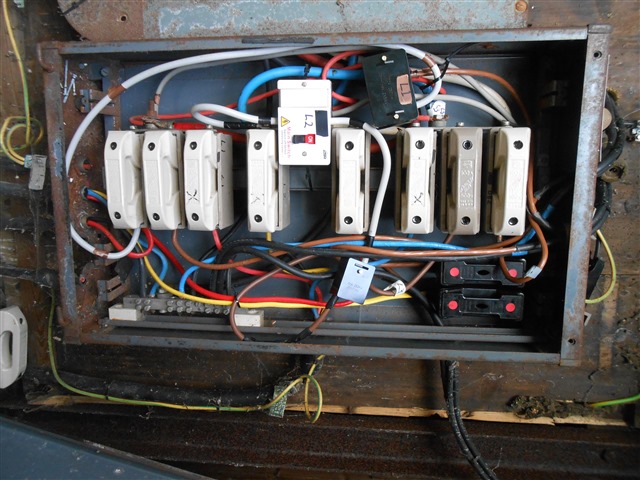

I love the 2-colour warning notice.
I don't know which is the "MET", but the one below the head has too many cables for my liking. Whatever happened to the idea of the double screw terminal?
All those earth wires are connected to the water pipe clamp on the lead sheath of the incoming cable.

I can’t see why that was underlined or how to remove the lines.
The house was built in the 1890’s on Cathedral Road and the power station was built 1894, at that time horse trams running past the house and were electrified in 1902.
So it is actually possible the house had an electric supply from when it was built and it could have had a D.C. supply.
In 1923 the electricity supplies to consumers were:
https://en.m.wikipedia.org/wiki/Cardiff_power_stations
I did wonder if it’s possible for the pitch filling to have been attacked by woodworm.
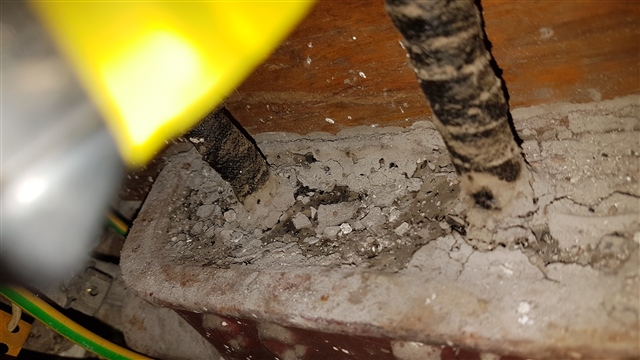

I think personally I'd pass on eating either. But there are quite possible bubbles or even quite long tunnels where either air or moisture was entrained when the tar was originally poured that leave it slightly porous or indeed some lighter hydrocarbons oils or paraffins were in the mix that have evaporated. - cold applied roofing tar - the stuff dissolved in naptha, often sets slightly bubbly for the same reason. Tar from the gas works did not always have a well defined make-up, it was just cheap waterproofing and long lasting. Before modern plastics there really were not so many choices
The mice ate the caps and nozzles on my cans of WD40 and are quite partial to PVC insulation, so I suppose it’s a matter of personal choice.
The CC on the head presumably is Cardiff Corporation so puts it pre-1948, so between 74 to 128 years old.
I would inclined to go towards 128 years old rather than later.
One thing for certain, those Cardiff Corporation cable jointers certainly knew how to make off a maintenance free joint.
I see no joint in that photo, but I imagine the ones in the PILC outside are holding up well, and were probably jointed very much in the manner off the one shown here 6 mins of true craftmanship, not that we'd slop solder about by ladle these days...
Note the heavy tinning of the wires and the way the overlaps are held on with thin tinned wire as a sort of frapping.
Mike.
We're about to take you to the IET registration website. Don't worry though, you'll be sent straight back to the community after completing the registration.
Continue to the IET registration site