This discussion has been locked.
You can no longer post new replies to this discussion. If you have a question you can start a new discussion

Bonding in greenhouse

On an eicr

I have a greenhouse connected to a sub DB in an outhouse, which is on a TT earth. Circuit is protected by upstream 30mA and 100mA RCD's.

I am debating in my mind if the frame of the greenhouse should be bonded to the single socket in the green house.

I would consider the frame as an extraneous part and therefore first reaction is to bond it.

But then thinking about it. bonding would reduce the risk of shock inside the greenhouse in the case of the socket became live but increase the risk of shock outside the greenhouse if the socket and greenhouse became live.

On balance I am tempted to go with not bonding, what are your thoughts?

  • A greenhouse is a building, and although most come under permitted development classification, some require planning permission.

    BS 7671 requires protective bonding to be applied within each building where ADS is used, and that includes structural parts of the building if they are  extraneous-conductive-parts.

    Note 1: the protective bonding applies to each building; however, if a PME earthing arrangement is exported to a building or outbuilding, the PE conductor to the outbuilding should meet or exceed the minimum cross-sectional area requirements for the PME service of the intake of the premises.

    Note 2: Depending on the DNO's local network characteristics, they may recommend against exporting PME earthing arrangements to certain metal-clad or metal-framed buildings or outbuildings. See G12/4 and guidance from your local DNO.

    The only thing to decide is whether (depending on the structure itself) the metal frame is actually an extraneous-conductive-part. There is guidance for this. As has already been said, if there is a wooden footing frame or brick footing wall extending above ground level, effectively separating the frame from the ground, then the metal frame may not be an extraneous-conductive-part.

    The key risk to avoid is for persons within the greenhouse having contact with both exposed-conductive-parts and extraneous-conductive-parts. Again, as has already been said:

    (a) If the metal frame is not an extraneous-conductive-part, then bonding it may increase risks for those touching the greenhouse frame from outdoors if there is a fault. If it is not an extraneous-conductive-part, it may not be wise to bond it.

    (b) If the metal frame is an extraneous-conductive-part, it should be bonded, but note that it will cause a slight ground potential rise around the building during a fault if it is main bonded, so the risk to someone touching the frame from outside is reduced.

  • If the greenhouse is not a building then how would you define it

    Perhaps a "garden structure" (at least in a domestic setting). BS 7671 gives us no definition to work with but my thinking is that it's rather unlike most buildings where it would be reasonable to try to create the equipotential zone that 411.3.1.2 is all about (reasonably dry, or non-conductive construction) . In most respects the inside of a greenhouse is much more like outdoors than indoors of most buildings.

    There's a whole range from structures from tiny lean-to greenhouses (not much more than a tall cloche) to car ports to dolls houses that might well fall under some people's dictionary definition of a building, but nevertheless wouldn't be sensible to treat as such from a wiring regs point of view. We have to fall back on our engineering judgement.

        - Andy.

  • Isn't a greenhouse a BUILDING then? Often called an outbuilding by insurance companies. An outbuilding like a garden shed or detached garage or garden privvy. If the greenhouse is not a building then how would you define it Andy.

    Z.

  • 411.3.1.2 (v) might apply though. "Exposed metallic structural parts."

    Only if it's part of a building (see 1st phrase of 411.3.1.2 and my earlier comment).

       - Andy.

  • "Sorry not very clear. I am thinking worst case scenario is case of metal clad socket becomes live along with cpc connections. Could happen if there is a short to earth and RCD fails to operate."

    There are two R.C.D.s connected in series. The chance of both failing is very slim indeed.

    Z.

  • 411.3.1.2 (v) might apply though. "Exposed metallic structural parts."

    Z.

  • The R.C.D. will trip off with a 300 Ohm L to E short.

    Table 41.5

    Z.

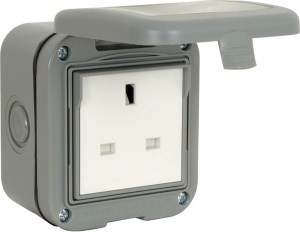
  • I would not recommend a metalclad socket in a greenhouse. It will rust and deteriorate. Also it is not suitable for the humid and damp greenhouse conditions. It may get sprayed with water. A plastic outdoor socket is better suited to this location.

    705.512.2

    522.3

    And no, I would not bond the greenhouse frame.

    Z.

  • But then thinking about it. bonding would reduce the risk of shock inside the greenhouse

    Not necessarily - since the 'floor' is likely to remain somewhat closer to true earth potential even when the bonded frame is at some other (possibly hazardous) potential. And not just the floor itself either - but anything metallic placed on or on it - from metal plant supports to aluminium staging.

    I wouldn't make any assumptions about the joints in the frame either - oxidized aluminium isn't the best of conductors and if the frame is factory painted/powder coated (as is increasingly popular these days) there's even less chance of a good metal-to-metal bond.

    Personally I would try to deem that a greenhouse is not a proper building and refer to the new words in 411.3.1.2.

       - Andy.

  • I have to admit I failed to do enough checks on the green house, at the time my initial reaction was that it probably needs bonding and didn't go much further with checks.

    It's either straight on the ground or on one layer of bricks, I know a big difference. If it's well connected to ground with a low impedance bonding makes sense. If it's isolated no need to bond, but what if it's say 300 ohms.