This discussion has been locked.
You can no longer post new replies to this discussion. If you have a question you can start a new discussion

Use ferrule to increase solid wire size

Hi,

I need to fit a 3-phase distribution block, and the closest candidate has two types of inputs—input (two) and output (six). The input is 7.6mm2, and the output is 5.6mm2, and one of the inputs can be used as an output. I only use rigid conductors of 1.5-6mm2 in the house - the lights are 1.5, the majority is 2.5, power-hungry is 4mm2, and one fat transit is 6mm2. Depending on the breaker's possible load, I use 4 or 6mm2 inside the wiring closet to pass between the power-hungry groups. I don't use

Within this paradigm, I would like to use 6mm2 as an input and possibly 4mm2 as an output for the distribution block. But, following Legrand's user manual, the 7.6mm2 should accommodate 10 to 25 mm, and I am falling one step short of matching 6mm2. IMHO, I can use aluminum pressed ferrule to increase the solid wire size - the connection surface must be enough to avoid any dangerous situations. What is your take on it?

Regards

  • Mike,

    These were just two short wires around that I took for the purpose of demonstration. Thank you for your answers and verification!

    Cheers

  • Please don't think I'm 'kicking' you - it can be hard to judge the level of someones knowledge right just by their typing -  especially when things are posted by folk in other countries and may be  not in the Mother tongue. (In reverse, I can do some German but the result can be pretty lumpy.)

    Something obvious to you may not be so obvious to me or the other way about


    That photo looks pretty solid, & as I imagined it is now impossible for the wire to  slide up the side of the screw.- I presume it survives the ' wiggle & pull' unofficial test as well. I also assume you won't be mixing earth and neutral colours in the real thing.;-)

    Mike.

    Ps As general note, it is far better to ask the 'silly' questions early on, it  is how we learn, and it is a lot sillier not to ask and to assume the wrong thing and have to do the job twice.

  • Good morning Andy,

    I have a per level building block that contains all wiring for the specific floor. At the entry, there is a closet where the mains is, are high-amp breakers (some 3 phase and several 1 phase). These all equipped with the differential breaker to watch for the ground leakages. 

    Ground floor uses one phase out of three in a separate box that is connected with 4 sq.mm cable. It is equipped with one 1x16A B, 3x10A B's (light, LED, and comm's), There is one 3 phase 6 sq.mm cable that runs from the main closet to the first floor where it splits leaving one phase untouched (for ground floor as per above), one for the first and one for the top floor. As on the first floor, I have a building block that contains a distribution point and breakers and, as I was wondering, since I have a diff breaker and individual breakers per group, should I have an additional breaker at the floor entry point? Hence, the question about the split block because outputs can be more than four.

    Thank you!

    Regards Matvey

  • Good moring Mike,

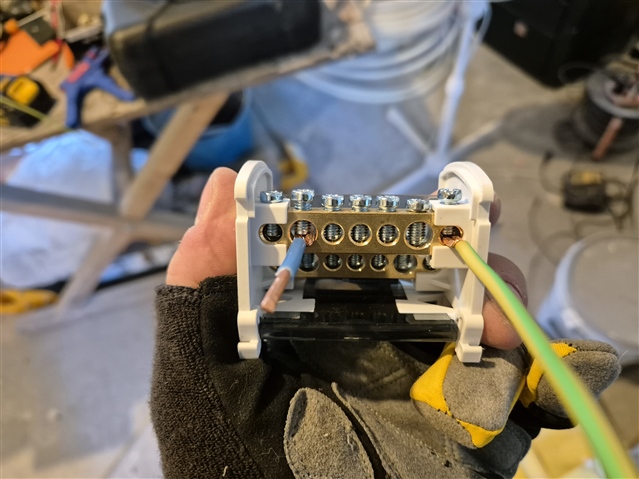
    Don't kick me too much - I am not a professional installer and didn't think of folding these ;-) I have followed your advice with the double backing - it worked like a charm. The one on the left is six sqm, and the one on the right is four sqm. Thank you!

    Regards Matvey

    Block

  • You should not put a ferrule on a solid wire.

    Well, not one to DIN 46228, NF C 063-023 or UL486-F because they are for Class 2, 5 and 6 conductors only (but Class 2 is rigid, as discussed in my earlier post) ... but that would rule out Aluminium because the standards are for brass tube ferrules. Having said that, Aluminium not a good idea on a copper cable anyway ...

  • given the confusion of diameter and area in mm2, and a few other odd choices of words, I'm not too sure if the OPs use  of the phrase "IMHO, I can use aluminum pressed ferrule to increase the solid wire size" should be taken as what we would normally mean either - I think we should allow the possibility for things "lost in translation".

    But I'm not that sure of current Netherlands practice either - maybe their 6mm is solid cored. And I missed the 'aluminium' on the first pass, or I'd have said that unless the wire is aluminium, tinned copper would be better, if we need it at all,  mixed metals things usually end badly.

    M

  • Solid core 6mm

    I thought OP said it was 'rigid' - i.e. Class 2 or Class 1 ?

    • s - solid, Class 1 only,
    • r - rigid, Class 1 or Class 2,
    • f - flexible, usually Class 5 but may be Class 6

    It would be unusual to find Solid 6 sq mm wiring in domestic ... but I agree not necessarily 4 sq mm could be either Class 1 or Class 2 dependent on cable type ?

  • looking at the actual terminals he has, which have more in common with a UK MET than a UK junction box of any kind let alone screwless terminals I'm not convinced that it needs a ferrule at all, it just needs to be in one of the smaller holes, or folded.  Had it been some sort of cage-clamp, maybe  a ferrule would be needed, Solid core 6mm will  be quite willful however and probably wont go easily into a ferule anyway,

    We commonly stuff extra strands along side into crimp bodies to ensure a good fill for the crimper when the chosen wire is too thin for the crimp terminals on things like the mil spect 38999 connectors - but it is always fine stranded in that case.

    Mike


  • note that in the UK 6mm2 would normally be 7 strands, not solid core. I'd still fold if the  hole was too big, 

    German ferrules (DIN 46228-1 and DIN 46228-4) at least, are intended for use with Class 2 (7 strand + rigid), Class 5 (flexible) and Class 6 (extra flexible) stranding ... but NOT Class 1 (solid) conductors.

    However, I'd be careful with csa > 6 sq mm Class 2 stranded conductors, to not flex the cable too much after crimping the ferrule, until the terminal is tightened. Whilst some screwless terminals are suitable for use with ferrules, I would not use ferrules and screwless terminals for class 2 stranded conductors with csa > 6 sq mm.

    If you took a Class 2 conductor, and "doubled it back" in a twin ferrule for the suitable CSA, would that be OK I wonder?

  • I can use aluminum pressed ferrule

    Hopefully NOT aluminium on copper wires and brass terminals - we had awful problem with aluminium conductors in the 1960s and 1970s - I wouldn't advise going down that road. Tin or nickel plated brass or copper maybe.

      I need to fit a 3-phase distribution block

    Just out of curiosity, what's the application? It' not a common problem - normally smaller cables are fed from overcurrent protective devices (MCBs or fuses) rather than from a multiway terminal block (except for N of course, but the DB N bar usually serves that purpose).

       - Andy.