Why is the accuracy of multifunction testers so low

I am working on a scenario at the moment where my customer has an EV charger cutting out due to low and also possibly high voltage.
My KT65DL is indicating voltage as low as 214V and seeing swigs from 214 to 246 in a 1 hour period. The DNO are saying they don't trust the values being given and are declining to put a voltage logger in, asking for data from the EVCP manufacturer, which is unlikely to be available as it's Tesla and probably no more accurate.

But it's accuracy is +/- 2% plus 4 digits, so effectively +/-5V, which means it has very little value for checking the supply voltage is in range, also doesn't help that the sampling is quite slow and I assume minimums are being missed.

To my knowledge it's not that expensive to build reasonably accurate voltage meters, maybe AC meters cost more? But given multifunction testers cost £500 or more why is the accuracy so low?

  • Here is the best article I found on online,  if you have to try and determine the voltage test result taking into account anything after the decimal point,  there's a problem.

    I would be working in whole numbers, not fractions and certainly not taking millivolts into account. 

    electrical.theiet.org/.../

  • Yes, both the Open PEN device and tester need to be testing in the same way to get the same results, BS7671 says the measurements should be RMS, but a lot of EVSE has been developed since the relevant regulations were written and implemented, so can comply if they vary from what is written in the book, because there’s an allowance for new technology.

  • And then there's the further complication in this case - I've only just thought about this - that it all depends what the cut-out circuit on the EV charger is working on, which almost certainly won't be true rms!

    So actually the only way to know whether it's the voltage swing that's causing the charger to cut out is to have a meter that measures the voltage in the same way (and at the same speed) as the voltage monitoring circuit in the EV charger...which I can well imagine is just a tiny transformer, a diode, and a capacitor...

  • A Fluke blog, including a video, remember what you are trying to measure is a moving target and it’s an event that needs to last for more than four seconds, so there could be a lot of near misses lasting several seconds.

    www.fluke.com/.../what-is-true-rms

  • Chris Pearson mentioned using an AVOmeter (I now have two).

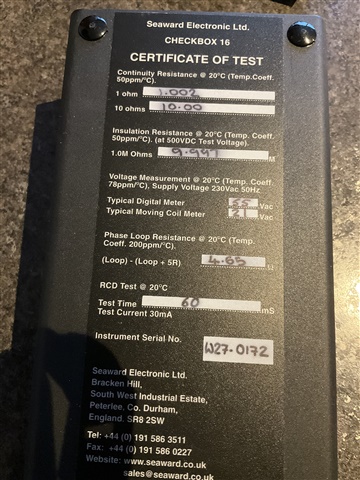
    Twenty four years ago, along with my Robin KTS1620 I bought a Seward Checkbox 16 to check the calibration, checking the resistance measurements and RCD is straightforward, checking the voltage is a bit more airy fairy, as it’s still dependent upon the mains voltage, there is a voltage output on the front of the check box, but it tells you the test results will be significantly different measured with digital and analogue meters.

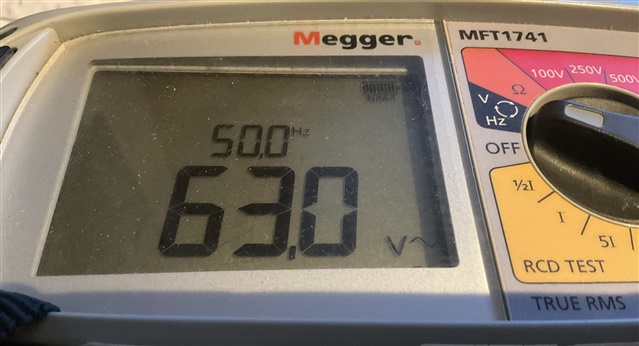
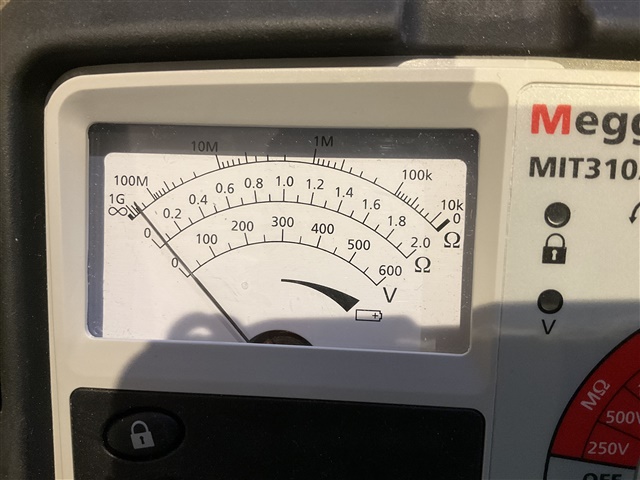
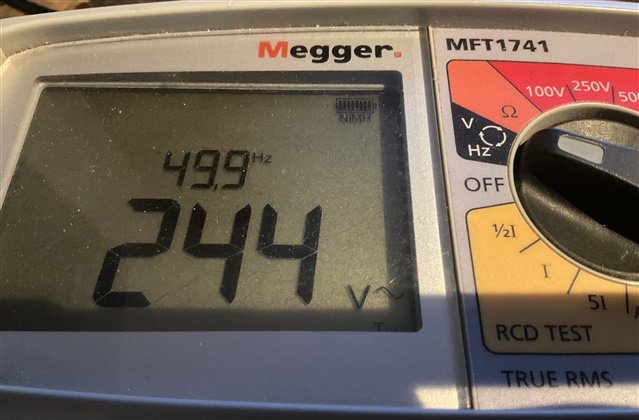
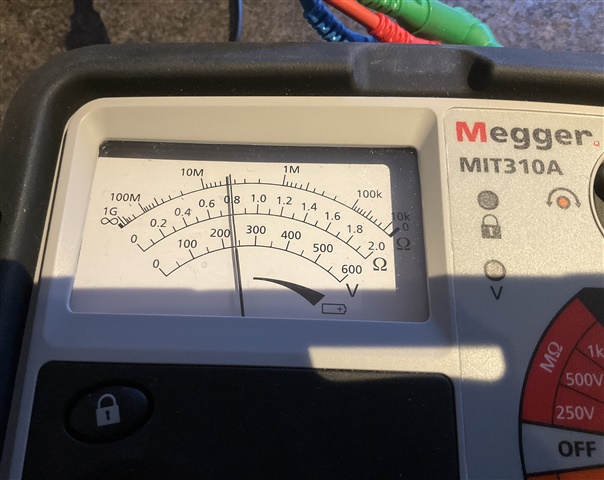
    I just happen to have a modern conventional moving-coil analogue meter, so here’s a comparison of voltage when measured using the check box with both types of meter.


    and here is a comparison measuring the mains directly 


    Which is in line with what is to be expected having taken note of what it says on the back of the check box.

  • Twenty years ago when I was going to my first installation tester I asked for advice from Paul the then Head of Electrical Department at Kidderminster College, analogue testers were still readily available as sets of testers, but I bought a state of the art Robin KTS160 digital multifunction tester.

    Paul said to me that older electricians found it hard to interpret the test results from digital meters, because they were used to measuring with analogue meters. The older electricians would turn the analogue meter on, zero the needle as required, then press the button, the needle would ping up and wobble about a bit, they would look at it and go “Yeah, that’s okay” and that was it done. But with a digital meter they have a snap shot in time with a test result to one or two decimal places, an “accuracy” they have never achieved before, leading them to reach for a book to check the results and to mither about their inability to actually get exactly the same earth loop test results twice if they then repeated that test.

    That is a comment that has stuck in my head for over twenty four years, another comment that sticks in my head is that having purchased more testers than I now need, I have spoken to both the technical department of a tester manufacturer and their team on the trade show stands I have been advised to keep them all, because they all measure in different ways and some days one will work better than the others, not the answer you want, but true.

  • Several years ago I posted a discussion about the specifications of Megger multi function testers around the world.

     Megger MFT testers from around the world. Identify the countries by their functions. 

    The Americans have a very different approach to electrical installation testing than we do here in the UK.

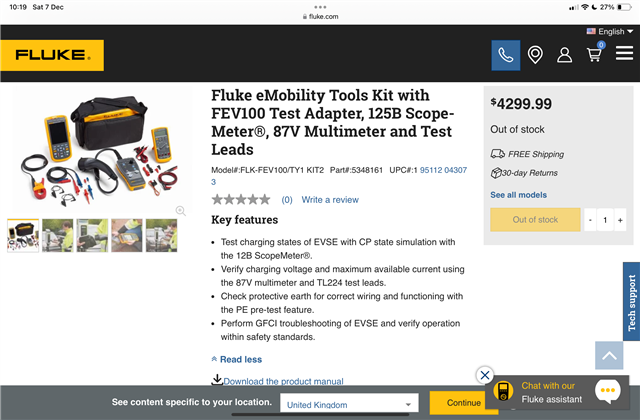
    Here in the UK if you buy a Fluke EV installers test kit you get a Fluke MFT and a EV socket testing adapter.


    https://www.fluke.com/en-gb/product/electrical-testing/installation-testers/fev300-1664-kit

    The kit is not the same in America, you get the EV socket testing adapter, a electronics multi meter and a scope meter.


    https://www.fluke.com/en-us/product/electrical-testing/installation-testers/emobility-kit-125b

    I am not someone who uses a scope-meter, I presume that using a scope-meter it’s possible to record the peak voltages as well the RMS voltage, but as the Open PEN protection is also measuring the RMS voltage (that is what it says in BS7671) we don’t need to know the peak voltage?

    matt-e.co.uk/.../

  • Interesting to see that the meter linked above is much less accurate for AC voltages than DC, I guess it's difficult to compensate for voltage drops across diodes, assuming meters use a bridge rectifier.

    I suspect it's more about, unless it filters for 50Hz, the impact of the actual waveshape. It doesn't look to me as if MFTs filter 50Hz, but I may be wrong, but if they don't then the actual waveshape - which by the time you get to the property is vanishingly unlikely to be a pure sine wave - will have a big effect on the accuracy. Even with the regs on switch mode convertors (including car chargers) there is a huge amount of rubbish on domestic 50Hz circuits these days. (Even more in industrial circuits.)

    I wouldn't expect a modern (in the last 30 years!) professional meter to use diodes, I'd expect it to calculate the rms voltage from the waveshape - although many will use the average of each half cycle.

    However re the comments of "it actually seems to be more accurate than that", yes very probably - in fact I'd be worried if it wasn't. 4% is the point at which you could complain to the manufacturers that it hasn't met their spec, they'd have designed it to stay well within that so they don't get loads of returns. And as Graham suggests, they have to allow for, particularly, temperature extremes which throw both the voltage reference and the components in the analogue front end. It would be nice if they quoted accuracy between, say, 10C and 30C as well as over the full temp spec of the meter, but that won't sell many more meters to do so!

    Thanks,

    Andy

  • well poor joints and voltage drop on the 11kV side has an effect of course, but because of the lovely way transformers change voltage and current in inverse ratio, you find you need a lot of ohms on the 11kV side to introduce the same effect as a resistance on the 400V side - well (11000/400) squared as many ohms to be precise (*)- so half an ohm on the LV side is more like a few hundred  ohms on the 11kV side, which is why one can afford HV lines of many km of course, and why there have to be quite so many LV transformers.

    So I'd expect an LV  fault first.

    Mike

    * and I was deliberately vague about are we comparing at voltage drops phase to phase or phase to neutral, as I know that the transformers are delta primary on the 11kV  and star wired 240V phase to neutral so perhaps  you may want to consider (11000/230) squared instead. In any case, it  is common to ignore the drops on the HV side, as a first approximation, and the smoothing effect of many loads pm the same 11kV branch mean that steps due to any given load are less serious.

  • Just managed to get hold of the local supply network diagram. As you described it looks like there is actually a lot of 11KV cables going around the village, with what looks like small pole mounted transformers dotted all over the place. Probably no more than 150m from a transformer to any house.
    But I assume that the pole mounted or small ground mounted transformers are fixed ratio without any other technology. Therefore voltage drop in the 11KV network could still be an issue.

    I will be measuring earth/neutral voltage reference to something conductive stuck in the ground.

    I learnt quite a bit this evening digging around in diagrams etc, not sure how much use it will be day to day but interesting anyway.