Surge protection devices without overcurrent protection

Hello all, greetings from a desk day.

I am just off the phone with our genius SPD lady at SPD.  I mentioned the latest Fusebox distribution board which does not have an overcurrent device for the SPD.  The device is a Fusebox SPD1MT2 type 2 direct to busbar surge protection device.   She tells me that it is not compliant in accordance with section 524.4.5 and am inclined to agree.

www.fusebox.shop/.../spd1mt2

So, I installed one a week or so ago.  Purchased in good faith, and guilty of assuming an overcurrent device would be there,   I was a touch surprised when I saw no MCB for the SPD.

Their website states product description states 'with No MCB required'. 

I'm reading now that overcurrent can (in italics) be built into the device but my conversation with SPD hinted at some industry 'naughtiness'.  

Any views? Where do we stand with that then, in terms of compliance as installers?

thank you, 

Zs

  • Shouldnt that be what the supplying Company should be doing to justify their certificate of compliance?

    I completely agree. Having been involved in the manufacturer and assessment of electronic equipment and CE approval I learned that to keep your job in that sort of environment it was more or less essential to take the easiest interpretation of the rules that could just about be plausible.

    The one that really gets me is class 2 metallic light fittings that are no longer class 2 by the time they have been installed in a typical UK home with loop in, loop out and switch entering the fixture. 

    Unless there is independent assessment and a significant downside to non compliance very few companies are going to change the way they interpret and implement the rules. I suppose on the upside a poor interpretation of the rules is better than no rules and safety has improved.

    But if companies like Surge Devices are openly saying that a product architecture isn't safe I think they need to provide evidence, especially as it's a fairly easy thing to demonstrate. Having the SPD protected or not doesn't make much difference to me as I always install DB's with plenty of extra capacity, but if the industry changes it's mind in 2 years time it's going to be embarrassing and a lot of wasted time altering installations.

  • As an aside, like other SPDs, this one has a red/green flag, but what use is that to anybody when it is hidden under an opaque cover?

    You can check it while you are testing all your RCDs.  Which everybody does regularly.

  • You can check it while you are testing all your RCDs.  Which everybody does regularly.

    Such a procedure is nearly impossible in a modern household ... the following devices MUST NEVER be turned off:

    • Broadband router.
    • PS5 (other mains-powered game stations are available).

    I'm no legal professional, but I think the legislation that prevents turning off such devices (at least according to my now adult kids) is the Human Rights Act ?

    Joy

  • On the subject of red/green flags I think that the UK even the EU should look at having a product standard in place to say

    Green mean active and working correctly 

    and

    Red means fault or OFF.

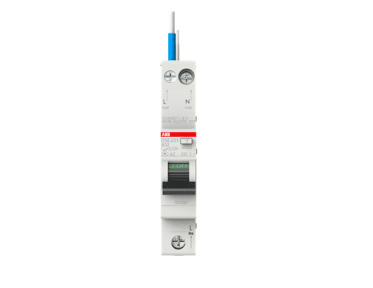
    This should be applied to SPD, RCD including RCBO and MCB that and sold/manufactured/distributed in the UK.  As an example see screenshot below of a ABB RCBO, 32A Current Rating, 1P+N Poles, 30mA Trip Sensitivity, Type B

  • NO!!!

    It is already in the product standards. For example: BS EN 60898‑1:2019+A11:2024 8.1.2 Mechanism If a separate mechanical indicator is used to indicate the position of the main contacts, this shall show the colour red for the closed position (ON) and the colour green for the open position (OFF).

    Green for safe and red for danger. Just like traffic lights - green means safe to go (but the road may be blocked) and red means danger (even if nobody is coming from the other direction at that moment).

  • I understand your point of view but the fact remains that not all companies are following the same standard.  Some use green for ON and some use Green for OFF 

  • On the subject of red/green flags I think that the UK even the EU should look at having a product standard in place to say

    Green mean active and working correctly 

    and

    Red means fault or OFF.

    There is already one, BS EN 60073, that can be readily used.

    It is already in the product standards. For example: BS EN 60898‑1:2019+A11:2024 8.1.2 Mechanism If a separate mechanical indicator is used to indicate the position of the main contacts, this shall show the colour red for the closed position (ON) and the colour green for the open position (OFF).

    Green for safe and red for danger. Just like traffic lights - green means safe to go (but the road may be blocked) and red means danger (even if nobody is coming from the other direction at that moment).

    Whilst this is used in some protective device product standards, and certainly for overcurrent protection, RCD and switching/isolation devices, these generally align with BS EN 60073, I don't think it is (or was always) fully adopted in the SPD standards, and there are certainly some on the market that have yellow or orange illumination to show "working" ?

  • I don't think it is (or was always) fully adopted in the SPD standards, and there are certainly some on the market that have yellow or orange illumination to show "working" ?

    A quick shufti at my pair revealed one green status indicator and one blue one.

    BS EN 61643-01:2025+A11:2025 simply requires there to be a "status indicator", which can be visual or audible, local or remote.

  • devices MUST NEVER be turned off:

    • Broadband router.

    Even while away on holiday so that the Solar Battery system can continue it's cloud data logging. [Ask me how I know..]

    +2