


i have come across black cut out fuses that light up my single pole tester, but only on the label.
my 2 pole tester does not light up from label to MET.
is this my single pole tester being over sensitive or should i call 105?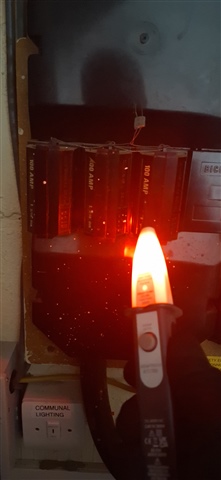
i have come across black cut out fuses that light up my single pole tester, but only on the label.
my 2 pole tester does not light up from label to MET.
is this my single pole tester being over sensitive or should i call 105?
It made me go back to the van and get a 2 pole tester, there is a high field strength here, my non contact volt stick lights up 150mm away
This means that L and N are well separated - if you like to imagine the field lines between a pair of wires as they pull apart, the further of the electric field lines fly off before returning, and some dont return at all, but head for the plate at the end of the universe, or local earth....
This illustration is from https://cococubed.com/images/energy/circuit_eb_fields.pdf The magnetic fields (orange/brown - where a compass would point if you put it ther) are proportional in strength to the current, while the Electric fields (black, along which a charge would feel a force if placed at that point) are proportional to the voltage.
The closer the wires the more intense the electric field between them, and the less there is 'hanging out' as it were. As a very approximate rule of thumb once you get out to a distance of a few times the conductor centre to centre spacing, it has all but died away. But in some cut out designs, the spacing is an inch or two, so the field is very noticeable/ detectable out to a few times that... 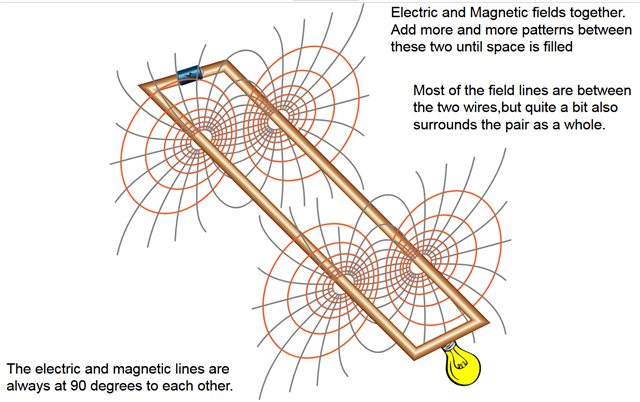
PS
This illustrates a DC. If it is an AC and a high enough frequency, then the fields at any snapshot in time, are all slightly offset in phase along the wire, completing a full cycle of phase shift over a distance of one wavelength. Not a big issue at 50Hz unless you are wiring a continent or across oceans, the wavelength at 50Hz is 6 megametres (6,000 km) (1GHz is 300mm 1MHz is 300m. 1Hz is 300Mm etc). Earth radius at equator is ~ 7Mm.
Mike.
edited for silly typo..

Mike,
Sorry to quibble - and it's far beyond prctical relevance for power transmission - but I make the wavelength of 50Hz energy to be 6 megametres (rather than 60).
Excuse my going slightly off-topic: I'm encouraged that megametres are used by someone else than me. Even though they're preferred SI units, and mega-anything-else is freely used, and that Mm's are ideal for such things as planet-wide dimensions (e.g. distance to the Moon is ~400 Mm), most people insist on working in thousands of kilometres.
On second thoughts, the reluctance may be due to the possibility of (very unlikely) confusion between Mm and mm.
David.

quite right. I've gone in and edited it. - and I should have spotted it as obvious because of the Schumann resonances - the lowest is 7Hz or so.
Thanks for spotting that. M.

On second thoughts, the reluctance may be due to the possibility of (very unlikely) confusion between Mm and mm.
You would think that the context and a factor of 109 would make it obvious.
Along similar lines, it seems odd that annual domestic energy consumption is usually given in thousands of kWh rather than MWh.
On second thoughts, the reluctance may be due to the possibility of (very unlikely) confusion between Mm and mm.
You would think that the context and a factor of 109 would make it obvious.
Along similar lines, it seems odd that annual domestic energy consumption is usually given in thousands of kWh rather than MWh.
We're about to take you to the IET registration website. Don't worry though, you'll be sent straight back to the community after completing the registration.
Continue to the IET registration site