Regulation 643.3.3 (ii) clarification

I want to ask if someone can help clarify the requirements on the regulation 643.3.3, notably the second para  (or ii in GN3)

Whilst it is understood that an initial insulation resistance test should be carried out with all Sensitive loads disconnected, once they are reconnected the regulation reads "Following connection of the equipment, a test at 250 V DC shall be applied between live conductors and the protective conductor connected to the earthing arrangement."

Does this mean we are conducting two separate tests, i.e. line to CPC and Neutral to CPC? Or a single test where we link line and neutral, then test that to CPC (i.e. like previous guidance). I suspect it is the letter, but would be grateful for your thoughts.

Parents
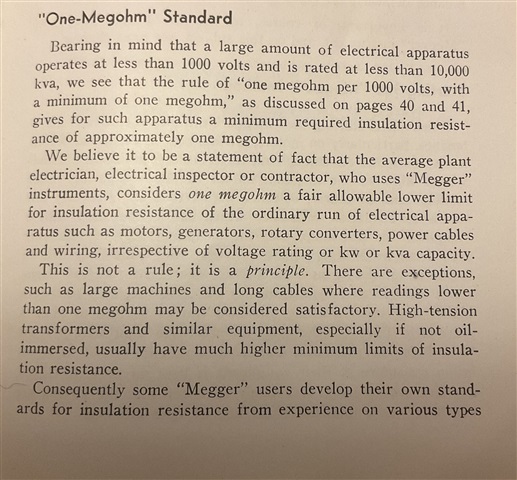
  • The one megohm minimum value is longstanding, it is discussed in my copy of The Pocket Manual of “Megger” Practice published in America by the James G. Biddle Company in 1935, though during the last ninety years we went through a period when two Megohms was recommended.

    A little Friday evening light reading:

Reply
  • The one megohm minimum value is longstanding, it is discussed in my copy of The Pocket Manual of “Megger” Practice published in America by the James G. Biddle Company in 1935, though during the last ninety years we went through a period when two Megohms was recommended.

    A little Friday evening light reading:

Children
  • Thank you for those interesting documents.

    I suspect that 1MΩ was the limit of reliable measurement with your Megger in those days. My Avometer 8 runs out of scale at 2 MΩ, though granted not at 250+ V.

    those old hand cranked Meggers  measured to 10000 Megohms, with higher values being described as “Infinity”.

    Or nowadays ">999 MΩ".

    Let's not forget the movement of the needle, or digital equivalent. If it whizzes up to the top of the scale, happy days! If it stays rooted at the bottom, go and find the screw or nail with which some wally has impaled a cable.

    If it steadily goes up the scale, but runs out of steam well above 1 MΩ, you have just charged up a capacitor.