Group 1 Medical location - maximum resistance between EBB, socket outlet and exposed conductive part - part 2 of 2

Follows on from part 1 of 2, previous post.....

Clause 9.12.1 of Guidance note 7 states:

However it also states:

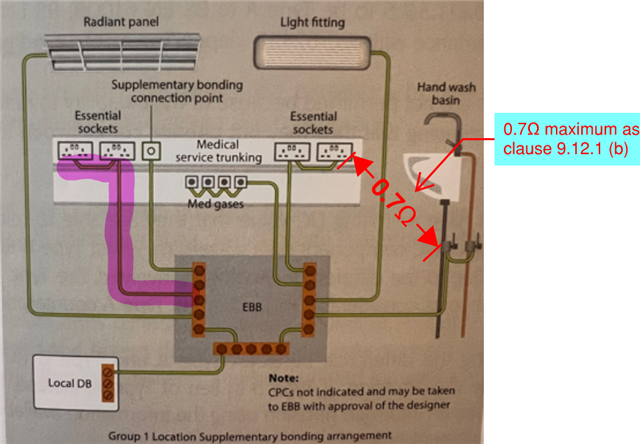
From the below diagram. I have added in red text, where I have interpreted a typical example of where the 0.7 ohm maximum resistance has to be applied. As part (c) of the clause states in general a  in general a value of 0.35 ohm can
be expected between the EBB and the earth terminal of any socket-outlet (or fixed equipment) and any exposed-conductive-part and/or extraneous-conductive-part.

For sizing of the conductors between the equipotential bonding bar (EBB) and the of bonded items, (example highlighted in pink in image below) - what should the maximum resistance be?
Parents
  • Some of the explanatory wording seems more mystifying than perhaps it could be, but the underlying principle seems clear enough - given a requirement for a certain maximum reading between any two points (that loop consisting of two bonding conductors) - one easy way of ensuring that would be to limit each of the conductors to no more than half the allowance - so 0.35Ω for 0.7Ω or 0.1Ω for 0.2Ω. I guess at a push you could allow any one conductor to be higher, but all the others would have to be correspondingly lower to compensate and it all gets a bit messier to calculate (and much more difficult for any future additions or alterations).

       - Andy.

Reply
  • Some of the explanatory wording seems more mystifying than perhaps it could be, but the underlying principle seems clear enough - given a requirement for a certain maximum reading between any two points (that loop consisting of two bonding conductors) - one easy way of ensuring that would be to limit each of the conductors to no more than half the allowance - so 0.35Ω for 0.7Ω or 0.1Ω for 0.2Ω. I guess at a push you could allow any one conductor to be higher, but all the others would have to be correspondingly lower to compensate and it all gets a bit messier to calculate (and much more difficult for any future additions or alterations).

       - Andy.

Children
  • I guess at a push you could allow any one conductor to be higher, but all the others would have to be correspondingly lower to compensate and it all gets a bit messier to calculate (and much more difficult for any future additions or alterations).

    It seems remarkably simplistic to divide the limit value (be it 0.2 Ω or otherwise) by 2.

    The EBB is required to be "in or near" each location (710.415.2.3) and "near" generally means, "immediately outside the room", so the EBB may well be adjacent to at least some sockets. It could even be on the other side of the wall.

    The length of 4 mm² cable with a resistance of 0.1 Ω is 22 m (and 13.5 m for 2.5 mm²; 8 m for 1.5 mm²) so it is not a particularly challenging target.