Group 1 Medical location - maximum resistance between EBB, socket outlet and exposed conductive part - part 2 of 2

Follows on from part 1 of 2, previous post.....

Clause 9.12.1 of Guidance note 7 states:

However it also states:

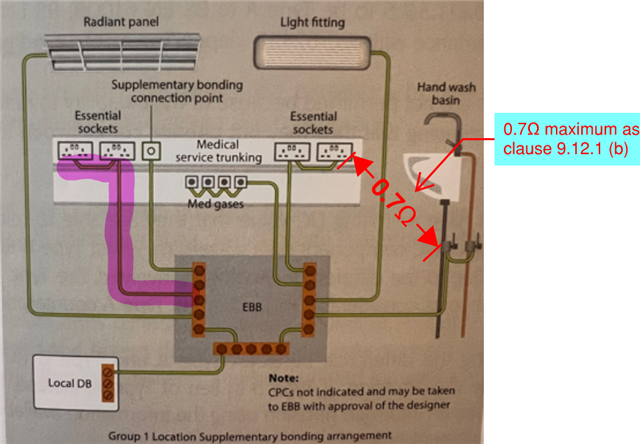
From the below diagram. I have added in red text, where I have interpreted a typical example of where the 0.7 ohm maximum resistance has to be applied. As part (c) of the clause states in general a  in general a value of 0.35 ohm can
be expected between the EBB and the earth terminal of any socket-outlet (or fixed equipment) and any exposed-conductive-part and/or extraneous-conductive-part.

For sizing of the conductors between the equipotential bonding bar (EBB) and the of bonded items, (example highlighted in pink in image below) - what should the maximum resistance be?
Parents Reply Children
  • That is an interesting document, but I am a little surprised to see  the insistence of all sockets being on the same phase.
    I'm also surprised by the recommendation to use 4mm to 'banana plug' adaptors and  wander lead to verify this - testing an in service installation this means the wander lead is connected to the reference phase. Now  the short lead in the testers hand is current limited via the meter - which is probably a high impedance unit, reducing any potential for shock with contact with the exposed banana.  I appreciate the test leads are shrouded bananas, but in a working ward or similar I'd have thought a long live single inuslated  wander lead is some way from ideal.
    Any what is the risk to patient of having 2 phases present anyway ? One phase to earth is the far more common failure mode.

    Mike.

  • An interesting read. I spotted the "Medical IT socket-outlets" (not something I was aware of) and did a search to better understand what there were.

    One point that came out was the recommendation(?) that they should be unswitched and then a discussion about medical-it-socket-outlets and who's choice it was, plus that the switched sockets er easily available on line e.g. selectric-smooth-13-amp-blue-medical-socket-outlets (google's 1st listed)

    Definitely some interesting considerations.

  • recommendation to use 4mm to 'banana plug' adaptors

    I'm guessing they don't want the medical sockets opened as part of testing with possible disturbance to the connections.

    One phase to earth is the far more common failure mode.

    But it's always the 'Neutral' phase in an insulated IT system, because it's not a faulty fault until the second fault. Grimacing  The first fault makes it 'PME' in some senses, and then that other phase becomes a hassle.

    I could be completely wrong though...