Group 1 Medical location - maximum resistance between EBB, socket outlet and exposed conductive part - part 2 of 2

Follows on from part 1 of 2, previous post.....

Clause 9.12.1 of Guidance note 7 states:

However it also states:

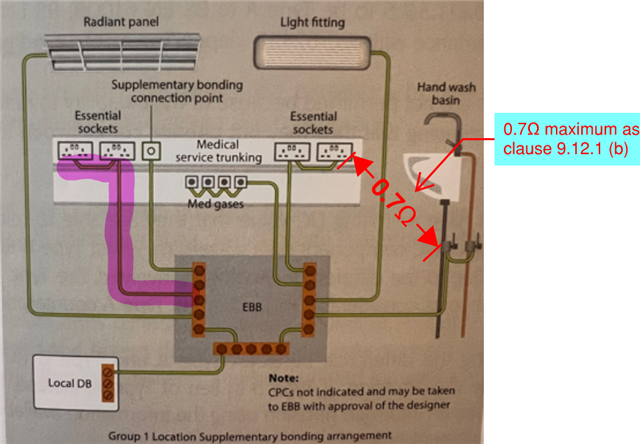
From the below diagram. I have added in red text, where I have interpreted a typical example of where the 0.7 ohm maximum resistance has to be applied. As part (c) of the clause states in general a  in general a value of 0.35 ohm can
be expected between the EBB and the earth terminal of any socket-outlet (or fixed equipment) and any exposed-conductive-part and/or extraneous-conductive-part.

For sizing of the conductors between the equipotential bonding bar (EBB) and the of bonded items, (example highlighted in pink in image below) - what should the maximum resistance be?
Parents
  • The max resistance needs to be whatever it needs to be to keep the touch voltage to 25V. generally 0.2 but that is based on 20A type B Circuit breaker(for group 2 locations) Group 1 we have RCD protection on all circuits so mostly compliant by default..

  • to keep the touch voltage to 25V.

    Is that to be read more as "substitute 50V with 25V in the formula of 415.2.2" rather than "keep the touch voltage to 25V under all circumstances" - given that fault currents exceeding that necessary to open the protective device within 5s will usually result in higher touch voltages (if for reducing lengths of time).

       - Andy.

Reply
  • to keep the touch voltage to 25V.

    Is that to be read more as "substitute 50V with 25V in the formula of 415.2.2" rather than "keep the touch voltage to 25V under all circumstances" - given that fault currents exceeding that necessary to open the protective device within 5s will usually result in higher touch voltages (if for reducing lengths of time).

       - Andy.

Children
No Data