Domestic Installer - a scheme that covers general electrical installation work in UK domestic properties only

Domestic Installer - a scheme that covers general electrical installation work in UK domestic properties only.  But what if the dwelling has 3 phase due to size of house or for Solar PV or EV (Electric Vehicle or HP (Heat Pump)?


Eg 

Single phase safe isolation 3 point test at 230v AC nominal

3 phase 10 point test but at some point phase 1 to phase two at potentially 400v AC


As always please be polite and respectful in this purely academic debate.


Come on everybody let’s help inspire the future

  • As an electrician that mainly does domestic work  I only see 3 phase maybe once or twice a year. Then on most occasions it has fairly limited impact on what I do, 

    Personally I think I have had enough training and knowledge to perform the work safely. But as I don't do it often I recognise that I have to step back and think about things more carefully. But that's like most things in electrical work, there are so many different aspects to the job that many of us will come up against things we haven't done before or in a long time on a regular basis and have to so some back ground work.

    I would say the one downside of bs7671 used on its own is that its not a good solution for identifying potential risks to think about. Its great for finding answers when you know what the question is.

    We have these crazy long check lists for an ev instal, maybe a list of things to think about with 3 phase would be useful.

    Phase rotation, phase balancing, make sure protective devices are compatible with a 3 phase board,make sure you buy boards that allow instalation  of an spd if required make sure adjacent sockets are on the same phase, how are you going to achieve a switched neutral if required, do single phase bidirectional rcbos for a 3 phase board exist or would you need a seperate board etc.

    Overall I think the hard part is working out how to comply with regs in a 3 phase environment, compared to single phase  things we do day to day suddenly change slightly and become more complex.

    I found a good example recently. Electrician had clearly forgot about buying boards that supported spds. They have bolted some spds inside the board. Totally invisible outside  have to move wires inside to see them. Customer won't be able to see if they failed and its going to take hours to change a module.

  • adjacent sockets are on the same phase

    Why? That requirement disappeared decades ago...

       - Andy.

  • The electrical installations in Grenfell Towers were all domestic installations, all the installations within the flats and the landlords halls, stairs, and communal areas come under the Notification Requirements in Part P of the Building Regulations, including any fire sprinkler systems and the like.

  • including any fire sprinkler systems and the like.

    That's a good point, but do sprinklers not fall under Part B?

  • That requirement disappeared decades ago...

    For very good reason ... although in domestic situations I'd still recommend arranging things so that, as far as possible, simultaneously-accessible socket-outlets are on the same circuit.

  • Two sets of certificates will be required one covering the fire sprinkler system electric installation design, installation and testing, and another to cover the actual fire sprinkler system design, installation and testing.

    The installation electrician may only be signing certification for the electrical installation work and maybe the testing if they did not design the electrical installation.

    Domestic electrical installations can be huge and involve many different people contributing to the design, installation and testing.

  • "as far as possible, simultaneously-accessible socket-outlets are on the same circuit"

     I must say I am not entirely clear why you would really need to worry much about that. The idea that the whole circuit means it all goes off all at once is actually something of a pain if the ADS ever operates, as indeed it is in countries where lights and power are on shared 16A circuits. 
    That said, when I was working in Germany in the early 2000s common domestic practice was that lights and power shared, and it was one floor per phase for all the single phase stuff, at least for houses with 2 floors and a cellar, and cellar and attic shared a phase if there were both.

    We are now a longish lifetime away from the old AC/DC radios and TVs that had the metal chassis attached to one pole of the mains, and 2 pin plugs that meant that half the time, that pole was a live phase. Nothing that meets modern product standards is made that way, so the only time you would be holding something live is under fault conditions. Given the whole ADS strategy hinges on simultaneous independent faults being improbable, we should afford the two faulty appliances side by side the same likelihood.

    regards Mike

  • I think that here some are using the phrase 'domestic installer' as a diminutive, for someone who only does minor works, adding the odd new socket or a fused spur for the extractor fan, or installing alarms or something, perhaps by dint of lesser experience or qualification. Sort of thing alluded to here

    https://electrical.theiet.org/media/1701/the-domestic-installer-part-p.pdf

    "It is important to note that a domestic installer is not an electrician. "

    which strikes me as an odd thing to say...

    I also thing the rest of us are using it as 'person who designs and installs on domestic property' - which can as alluded above be almost unlimited in complexity and disagree with that definition.

    Mike

  • That article was published more than twenty years ago, new requirements are coming into force on the 1st January 2026 which are far more stringent.

    electrical.theiet.org/.../eas-qualifications-guide-june-2025.pdf

    Edited- 1st January 2025 corrected to 1st January 2026, which is in around three weeks from now.

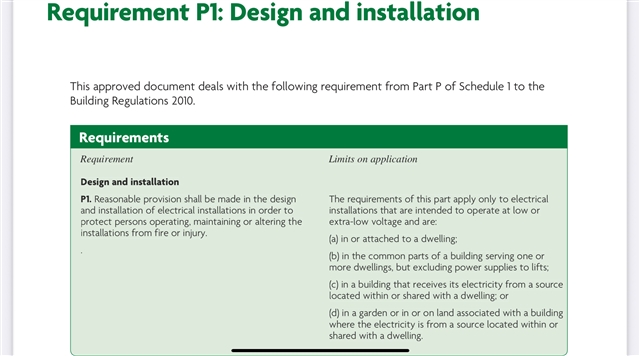
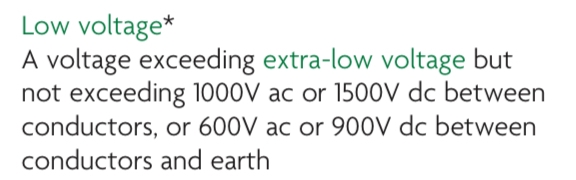
  • Part P applies to Low Voltage and Extra Low Domestic Electrical Installations, there is no mention of single or three-phase supplies and there is no differentiation between them in the Building Regulations.