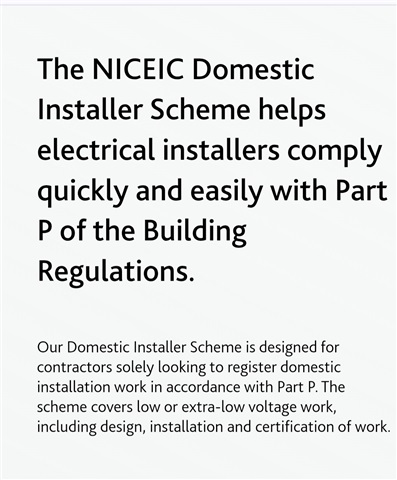
Domestic Installer - a scheme that covers general electrical installation work in UK domestic properties only

Domestic Installer - a scheme that covers general electrical installation work in UK domestic properties only.  But what if the dwelling has 3 phase due to size of house or for Solar PV or EV (Electric Vehicle or HP (Heat Pump)?


Eg 

Single phase safe isolation 3 point test at 230v AC nominal

3 phase 10 point test but at some point phase 1 to phase two at potentially 400v AC


As always please be polite and respectful in this purely academic debate.


Come on everybody let’s help inspire the future

  • Sergio said: "The CPS's say Domestic Installer is only 230v in dwelling like house/flat thus if 3PH gets fitted this will leave people having stern conversations."

    Then provided a link to this webpage, contradicting himself.


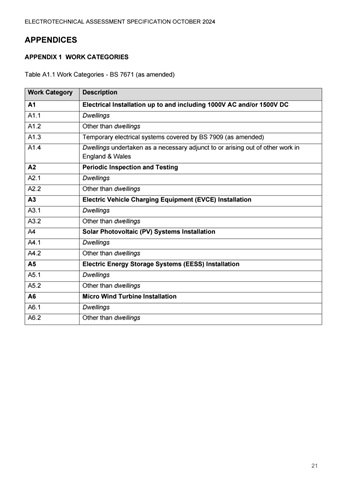
  • The EAS document:

  • I think that here some are using the phrase 'domestic installer' as a diminutive

    The vast majority of dwellings must have single phase and one consumer unit. Compared with a factory or a hospital, even a small one, the installation is much simpler.

    Let us not forget that, legally, registered CPS are for dwellings. In a sense, the exemption from obtaining building regulations approval in advance is a privilege. However, I do not think that your local authority would cope if every new circuit, etc. in a dwelling had to be notified.

  • I must say I am not entirely clear why you would really need to worry much about that.

    In a place of work, agreed, no worries ... accessing a live conductor is a breach of legislation.

    In domestic premises, access to live terminals by the curious is possible, as we have seen numerous times, by defeating shutters and poking things into the socket-outlet. Yes, this is mis-use ... but not necessarily a breach of legislation if a private individual does this in their own home (it could be considered negligent ... or a breach of a duty of care ... but that's a different matter).

    If we consider, however, someone accidentally bridging both live conductors with themselves, if the RCD protecting the circuit is not bidirectional, there is no guaranteeing the RCD protection will operate ...

    All mis-use, granted ... but the same went for the former consideration of having socket-outlets on the same phase if they are simultaneously accessible ...

  • For very good reason ... although in domestic situations I'd still recommend arranging things so that, as far as possible, simultaneously-accessible socket-outlets are on the same circuit.

    Same circuit or same phase?

    I would certainly say that in all but the grandest houses, only one circuit should serve any one room. The risk is that a householder (who has never heard of safe isolation) may wish to change a socket-outlet and for example, opens the breaker marked, "kitchen skts" in the belief that all of the sockets in the kitchen will be isolated.

  • Same circuit or same phase?

    I would certainly say that in all but the grandest houses, only one circuit should serve any one room. The risk is that a householder (who has never heard of safe isolation) may wish to change a socket-outlet and for example, opens the breaker marked, "kitchen skts" in the belief that all of the sockets in the kitchen will be isolated.

    Yes, same circuit (per function), e.g. one for lighting, one for socket-outlets.

    There are a number of good arguments both ways ... but after all, two "faults" (or two "acts of mis-use") are required to access line conductors to two circuits ... or two phases if those circuits happen to be on separate phases, or the line conductors are two phases of the same circuit..

  • It is important to note that a domestic installer is not an electrician. "

    which strikes me as an odd thing to say...

    The statement in the article is correct, providing you subscribe to the view that a qualified electrician must have a NVQL3 or equal. The domestic installer qualification is level 2. For contractors involved in a CPS, the EAS allows them to potentially move “employed” persons with such qualifications and sufficient experience into a lower risk category thereby lowering the amount of QS oversight required. The requirement remains, however, that the work of the “domestic installer” must be inspected and tested by an electrician. 

  • The requirement remains, however, that the work of the “domestic installer” must be inspected and tested by an electrician.

    I do not think that can be correct because a domestic installer is entitled to self-certify notifiable work.

  • Interesting observations, and quite an interesting extension from the UK govt. definitions here.


    https://assets.publishing.service.gov.uk/government/uploads/system/uploads/attachment_data/file/510013/VocationalQualificationsNote2016.pdf

    NVQ level 2: competence,
    which involves the application of knowledge and skills in a 
    significant range of varied work activities, performed in a variety of contexts. Some of the activities are complex or non-routine, and there is some individual responsibility or autonomy. Collaboration with others, perhaps through membership of a work group or team, may often be a requirement.

    NVQ level 3: competence,
    which involves the application of knowledge and skills in a 
    broad range of varied work activities performed in a wide variety of contexts and most of which are complex and non-routine. There is considerable responsibility and autonomy, and control or guidance of others is often required.

    I fully support the idea of folk having to show appropriate competence before being let loose by the way. I'm just not sure how good a fit those two descriptions are to what we really need in the electrical game, as I think they are deliberately fuzzy to allow qualifications as diverse as hairdressing and estate management to use the same definitions, which is perhaps not so helpful. 
    I presume then that the likes of C & G decide in more detail what material corresponds to which level for any given topic. (as an aside I find the mis-use of the work "vocation" to be annoying, as I suspect very few people, except perhaps ministers of religion, and those with some mental disorder, are actually hearing voices - the 'voca' bit -calling them and telling them what to get qualified in.  I'm aware its the official phrase, it just grates.)
    Mike.

  • I find the mis-use of the work "vocation" to be annoying

    I know what you mean, but the OED has (dating from the 16th century) amongst other meanings: The means by which a person makes a living; a person's employment or main occupation, esp. regarded as requiring dedication. More generally: a trade or profession; an occupation.