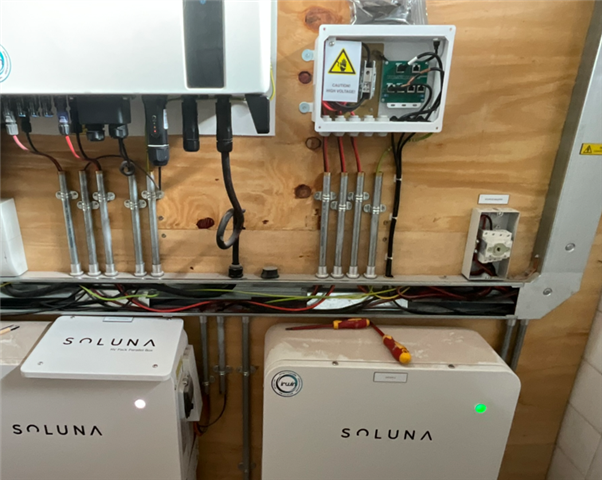
Wiring system for solar PV

Neat enough job and probably technically compliant, but is it sensible to put the DC side conductors in metallic trunking and conduit even if they do meet the class 2 or equivalent requirement? 

I am aware that there are SWA cables specifically for solar PV, so I guess there is not much difference if the SWA is earthed. However, on a slightly different point, if these SWA DC cables are buried, what is the point of earthing the wire armour?

Parents
  • is it sensible to put the DC side conductors in metallic trunking and conduit even if they do meet the class 2 or equivalent requirement? 

    What's your thinking, why do you think that would be a problem?

    When I was researching into a home solar installation, one of the topics that caught my eye was inverter design, that the older/early inverters used transformers and the DC side would, typically, be galvanically isolated from the mains/AC side of the inverter, so the DC side was a relatively simple/pure DC circuit, unearthed or earthed in some way - earthing one pole, resistively earthed with monitoring etc.

    The later designs of inverter, virtually all of the ones sold today, are transformer-less with the DC-side connections and all of the panels, cables etc connecting into the inverter's switching circuits which are themselves then connected to the mains/AC side, so the DC-side connections are not galvanically isolated from the incoming mains/AC, and depending on the design of the inverter, the DC-side will be at some fraction of the incoming AC voltage. 

    So with the DC-side not a simple isolated DC circuit, but actually a DC circuit with an mains AC potential from the inverter switching super-imposed on top, it then raises issues around capacitive coupling and leakage, particularly on the panels themselves and why its advised/required to earth these, otherwise their frames could also have an AC potential appear, with respect to earth, posing a hazard to anyone making contact with the panel metalwork. I understand this is one of the reasons why inverters typically have such high leakage currents.

    For metallic containment, I can see the positive of a continuous metal covering, reducing likelihood of contact with a damaged cable, providing a return path to earth to trip the inverter and the non-combustible metallic covering providing some containment for a fire/release of energy. But, depending on workmanship, sharp edges cutting into the DC-side cables, it could increase the likelihood of a DC-side earth fault, or a short-circuit, from pole-to-pole, or pole-earth-pole on the DC-side . You would expect the inverter to detect such a fault and shut-down, but the solar modules would continue operating, feeding current into the short-circuit (unless fused close to the panels).

Reply
  • is it sensible to put the DC side conductors in metallic trunking and conduit even if they do meet the class 2 or equivalent requirement? 

    What's your thinking, why do you think that would be a problem?

    When I was researching into a home solar installation, one of the topics that caught my eye was inverter design, that the older/early inverters used transformers and the DC side would, typically, be galvanically isolated from the mains/AC side of the inverter, so the DC side was a relatively simple/pure DC circuit, unearthed or earthed in some way - earthing one pole, resistively earthed with monitoring etc.

    The later designs of inverter, virtually all of the ones sold today, are transformer-less with the DC-side connections and all of the panels, cables etc connecting into the inverter's switching circuits which are themselves then connected to the mains/AC side, so the DC-side connections are not galvanically isolated from the incoming mains/AC, and depending on the design of the inverter, the DC-side will be at some fraction of the incoming AC voltage. 

    So with the DC-side not a simple isolated DC circuit, but actually a DC circuit with an mains AC potential from the inverter switching super-imposed on top, it then raises issues around capacitive coupling and leakage, particularly on the panels themselves and why its advised/required to earth these, otherwise their frames could also have an AC potential appear, with respect to earth, posing a hazard to anyone making contact with the panel metalwork. I understand this is one of the reasons why inverters typically have such high leakage currents.

    For metallic containment, I can see the positive of a continuous metal covering, reducing likelihood of contact with a damaged cable, providing a return path to earth to trip the inverter and the non-combustible metallic covering providing some containment for a fire/release of energy. But, depending on workmanship, sharp edges cutting into the DC-side cables, it could increase the likelihood of a DC-side earth fault, or a short-circuit, from pole-to-pole, or pole-earth-pole on the DC-side . You would expect the inverter to detect such a fault and shut-down, but the solar modules would continue operating, feeding current into the short-circuit (unless fused close to the panels).

Children
  • What's your thinking, why do you think that would be a problem?

    I wasn’t thinking safety. I was thinking that using metal trunking/conduit might increase risk of insulation faults which in turn could cause the inverter to drop out or lose grid connection. That might have financial implications, especially if, like this system, no one goes near it for months on end. 

  • I was thinking that using metal trunking/conduit might increase risk of insulation faults which in turn could cause the inverter to drop out or lose grid connection. That might have financial implications, especially if, like this system, no one goes near it for months on end. 

    Cable faults are just one potential fault cause, there's various other possible faults which could occur. If the system is going to be unattended, then perhaps set-up some form of remote monitoring, either via Wifi/LAN and the inverter manufacturer's cloud platform, or a more traditional approach, see if the inverter has any alarm outputs or volt-free contacts which could be wired up to provide an indication.

  • if a cable that is supposed to be insulated well enough that it is perfectly safe to touch and generally handle while live, can be made more likely to fail by earthing the metal nearby, by any mechanism other than mechanical damage / abrasion, there is something very much below par with that insulation...

    So long as there are grommets/ glands or bushes in all the right places, cables in trunking should be the best solution,

    Mike. 

  • but the solar modules would continue operating, feeding current into the short-circuit (unless fused close to the panels).

    Fusing PV output for d.c. fault protection can be tricky - as the available current is limited by what the panels can generate. Rate the fuse so it won't blow in normal service and it's very unlikely to blow given a short as the available current, even during bright sunshine, won't be much larger (max 1.2x comes to mind from somewhere, but I may have imagined that).

       - Andy.