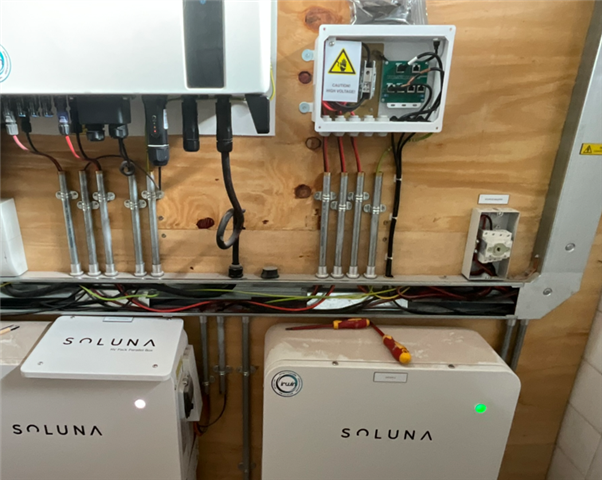
Wiring system for solar PV

Neat enough job and probably technically compliant, but is it sensible to put the DC side conductors in metallic trunking and conduit even if they do meet the class 2 or equivalent requirement? 

I am aware that there are SWA cables specifically for solar PV, so I guess there is not much difference if the SWA is earthed. However, on a slightly different point, if these SWA DC cables are buried, what is the point of earthing the wire armour?

Parents
  • Just thinking aloud...

    A lot of the early regs on earthing talk about preventing metalwork becoming "charged" - these days with almost everything a.c. we tend to think of that happening either because of insulation breakdown or capacitive coupling as any tiny leakage of a.c. currents will discharge on the next half cycle as easily as it charged on the first half-cycle. With d.c. power though I guess there's a potential for a charge to slowly build up on the unearthed metalwork over a very long time just due to less than perfect insulation (it may be many mega Ohms, but it's still not totally perfect) - if the metalwork is substantial then it could hold a reasonable charge (just like a capacitor) - maybe enough to give a jolt if it discharged to Earth via human contact?

      - Andy.

  • could hold a reasonable charge (just like a capacitor) - maybe enough to give a jolt if it discharged to Earth via human contact?

    That is 'static electricity'.

    One can estimate an upper bound for any given situation. The capacitance of something isolated to free space is always less than that of the sphere that surrounds it, and the capacitance to local ground can be estimated as a series of oddly shaped parallel plate capacitors, To give a feel, people are typically 100pF or so, the more ah  'corporeal' (being more like that ideal sphere) perhaps a few hundred, a car may be 1000pF and a lorry a few thousand. 

    The energy on a capacitor is 1/2 CV^2 so on 1000pf you don't get that much energy per kV 

    So how much hurts ? a whole joule is a bite like an electric fence, and the twitch/ startle response can be enough to cause injury.

    less than 0.1J is still an 'ouch- bleep' but not usually a problem, and around 1mJ or less (0.001 joules)  is the sort of crackle from combing hair vigorously or putting your socks on on a dry day and unremarkable.

    Having said that, note that under the right conditions, petrol vapour can be ignited by about half a millijoule, and methane (domestic gas) about half that again.
    There is a reason for the earthing worries near petrol pumps and anti-static flooring in places handling volatile chemicals.

    Generating that level of stranded charge accidentally from a DC supply can be very much a problem with kit that throws a lot of voltage, like particle accelerators X ray machines and so on. Luckily this is only normally found in bigger hospitals, university research sites and a few 'ministry' type places that are quite coy about what they actually do...  In such cases a gentle bleed down, with braids and metallic or carbon fibre brushes bridging between places where you don't want a voltage to build is the solution.  I have seen sparks drawn from metal steps left on a rubber mat before... 

    However, at voltages below a thousand, as currently solar systems are, the capacitance needed to pack a dangerous punch requires charging an unreasonable volume  of unearthed  metalwork. A long length of floating armour at the odd kV could I suppose be bad news. (perhaps 50uJ per metre. I'd be wary of 100m length of SWA being enough to ignite a vapour, but not to deliver a serious shock .)


    The other place where problematic charge build up happens, that is probably more familiar, at least to factory sparks, is where different insulators are constantly making contact and separating - rubberised conveyor belts and plastic rollers are a classic, but things like paper mills also have this issue.  Here the voltages can be tens of kV and up, and will both damage electronics and certainly make people jump if not carefully managed.

    Mike

Reply
  • could hold a reasonable charge (just like a capacitor) - maybe enough to give a jolt if it discharged to Earth via human contact?

    That is 'static electricity'.

    One can estimate an upper bound for any given situation. The capacitance of something isolated to free space is always less than that of the sphere that surrounds it, and the capacitance to local ground can be estimated as a series of oddly shaped parallel plate capacitors, To give a feel, people are typically 100pF or so, the more ah  'corporeal' (being more like that ideal sphere) perhaps a few hundred, a car may be 1000pF and a lorry a few thousand. 

    The energy on a capacitor is 1/2 CV^2 so on 1000pf you don't get that much energy per kV 

    So how much hurts ? a whole joule is a bite like an electric fence, and the twitch/ startle response can be enough to cause injury.

    less than 0.1J is still an 'ouch- bleep' but not usually a problem, and around 1mJ or less (0.001 joules)  is the sort of crackle from combing hair vigorously or putting your socks on on a dry day and unremarkable.

    Having said that, note that under the right conditions, petrol vapour can be ignited by about half a millijoule, and methane (domestic gas) about half that again.
    There is a reason for the earthing worries near petrol pumps and anti-static flooring in places handling volatile chemicals.

    Generating that level of stranded charge accidentally from a DC supply can be very much a problem with kit that throws a lot of voltage, like particle accelerators X ray machines and so on. Luckily this is only normally found in bigger hospitals, university research sites and a few 'ministry' type places that are quite coy about what they actually do...  In such cases a gentle bleed down, with braids and metallic or carbon fibre brushes bridging between places where you don't want a voltage to build is the solution.  I have seen sparks drawn from metal steps left on a rubber mat before... 

    However, at voltages below a thousand, as currently solar systems are, the capacitance needed to pack a dangerous punch requires charging an unreasonable volume  of unearthed  metalwork. A long length of floating armour at the odd kV could I suppose be bad news. (perhaps 50uJ per metre. I'd be wary of 100m length of SWA being enough to ignite a vapour, but not to deliver a serious shock .)


    The other place where problematic charge build up happens, that is probably more familiar, at least to factory sparks, is where different insulators are constantly making contact and separating - rubberised conveyor belts and plastic rollers are a classic, but things like paper mills also have this issue.  Here the voltages can be tens of kV and up, and will both damage electronics and certainly make people jump if not carefully managed.

    Mike

Children