Could/Should a uk domestic dwelling need a 10kA breaker in the future

Could/should a UK domestic dwelling need a 10kA breaker in the future, especially with the rise of high-power EV chargers or heat pumps, as these additions can increase potential fault currents (PSCC) beyond what a standard 6kA breaker can handle, making 10kA a safer, "future-proof" choice for new installations or upgrades, even if 6kA is often sufficient for basic setups


As always please be polite and respectful in this purely academic debate.


Come on everybody let’s help inspire the future

  • I'm not sure that installing a heat pump or an EV charger can increase the PSSC - that is more a matter of supply impedance, set by substation transformer size, and then the length and choice of DNO cabling. I don't really see home generation with solar panels changing that either, or even large battery banks, being neither needed nor able to generate currents of more than a few tens of amps, and even a few hundred wouldn't  touch the sides in terms of the error bars on a typical PSSC test result.

    What I  can imagine is that average loads increase, and that may drive domestic split or 3 phase supplies to become more common, as this is both easier in terms of the existing distribution, and quite a lot safer in terms of arc flash and PSSC per line than a single phase higher current supply to get the same total kVA.

    How many times do you measure a PSSC greater than 6000A on load side of a 100A cut out ? Round here it is rare, so rare in fact I dont think I've ever seen it ! (while less than 1kA and some muttering about lights that noticeably dim when the kettle comes on, now that is quite common. Maybe I'm out in the sticks a bit. )

    Realise also that so long as the cut-out fuse is a modern cartridge type of the BS88-3 or BS1361 (ii) flavour, then the energy limiting action of the company fuse already protects the 6kA breaker, and that in effect means you are good up to  supplies of up to about 16kA PSSC - by which time you have to be  practically camped on the transformer and or have a factory style busbar instead of a normal meter & tails.

    This may be a problem in flats with a transformer on the same floor I suppose, but personally I cannot see high PSSC becoming much more of an issue than it already is. 

    Mike

    PS 

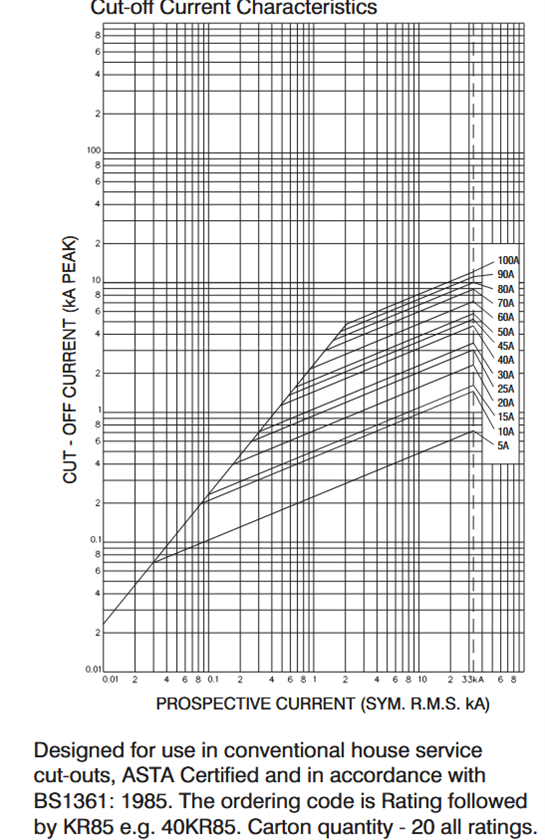
    Here is a bit more on how important it is that the supply fusing between the substation and the MCB is the right energy limiting type above 6A. Example Bussman 1361 house service fuse data.  A 6kA breaker on a supply with a different upstream fusing arrangement, is NOT guaranteed to survive or fail safely on supply with  a PSSC above 6kA. Old cut outs with unknown or rewirable fuses may need to be changed, or augmented by a modern fuse but there are hopefully not too many left in use.


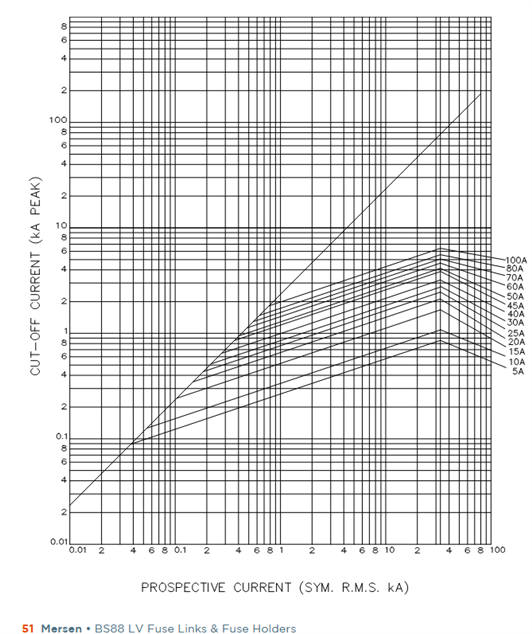
    Similar shaped BS88-3 curves from Merson (page 50...) show a closer energy limiting action.

    The values of I2T is the total let-through - this is what  damages downstream equipment. Quoted pre-arc levels are also quite different.

    TYPE RATING (A)  I2T I2T LOSS(W)

    BS88-3   BMF42V100 100   68000 5.8
    BS1361 100KR85 100  73,500 6.1

    In any case, once above 6kA PSSC at the incomer, it is very important to check  the supply arrangements in terms of upstream fusing. 

  • as these additions can increase potential fault currents (PSCC) beyond what a standard 6kA breaker can handle,

    UK consumer units do have 6 kA breakers, but they must be suitable for a 16 kA prospective fault current! This has been the case for 10s of years, and this has been part of product standards for UK consumer units from the standards that preceded BS 5486.

    In current, and more modern, consumer units to BS EN 60439-3 and BS EN [IEC] 61439, the use of 6 kA breakers for a 16 kA prospective fault current is termed 'rated conditional short circuit current' and given the symbol Icc. This is tested for in the UK national annex to the relevant assembly standard for consumer units.

    For consumer units specifically, this is addressed in Regulation 536.4.201 of BS 7671:2018+A2:2022. The 16 kA conditional prospective fault current rating is applicable for public supplies with a 19.6 kA prospective fault current at the transformer, provided that the service cable length is at least 2 m in length.
    Equally importantly, the UK-specific testing for conditional prospective fault current is a key reason why you can only install devices approved by the manufacturer in a CU in the UK (see Regulation 536.4.203).

    Icc can also be specified for RCCBs and switchgear in other situations, provided the backup overcurrent protection meets the manufacturer's requirements. This is addressed in Regulations 536.4.2.3 and 536.4.2.4 of BS 7671:2018+A2:2022

  • I would say no. Not with the forthcoming black and brown-outs we will soon be experiencing due to Net Zero. Demand will be reduced and measures will be introduced via your smart heat pump and car charger aps whereby neither will be permitted to connect at the same time. Cooking times and electric shower times will also be controlled and rationed. The data centres will take priority over demand from domestic consumers because the computers will be working overtime to provide AI answers to Ministers as to why the population is kicking off,. and all of the energy will be needed to power all those cctv cameras and electric panda cars to police the civil unrest which will ensue.

    Happy 2026

  • Wink