High earthing conductor current at a house

In the discussion on a similar topic concerning a bridge, JP kindly wrote:

Chris

An urgent investigation is required.

You don't say how much current is flowing in your protective conductors?

The symptoms of a lost neutral,  or a high resistance neutral, on a PME installation are ...

I can only measure to the nearest 10 - 20 mA. The current in the earthing conductor, which matches the difference between line and neutral, is highly variable, but seems to be between 10% and 15% of the line current. There are currents of a few tens of mA in the gas and water main bonds. They do not sum to the value in the earthing conductor. Even though the water supply is plastic, there may be a connexion between gas and water in the CH boiler.

Turning off the main switch reduces the current in the earthing conductor to zero. Turning off all the breakers also reduces it to zero. No one MCB abolishes the current: instead, the greater the number of closed breakers, the greater the current.

Stainless steel garden fork to kitchen sink or gas cooker gives about 0.15 V. Met to garden fork gives about 0.3 V.

Zs to a convenient socket was 0.57 Ω.

If there is a N-E fault in the installation, I suspect that it is in a ≈ 10 m length of SWA which goes from a switch-fuse adjacent to the meter, under the floorboards, to the main DB.

Investigations will continue tomorrow.

  • Try looking for the many 'vampire' electronic circuits that are likely to have EMC / EMI / RFI filters within them..

    No one MCB abolishes the current: instead, the greater the number of closed breakers, the greater the current.

    Things like TVs and digital boxes on standby, mobile phone chargers, PCs, displays, printers, laptops and their charger / PSUs, along with establishing which circuits they are on. Likewise the boiler circuit and central heating timers, microwaves and cookers, fridge and freezer. Solar inverters and car chargers (and electric bicycle chargers) are also possible leakage sources (all especially so when in standby mode).

    It's a veritable maze of appliances and circuits of power wasters (££) and leakage providers.

    I don't know which is worst, to find a cable fault, or to realise it's all normal current wastage ?  Grimacing

  • It's a veritable maze of appliances and circuits of power wasters (££) and leakage providers.

    Philip, I couldn't agree with you more. We recently had a smart meter installed and this shows a background consumption of about 120 W. Broadband router and its booster are always on. Then tellies, printer, phones, iPad and 'phone chargers, clocks (on boilers), microwave with its own little clock, fridge-freezers with their temperature displays, all with little LEDs, etc. Even the smart meter display draws a few mA!!!

    However, it does not account for 1/2 A to 1 A down the earthing conductor.

  • is your incomer TNC ? if so if it  is all 'in house' I'd expect the earth current to scale with the load - as your fault will be one resistance in parallel with the NE split which is another. Both are largely constant & resistive.

    If you are looking at an amp or so, while main current is a few tens of amps, then the two resistances are in the ratio of say 10 to one or whatever the current split is. Such a significant fault cannot be load side of a working RCD, or you'd never keep the thing held in.

    Not sure if that helps focus attention on a reduced area?

    Mike.

  • We recently had a smart meter installed and this shows a background consumption of about 120 W.

    Our discovery was more that we'd had solar and battery installed, and even with a full battery charge (5kWh) we'd find that it was hit or a miss about the battery supplying all trickle loads through the night. The fridge & freezer were the main load.

    does not account for 1/2 A to 1 A down the earthing conductor

    Getting a clean reading can be tricky. We've an overhead supply (1ph) from a 3 phase pole distribution in the other corner of our garden. Our only mass-of-earth is via the water pipe / plumbing bond, so I think I some times get part of the 3ph out of balance via the DNO neutral supplying the MET point.

    I have noticed that I can get different / fluctuating results from the simple clamp meter depending on positioning within the internal cabinet, the tails and the CPC lead, i.e. imperfect sensing current's magnetisation into the 'CT' of the clamp meter.

    The overall 500mA+ reading does sound high for the 'normal' additive leakage currents - that's a lot of real power trying to create RF balanced conductive emission leads! 

  • Philip, thank you again. I forgot the toothbrush chargers.

    The whole thing does not seem quite right, but there must be a lot of householders in a similar position who have measured nothing.

  • Such a significant fault cannot be load side of a working RCD

    Who mentioned RCDs? 15th Ed, so RCD sockets by the back door and in the conservatory.

  • If the current drops to zero in your earehing conductor when you turn off yur main switch that points to an IR fault on your installtion probaly neutral to earth. If you had RCDs on the origins of ciruits they would be tripping on the faulty circuit.

    Clamp your meter tails minus the earthing conductor with your clamp meter with the supply on. If you get a reading then that would prove an IR fault. You will get some leakage from Class 1 appliances with a front end noise filters but not the amount you have measured.

    Not looking like a PME fault but for a final check clamp the gas pipe itself.

    Let us know how you get on?

    Screwfix do a range of modern consumer units that would provide a quantum leap foward in the safety of your installation!

    JP

  • At least you have proved that your earthing conductor is conected to something earthy. Isolate and disconnect the earthing conductor and do a loop test to see how good your earth is, then do the same for your neutral and see how good the neutral is. Your meter may also give you a simultaneos voltage reading, if not measure the voltage line to earth and neutral to earth a record the voltages.

    While you are in Screwfix get a pack of 19 core tails with a 16mm earthing conductor, they are eqasier to manimulate.  No need for a front end SPD if you have one intergrated in to your super safe consumer unit. 

    JP

  • Chris

    Most of the loads you mention like your toothbrush charger are Class 2 appliances so you will not get earth leakage current from them.

    They are parasitic loads when not performing a function so costing you money. I power logged my installation for a week and saw how much wastage there was on my installation and a had a campaign of switching everything off at the socket when not in use. Partially  successull due to variable compliance with the senior management stating that no one else does this.

    IR testing of your installation with all loads disconnected at 250V will be revealing?

    JP

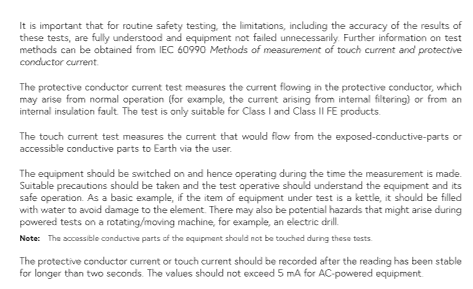
  • Above from the COP for In-service I&T of Electrical Equipment. The 5mA seems liberal for an individual appliance. If I recall correctly, earlier versions of the COP had tables indicating allowable leakage for class 1 equipment of 1mA and higher for certain heating equipment. Perhaps the increased use of filtering on much equipment put paid to those values.

    It would seem that even a small number of such appliances could quickly increase earth leakage. I recently measured things in my own home which is TT. Everything off 3mA, everything on but not necessarily drawing normal load current, 11.4mA. Reasonable spread across circuits. Used two separate Megger earth leakage devices for comparison. Didn't inspire me with confidence that the results are an accurate reflection of reality but I guess a reasonable degree of allowance needs to be made for field measurements.