Coding and regs in force at time of installation

While we code to the current regulations we seem to make allowances usually a C3 for earlier installations.

for example Arc Fault Detection Device in a high risk residential building, if the building is 20 years old this makes sense, otherwise we would have to upgrade many properties.

how should we code if the building was wired recently when Arc Fault Detection Device is required .

Arc Fault Detection Devices were just picked as an example but could apply to any changed requirements where the installer has not met the regs at the time.

  • This question keeps coming up with statements like, " it was safe at the time of installation so it must be safe now".

    Assuming that the installation is in good condition (with no N-E faults), when does it become unsafe?

    Take RCD protection. I do not know when it became mandatory, or even advised, but my installation at home circa 1982, so 15th Edn, addressed the risk of shock outdoors by having RCD sockets by the back door and in the conservatory, and RCBOs in the CU in the outbuildings. At some stage, RCD protection indoors became mandatory on socket circuits, and now on domestic lighting circuits.

    So the gap between what was considered safe say, 50 years ago, and what is considered safe now has been steadily widening. However, as Note 2 to 651.2 says, that 50 year old installation is not necessarily unsafe, just less safe.

    An ancient householder may say that he (or more likely, she) has lived in the house for over 50 years and never had a problem.

    So for me, it is very much shades of grey and not black and white.

    ETA: the Government's current consultation on road safety considers mandating a whole raft of safety devices in new vehicles. Many (most? all?) are currently available. So where is your cut-off? 20 year old car, 50 year old car, 100 year old car?

  • the inspection should be carried out against the current edition of BS 7671

    That could lead to some confusion.  EG. BS7671 does not mention distance from kitchen sink for a plug and socket arrangemant

  • That could lead to some confusion.  EG. BS7671 does not mention distance from kitchen sink for a plug and socket arrangemant

    Therefore you can't simply code a socket simply for being <300mm from the sink - instead you have consider whether it's suitable for the conditions - which is a BS 7671 matter (perhaps informed by guidance that gives typlcally acceptable distances for typically IP rated (IP2X) sockets).

       - Andy.

  • So what ? There are lots of things the regs don't give a hard number for. The inspector is paid to make a professional judgement, not to parrot figures from some guide, anyone can do that.


    I'd suggest that an inspection, if it is to be done properly is actually not an activity suited to the inexperienced, as it requires the ability not just to install something in one specific 'cookie cutter' way that works, but also to step into the shoes / mindset of the original designer and/or installer to see all the other possibilities, and perhaps all the credible failure modes, and then decide if it was sensible or not.

    Books like the code breakers may be a good friend, but I suggest also a bad master. 

    Mike.

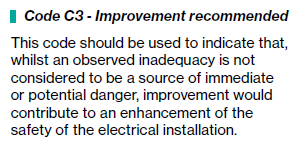
  • If the inspector considers that an item, although not warranting code C1 or C2, requires improvement, it should be given code C3 on the EICR.

    I have dismissed the wording in GN3 as a mistake. 

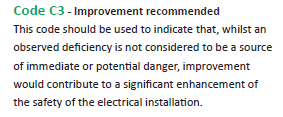
    The above from Best Practice Guide 4 Version 7.2. Note the wording difference in a previous version below. Omit "significant" and a C3 can apply to any pittance of an enhancement, perhaps designed to accommodate those pushing AFDDs!! (Sorry for the cynical remark, the City and Guilds debacle has angered me and coloured my view on any guidance that can be tainted by a commercial connection). 

  • Lex de minimis non curat.

  • I don't see any mistake there.  If something does not cause any immediate or potential danger, how does fixing it produce a significant enhancement of the safety of the installation?

  • to step into the shoes / mindset of the original designer and/or installer to see all the other possibilities, and perhaps all the credible failure modes, and then decide if it was sensible or not.

    The use of the property is also important.  EG a PRS (Private Rental Sector) average 3 bed dwelling as this will include the requirement for smoke/heat alarms.  The CO alarms should/could be dealt with by the heating engineer when they do their annual Gas Safe Service and inspection.  

  • At the risk of second guessing,  

    I think Lyle's concern is that the upper of those two quotes leaves open the door to a "make-work" approach to very marginal improvements, and someone may quote to go round oversleeving red cable with brown or something, that is equally neither cost effective nor desirable and brings the business into disrepute as rip-off merchants.

    M

  • I am inclined to agree with Simon. The word, "significant" is otiose because you would not code a non-compliance which is trivial - e.g. red and black conductors instead of brown and blue.