A solar PV question

I think that I am getting to grips with solar PV, but slowly.

Annex D82 shows a typical domestic system. I do not intend to have load shedding, but there will need to be metering of the connection to the grid. Presumably, this is achived by putting a CT clamp on the relevant cable.

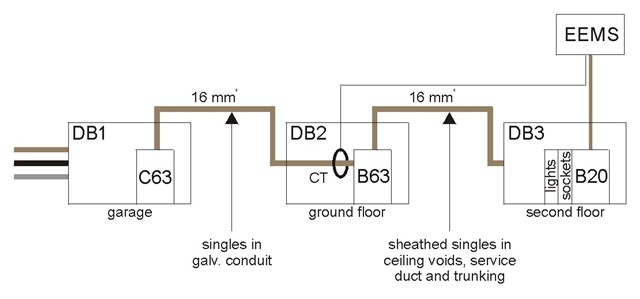
I would like to get the installation as ready as it can be for when I get a system put in. On the second floor, there is a small DB which serves one lighting and one socket circuit. For some reason which is unclear, the distribution circuit uses 16 mm² cable. So the easiest and most economical approach would be to wire the inverter output into the second floor DB as shown in the diagram below.

Whilst I have the floorboards up for other work, I thought that it would be useful to install a CT clamp. So, my question is whether there is a standard design, which would allow me to do so, or whether each manufacturer has their own specifications?

If any of you can see any other potential snags, do please let me know.
Parents
  • but there will need to be metering of the connection to the grid. Presumably, this is achived by putting a CT clamp on the relevant cable.

    Depends what the metering is for. If money's involved it usually means a MID certified meter - and all the ones I've seen have been the direct wired whole current type (domestic sorts at least). In the days of the feed-in-tariff a "total generation" meter was fitted in the PV's a.c. circuit, but if you're just going for Export payments, your supplier's revenue meter should handle that (smart meters have a separate export register).

    If it's for more for load shedding or just "for curiosity" logging or monitoring then a CT is more usual. CTs come in a few different types - as well as differing ratios they often come with some means of protecting against open circuit on the secondary side - e.g. an in-built burden resistor (of various values) or zener diode type clamping of the output - so there are quite a few different permutations possible.

      - Andy.

Reply
  • but there will need to be metering of the connection to the grid. Presumably, this is achived by putting a CT clamp on the relevant cable.

    Depends what the metering is for. If money's involved it usually means a MID certified meter - and all the ones I've seen have been the direct wired whole current type (domestic sorts at least). In the days of the feed-in-tariff a "total generation" meter was fitted in the PV's a.c. circuit, but if you're just going for Export payments, your supplier's revenue meter should handle that (smart meters have a separate export register).

    If it's for more for load shedding or just "for curiosity" logging or monitoring then a CT is more usual. CTs come in a few different types - as well as differing ratios they often come with some means of protecting against open circuit on the secondary side - e.g. an in-built burden resistor (of various values) or zener diode type clamping of the output - so there are quite a few different permutations possible.

      - Andy.

Children
  • Andy, thank you.

    The smart meter will take care of the money side of things.

    I had assumed that the grid tie would have to be measured, not least in the dark so that the rate of discharge of the battery would match the house's loads (if sufficient) and not simply discharge into the grid.

  • I had assumed that the grid tie would have to be measured, not least in the dark so that the rate of discharge of the battery would match the house's loads (if sufficient) and not simply discharge into the grid.

    Yup, I'm sure that's right if the PV inverter has a battery built-in (eve now not all do of course) - same principle as load shedding, but aiming for zero import rather than some below some higher figure. Some export tariffs pay quite well (e.g. 15p/kWh) so it's no always cost effective to store to self consume. On the other hand if you are going for a battery system it might be worth looking at one that can be charged from an off-peak tariff as well. Lots of options!

        - Andy