Trying to get a better understanding of RCD requirements

I am visiting a customer today to quote on installing an outside socket for the supply of a split air conditioning unit.

Installation manual just says, recommend the use of a 30mA RCD, no other details.Phoned tech support, apparently never been asked what type of RCD should be used and didn't know there were different types. ,Just know that it should be a high immunity RCD. Need to find out if the high immunity RCD requirement is just general guidance or for specific models. The unit creates a variable load between 0.5 and 7.0A, with max current of 10A, presumably on start up. The variable load implies to me a variable speed drive.

There are a few companies that provide high immunity RCD's, Hager, Schneider etc. Assuming that the convenient way to supply the outside socket will be from an existing ring final it's going to be inconvenient and expensive if I can't use the existing RCD or RCBO and a suitable replacement isn't available, clearly if there's a type AC in place it will need changing.

Reading around I can see that high immunity RCD's tend to be type A's that have filters to stop tripping short spikes in leakage (up to 10mS) from tripping the rcd. It also sounds like a type F RCD has or may have similar features, couldn't find anything specific enough to trust. There are a lot more companies providing type F and type B RCD's now, hence the interest in suitability.

I could be very safe and completely over engineer the job, but then a handyman will just quote for a external socket on an existing type AC RCD. I loose the revenue and customer has an unsafe installation. Trying to find the right compromise.

As a side question I am trying to get a better understanding if RCD types and in practical terms what improves when going through type A, F and B. Clearly understand the DC blinding issue, but as we move beyond type A, as an example are we gaining immunity to high frequency leakage or are we gaining the ability for high frequency leakage to cause a trip. If I spend long enough reading the specs I will work it out, just wondering if there is a good explanation anywhere.

Looking at BS7671 it has a table showing what leakage from various AC rectifier faults look like. But there doesn't seem to be anything showing what leakage from switched mode PSU's, variable speed drives etc looks like under normal and fault conditions. I can make some educated guesses, but overall feel there's a lack of information.

  • You need to find out more about the load ie: leakage current and type dc,ac,pulsed dc and frequency,a variable frequency drive may need a type f, type b or type b hp. Motor startup current is more for the ocpd as is running current. 

  • I loose the revenue and customer has an unsafe installation.

    Or perhaps the installation is safe, but the customer gets nuisance tripping.

    "High immunity" and "super immune" seem to be marketing hype. Are they to a new standard?

  • I think a bit of both, I know Hager have been marketing a new RCD recently that apparently overcomes nuisance tripping with heat pumps. reading marketing from others; apparently there can be a surge of leakage current with motor startup, lasts less than 10mS and they put a low pass filter in to stop this causing trips.

  • You need to find out more about the load ie: leakage current and type dc,ac,pulsed dc and frequency,a variable frequency drive may need a type f, type b or type b hp. Motor startup current is more for the ocpd as is running current. 

    I wish I could get more information. The tech support people I could get hold off didn't understand the difference between MCB overload curves and types of RCD and just kept on stating that the electrician is responsible for selecting the protective device. It's one of the many Asian companies, even if there is someone in europe that's more than first line support I don't know how to get hold of them.

    Also discussed the high immunity statement again, turns out they were just talking about a type C overload curve for the MCB.

    It's only the second time I have been asked to put in a supply for aircon and both manufacturers have not been able to provide suitable information. Both claim they are never asked about RCD type. I assume others aren't asking because they don't want to add an expensive type B or type F to the quote, although looking recently they are beginning to reach sensible prices.

  • Welcome to the minefield of RCD selection for Inverter driven motors. I brought this up a year or so ago when fitting a heat pump at my own house. I suspect your heating/AC unit will be inverter driven (most are nowadays), so the typical RCD requirement would be a Type B. Or maybe a F.

    On the thread linked below, there is a link to the Hager RCD selector. It isnt clear for individual applications.

    To cloud things even more, Fusebox supply a Type B RCD, which was, and still is, being widely used for HP installs. Mainly as it was the cheapest out there, and available at many Wholesalers. But then Vaillant issued a safety update which stated that the Fusebox Type B RCD does not meet their disconnection requirements. I think that was in another thread (started by Andy Jewsbury iirc). So you could do the right thing, fit the expensvie Type B RCD, then still not comply with Manufacturers requirements.

    I never did get the answer about the product standards for the Type Bs. Are Fusebox not meeting that standard, or are Vaillant requesting an item that goes beyond the requirements of the RCD product standard?

    So there you see, a minefield.

    https://engx.theiet.org/f/wiring-and-regulations/31020/rcd-types-an-informed-source-of-information

  • What is new about VSDs? My lathe was fitted with one 30-odd years ago. If we had had RCD protection then, it would only have been type AC.

  • First thought - why a socket? All the A/C (and indeed HP) installs I've seen have been hard-wired with a rotary isolator - maybe (from a BS 7671 perspective) you don't need an RCD at all? (presuming it's TN, not TT, of course).

    From what I could gather (perhaps from more reading between the lines), the B-HP type recommended by Vaillant et al were down to nuisance tripping issues as the inverters can have higher leakage currents at higher frequencies (anything up to 150mA at 1kHz). The manual that came with my HP seemed pretty clear that an RCD was optional (i.e. only needed when the installation conditions demanded one, rather than for the benefit of the HP itself) - I did query with Vaillant themselves whether their latest press release was meant to imply a 30mA B-HP was really needed on all installations, or just those installations where a 30mA RCD was already needed (e.g. due to soft sheathed cables concealed in walls) - I've had an e-mail to acknowledge my question, but as yet still no reply. So mine has gone in without any RCD protection (but does meet 543.7 for high protective conductor currents).

       - Andy.

  • Is there a market for a "high immunity" RCD that never trips, except when you press the test button?

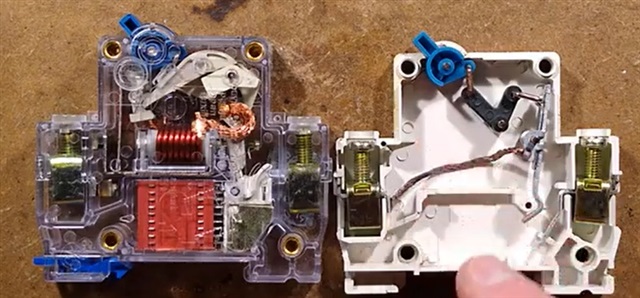
  • The equivalent non functional MCB already exists


    A similar rated real one on from another 'no-name' brand on the left for comparison purposes ;-) (Clear body devices are found in a few places with lower fire standards and a culture of fakes - like that it is instantly inspectable...)
    The fake was sold under the 'Stilon' brand I think.


    Presumably because as the building burns it indeed remains 'still on'. An argument for 'death or glory' back-up fuses to give some fallback energy limit, and some sort of  supplier verification or testing of suspiciously cheap parts.

    The same sort of folk who thought that was a good idea may well make the kind of RCBOs you suggest as well.

    Image taken from this "bigclive" video from about 6 years ago.
    (https://youtu.be/2TJEzdqtXlQ )

    regards Mike.
    see also

    www.voltimum.co.uk/.../counterfeiting-alert-1

  • The RCD question originally came up because I was trying to stay within the installers recommendation to the client and install an outside socket connected to an existing ring final, clearly not an option for various reasons.
    The plan now is to run a cable round the outside of the house in conduit to a rotary isolator, supply coming from one side of a split load board, protected by a 30mA type A RCD. Moving to no RCD protected would either mean restructuring the board layout to enable a non rcd protected way, or install an additional board, which I am trying to avoid.