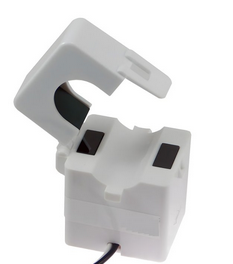
Current transformers

In distribution subs they have thermal ammeters I think they have a 30 minute warm up time so they don't get hammered by large starting currents or faults. I think I'm right in saying that the meters are switched out if circuit forr most of the time I'm you'd you can't leave CTs open circuited so do they just put a resistor across  the CTs in are the meters usually left in circuit. 

Parents
  • Also worth considering that, without a resistor or short at the current transformer, the voltage will not be maintained in the SELV range.

    You can buy current transformers that are guaranteed SELV, but they are very expensive.

    For other current transformers, these need to be treated as FELV at least, if not LV, and preferably go in an enclosure. Similarly, insulated wires not in containment or sheath wouldn't meet BS 7671 requirements.

    Only mentioning this, as current transformer installation is ramping up with PV inverters and EV charging equipment ... but not always installed according to BS 7671 requirements because the actual potential voltage range is not considered.

  • Similarly, insulated wires not in containment or sheath wouldn't meet BS 7671 requirements.

    Such as the CTs which are left dangling on the meter's/consumer's tails?

  • This all depends on where the CT wires go next  - the insulation from the meter tails is not the problem, and I can see the metering folk not wanting a box where you cannot see where the tails go as it would be an ideal meter bypass connection point.  The CTs for the PV rigs I have seen are insulated singles, and look adequate for alarm/ phone quality wiring.

    One saving grace is that the core sizes are small, and step up ratios conspire to not generate the same horrible voltages as the industrial bus bar ten thousand turn units can before saturation.

    For example, this brand of inverter and controls  which I think are the kind of thin tails kind you refer to, has options to takes a 'high' ratio CT ratio of 2000: 1 or a 'low ratio' one of 300/5 (or 60:1 as we'd call it normally) 

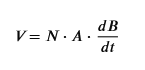
    To estimate open circuit voltage at core saturation look at the magnetic cross section of that sort of core (Am ~ a couple of cm2 at most ). In a none uniform core this  is the point the magnetic field lines all neck down, so the centre leg in a traditional EI core shape, and is where saturation occurs first.

      and assuming a core Bsat of 1Tesla  at  50Hz dB/dt when peak B is +/- 1Tesla is ~ 300 tesla per second. But as above here A is only 2/10000 of a square metre, so the volt per turn at saturation is about 600/10000 or 60mV (if you prefer about 15 turns per volt. TPV)
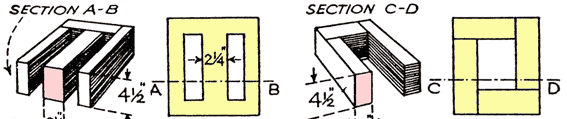
    Note we don't normally saturate cores, and for conventional (voltage )transformers at 50Hz, when  run backed down from saturation to get sensible core losses, another 'rule of 16' for those who like them, a transformer steel core minimum magnetic area of 16mm by 16 mm is about right for 16 turns per volt..

    In any case at say the high end of a real CT of that small core style is 15 TPV with 2000 turns the unloaded saturation OC voltage implies <~ 120V max.  

    This contrasts sharply with  far bigger dangers from  bus mounted CTs with far larger cores (square inch sort of cross sections to go round bigger conductors, so lower TPV, or higher VPT! but also more seriously with greater turns ratios, to bring primary side kA down to something sensible on the secondary).

    If operated unloaded these larger cores can generate many hundreds of volts, and in some cases, as well as having scope for killing an unskilled operator, can actually break down the insulation at the terminals and support some impressive arcing.  (while doing so, also dropping that fraction of a volt as one "turn" winding on the bus-bar.)
    Mike

    PS 

     Areas shaded pink are the limiting core areas in these designs. Ignore the ancient 'inch' notation. Unless you want to memorize  8 turns per volt per 1 inch square core area for 50Hz  transformer steels instead....

  • Needs a double plus good marking for that student Smiley

  • Also a lot of "consumer" CTs have either a burden resistor or voltage-clamping (e.g. back to back zeners) built-in.

        - Andy.

  • Agree, and to clarify we mean anti-series Avalanche or Zener diodes, not anti-parallel. You can get some nice ones you can plug into a cheap PC sound "card" with good LF response  with just the burden resistor added, that allow you to look at waveform qualityand harmonic analysis.

Reply
  • Agree, and to clarify we mean anti-series Avalanche or Zener diodes, not anti-parallel. You can get some nice ones you can plug into a cheap PC sound "card" with good LF response  with just the burden resistor added, that allow you to look at waveform qualityand harmonic analysis.

Children
No Data