Zs taken by live test and r1 r2 calculated by deducting Ze or Zdb

Is the only reason you do not calculate r1 r2 by deducting Ze/Zdb from Zs is that it is down to parallel paths. The reason I am asking is, when the apprentices are doing their trade test, they are encouraged to short the circuit they are working on to the earth bar via a crocodile clip to get r1 r2. Surely this is picking up parallel paths also? Or is there is another reason?

Parents Reply Children
  • CAN ANYONE OFFER A DEFINITIVE ANSWER TO THIS QUESTION. PLEASE READ AND ANSWER ACCORDINGLY......................

    Yes, I can.

    Loop impedance tests are not very accurate, so it wouldn't be recommended.

    The reason I am asking is, when the apprentices are doing their trade test, they are encouraged to short the circuit they are working on to the earth bar via a crocodile clip to get r1 r2. Surely this is picking up parallel paths also?

    There are two schools of thought on parallel paths and testing:

    1. Eliminate parallel paths by removing the cpc (at least for initial verification).

    2. Don't remove the cpc to prevent damage and avoid dismantling which can lead to errors in reconnection (more valid for periodic inspection and testing, or when extending a new circuit).

    With respect to Ze and Zs, BS 7671 does NOT require an accurate measurement of either Ze or Zs. Both can be determined with no measurements (e.g. by calculation) or verification according to Part 6.

    What is needed to be tested in terms of loop impedance/continuity, as a minimum are:

    • Test to demonstrate there is an earth fault path (rather than an accurate reading of Ze).
    • Test for continuity of protective conductors. (and live conductors of a ring final circuit only).
  • Ok, if you are doing an EICR, these results are asked for also it asks for a r1r2 or2 reading (at least one column to be completed) so, if we are keeping all earths connected and doing a r1r2 or a live test Zs, I am asking why it is ok to add ZE/ZDB to r1r2 but not ZS from ZDB to attain r1r2. Is there any reason why it is frowned upon. You are demonstrating there is an earth path either way and proving continuity either way surely?

  • Ok, if you are doing an EICR, these results are asked for also it asks for a r1r2 or2 reading (at least one column to be completed) so, if we are keeping all earths connected and doing a r1r2 or a live test Zs, I am asking why it is ok to add ZE/ZDB to r1r2 but not ZS from ZDB to attain r1r2

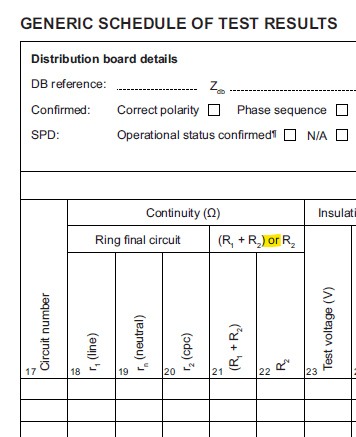
    I disagree, read the Generic Schedule of Test Results form in Appendix 6 carefully. The form asks for '(R1+R2) or R2'

    The reason one or the other, is it depends on the test method used for 'Continuity of Protective Conductors'.

    For radial circuits:

    • If you use the (R1+R2) method for continuity of protective conductors, you enter the value measured for (R1+R2) in column 21 and N/A in column 22 
    • If you use the 'wander lead' method, you enter N/A in column 21 and the measured value of R2 in column 22.

    The practice for ring final circuits is:

    • Carry out end-to-end tests (step 1). Write the measured end-to-end values for r1, rn and r2 in columns 18, 19 and 20 respectively.
    • Carry out the 'figure of 8' tests (steps 2 and 3).
    • Write down the greater of [(R1+R2)/4] or [largest measured value in the figure of 8 test step 3] in column 21, and 'N/A' in column 22.
      (NOTE: in theory, the  [largest measured value in the figure of 8 test step 3] should not exceed [(R1+R2)/4] so usually it's [(R1+R2)/4] that goes in column 22.)

    FINALLY, and this is VERY important:

    (a) it's potentially dangerous to conduct a live test before dead tests are complete. The measurement of  'continuity of protective conductors' is an essential test for safety of the person carrying out live tests later.

    (b) it doesn't conform to BS 7671. BS 7671 requires dead tests are carried out before live tests (see Regulation 643.1).

  • This regulation is in Chapter 64 Initial Verification. I'm not asking how to test, I'm asking what the difference is between is between doing ZDB and ZS and taking the reading away if you are not disconnecting the circuits from the earth bar when doing a r1 r2, I appreciate all initial verification tests are dead tests but, if on an EICR you are doing live testing and the cert is asking for one or the other r1r2 or r2, what is the difference? The original question was...... Is it only down to parallel paths the reason why it is frowned upon to back calculate? Also the boys are encouraged to clip on to the earth bar with everything connected when doing r1r2 readings. I'm looking for an answer as to why it is frowned upon to back calculate? If in a domestic property I test ZDB and ZS at end of line why would it be frowned upon to put in a r1r2 reading for that circuit?

  • why it is frowned upon to back calculate?

    What would it tell you? Say Zdb was 0.3Ω and R1+R2 = 0.2Ω but due to parallel paths Zs came out as 0.4Ω instead of 0.5Ω  - other than having "something" to go into a box on a piece of paper, what the value of calculating 0.4 - 0.3 = 0.1Ω ?

       - Andy.

  • I'm asking why, if we can do ZDB and r1r2 to calculate Zs why not back calculate. I know doing two tests would give you different values but I'm asking if you done ZS-ZDB to put r1r2 in, why is this frowned upon if you are keeping your circuits connected to the earth bar when doing r1r2? On an EICR it asks for reading in the box either r1r2 or r2.

  • This regulation is in Chapter 64 Initial Verification.

    Yes, Regulation 651.2 refers to the 'appropriate tests and measurements from Chapter 64'.

    I understand there are circumstances where it's difficult to carry out EICR without removing power, but there are dangers involved of carrying out live tests on circuits where you don't know there's continuity to the cpc ... so this should be an absolute last resort and backed up by some very good, documented, reasons, and a documented risk assessment. EAWR Regulation 8 makes earthing (where it's needed for safety) an absolute requirement, so if you or anyone else gets a shock because of lack of earthing (such as broken cpc or loose/ineffective cpc connection) whilst carrying out loop tests or RCD tests, it's something that's quite difficult to defend against if the HSE get involved.

    It's also really difficult to carry out a comprehensive inspection with the installation 'live' ... Regulation 14 of EAWR is relevant also.

    if on an EICR you are doing live testing and the cert is asking for one or the other r1r2 or r2, what is the difference?

    Then the industry practice would be to record 'LIM' in the R2 and R1+R2 columns because you didn't do those (continuity) tests ... and explain the reason for the limitations in the relevant section of the EICR form.

    I'm asking why, if we can do ZDB and r1r2 to calculate Zs why not back calculate. I know doing two tests would give you different values but I'm asking if you done ZS-ZDB to put r1r2 in, why is this frowned upon if you are keeping your circuits connected to the earth bar when doing r1r2? On an EICR it asks for reading in the box either r1r2 or r2.

    See above. If you didn't do those continuity tests, there isn't a result.

  • Is the only reason you do not calculate r1 r2 by deducting Ze/Zdb from Zs is that it is down to parallel paths. The reason I am asking is, when the apprentices are doing their trade test, they are encouraged to short the circuit they are working on to the earth bar via a crocodile clip to get r1 r2. Surely this is picking up parallel paths also? Or is there is another reason?
    So no one can give me a definitive answer to above. If you are not meant to live test why do you have a meter that does. As asked why is it ok to do live ZE but not Live Zs? Surely if you do a live test at end of line you are proving continuity on the cpc? Or am I missing something?

  • Is the only reason you do not calculate r1 r2 by deducting Ze/Zdb from Zs is that it is down to parallel paths.

    No, I think that GK has explained it earlier today.

    You are checking for CPC continuity, i.e. R2 is let's say, around 0.5 Ω (obviously, depending upon the length of the circuit). You can do this one of two ways. First, by connecting your meter to both ends of the CPC using a 'wander lead', you measure R2 directly. The second method is easier: join line and CPC in the DB and measure between them at the far point. This gives you R1 + R2. You put one or the other on your generic schedule.

    At this stage, you have yet to energise the installation, so you are working safely. So that is the main reason for obtaining R1 + R2 that way.

    If there are parallel paths, they may be included in your R2 value. You can reduce the chance of that happening by joining line and CPC before you put the CPC in the earth bar.

    Ze is one of the first live tests, which you do at the intake. Having measured that, and knowing R1 + R2 for all of your circuits, you can calculate all the values of Zs and check that against observed values.

    It is all about working as safely as possible.

  • Surely this is picking up parallel paths also?

    Yes and no. Parallel paths can occur in a number of different ways - yes ideally you'd measure R1+R2 (or R2) without any parallel paths at all - but that very difficult in practice. Not having the c.p.c. connected to the earth might eliminate some of the parallel paths, but other may well remain. On the other hand, testing just the final circuit bit of the loop separately from the supply side can reduce the effect of some parallel paths, even if the c.p.c.s remain connected.

    A while back people were trained to disconnect both L and c.p.c. and connect them together to do a R1+R2 test ... but that leaves the single most important joint in the circuit untested ... so whatever's suggested there's always a downside. The more you get into the regs the more you realise they're based less on perfect logic and more on compromise and weighing one disadvantage against another.

       - Andy.

    BTW - I think you mean R1 and R2 - rather than r1 and r2 ... upper/lower case is significant - the latter mean something rather different (end-to-end continuity of a ring).