Zs taken by live test and r1 r2 calculated by deducting Ze or Zdb

Is the only reason you do not calculate r1 r2 by deducting Ze/Zdb from Zs is that it is down to parallel paths. The reason I am asking is, when the apprentices are doing their trade test, they are encouraged to short the circuit they are working on to the earth bar via a crocodile clip to get r1 r2. Surely this is picking up parallel paths also? Or is there is another reason?

  • And this is what I'm trying to get to the bottom of, why is it frowned upon to back calculate r1r2 from ZS and ZDB.

  • In certain circumstances it can be the same,when I'm testing communal areas in small blocks of flats,wired in twin and earth it's very similar. My measured r1+r2 will often be very close to ZS-ZE,in a house though where they may be a gas boiler a water cylinder and maybe gas and water bonding it probably won't work unless  the wiring is not connected to these metallic services.

  • Probably needs a proper circuit diagram that shows the spurious paths and components (e.g. RCD inductances; real resistances of the soil of Earth; which end has the test 'short'; etc. )

  • So I think that we are agreed that ZS = ZDB + (R1 + R2) and R1 + R = ZS - ZDB.

    NO!

    1. Parallel paths not taken into account (BS 7671 requires us to take into account worst-case, when fortuitous earthing is removed).

    2. if, and ONLY if, there are no parallel paths, ZS = ZDB + (Z1 + Z2) and (Z1 + Z2) = ZS - ZDB ... to find out (R1+R2) you need to know the reactance in the circuit.

  • This makes me question why we measure r1+r2 with dc ? Why dont we use ac at 50 hz to give us a closer reading to real world conditions, i have also wondered this about ir why are they dc measured?

  • CAN ANYONE OFFER A DEFINITIVE ANSWER TO THIS QUESTION. PLEASE READ AND ANSWER ACCORDINGLY......................

  • Why dont we use ac at 50 hz to give us a closer reading to real world conditions, i have also wondered this about ir why are they dc measured?

    DC is OK for copper conductors up to at least 16 mm2. Only above this CSA are we concerned about reactance.

    The problem with SWA, it its CSA is above 16 mm2 for all multicore armoured cables, with, if memory serves, the exception of 2c 1.0 mm2 SWA.

    It also proves continuity (which is what BS 7671 requires for verification ... not an accurate resistance or impedance reading).

    Loop testing is actually rather inaccurate, often out by 10 % or worse, and for low values of loop impedance (high values of prospective fault current), specialist loop test equipment is needed.

    In fact, for initial verification and periodic inspection and testing, the loop impedance (calculated or otherwise ... BS 7671 does not require us to accurately measure it, although it's best to know you accurately have a fault path, once that's established, a calculation will satisfy the requirements of Part 6) is more of a "finger in the air" that everything is around about OK. ... the proof in the pudding is the original design (or use of standard circuits per Section 7 of the OSG).

  • CAN ANYONE OFFER A DEFINITIVE ANSWER TO THIS QUESTION. PLEASE READ AND ANSWER ACCORDINGLY......................

    Yes, I can.

    Loop impedance tests are not very accurate, so it wouldn't be recommended.

    The reason I am asking is, when the apprentices are doing their trade test, they are encouraged to short the circuit they are working on to the earth bar via a crocodile clip to get r1 r2. Surely this is picking up parallel paths also?

    There are two schools of thought on parallel paths and testing:

    1. Eliminate parallel paths by removing the cpc (at least for initial verification).

    2. Don't remove the cpc to prevent damage and avoid dismantling which can lead to errors in reconnection (more valid for periodic inspection and testing, or when extending a new circuit).

    With respect to Ze and Zs, BS 7671 does NOT require an accurate measurement of either Ze or Zs. Both can be determined with no measurements (e.g. by calculation) or verification according to Part 6.

    What is needed to be tested in terms of loop impedance/continuity, as a minimum are:

    • Test to demonstrate there is an earth fault path (rather than an accurate reading of Ze).
    • Test for continuity of protective conductors. (and live conductors of a ring final circuit only).
  • Ok, if you are doing an EICR, these results are asked for also it asks for a r1r2 or2 reading (at least one column to be completed) so, if we are keeping all earths connected and doing a r1r2 or a live test Zs, I am asking why it is ok to add ZE/ZDB to r1r2 but not ZS from ZDB to attain r1r2. Is there any reason why it is frowned upon. You are demonstrating there is an earth path either way and proving continuity either way surely?

  • Ok, if you are doing an EICR, these results are asked for also it asks for a r1r2 or2 reading (at least one column to be completed) so, if we are keeping all earths connected and doing a r1r2 or a live test Zs, I am asking why it is ok to add ZE/ZDB to r1r2 but not ZS from ZDB to attain r1r2

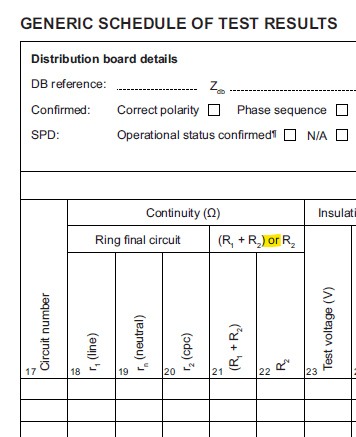
    I disagree, read the Generic Schedule of Test Results form in Appendix 6 carefully. The form asks for '(R1+R2) or R2'

    The reason one or the other, is it depends on the test method used for 'Continuity of Protective Conductors'.

    For radial circuits:

    • If you use the (R1+R2) method for continuity of protective conductors, you enter the value measured for (R1+R2) in column 21 and N/A in column 22 
    • If you use the 'wander lead' method, you enter N/A in column 21 and the measured value of R2 in column 22.

    The practice for ring final circuits is:

    • Carry out end-to-end tests (step 1). Write the measured end-to-end values for r1, rn and r2 in columns 18, 19 and 20 respectively.
    • Carry out the 'figure of 8' tests (steps 2 and 3).
    • Write down the greater of [(R1+R2)/4] or [largest measured value in the figure of 8 test step 3] in column 21, and 'N/A' in column 22.
      (NOTE: in theory, the  [largest measured value in the figure of 8 test step 3] should not exceed [(R1+R2)/4] so usually it's [(R1+R2)/4] that goes in column 22.)

    FINALLY, and this is VERY important:

    (a) it's potentially dangerous to conduct a live test before dead tests are complete. The measurement of  'continuity of protective conductors' is an essential test for safety of the person carrying out live tests later.

    (b) it doesn't conform to BS 7671. BS 7671 requires dead tests are carried out before live tests (see Regulation 643.1).