Group 1 Medical Location - supplementary bonding - use of junction boxes

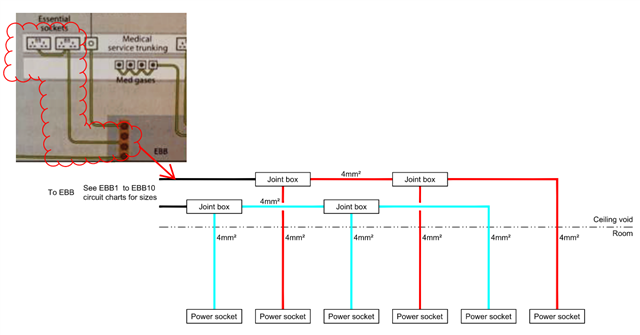
For the supplementary bonding connections connecting the general power sockets served by the general power circuit  is it permissible to have a junction box installed (in a ceiling void) prior to the EBB in a group 1 medical location to reduce resistance value of the circuit?

See image below for typical arrangement:
  • Note: this is one of a few related questions, but I am keeping each question separate with an aim for the answers, to focus, just, on each specific question. 

  • Interesting. My initial thought was that (in the words of an earlier edition of the regs) "joints are a source of weakness", and indeed sometimes significant additional resistance (I think for testing main bonding up to 0.05Ω can be allowed for each joint). On the other hand what you propose isn't that dissimilar from a "ring" bonding conductor approach, which is used in some very demanding situations with good results.

      - Andy.

  • Whilst electrically this might make sense, the wider question is in terms of regular inspection and testing ... in which case, infection control and other practicalities come into the mix. Some of these are CDM, some are healthcare (infection control).

    In this case, whilst 710.415.2.3 relates to the EBB itself, it also contains a clue that things requiring regular inspection and testing (at the frequency of the equipotential bonding system) should NOT be above a ceiling because of infection control issues when removing tiles for inspection and testing. So, because the inspection of the bonding system would also include these junction boxes, the answer would be "forget BS 7671, other practicalities say NO".

  • I'm also minded to consider this really is a question for stakeholders who need to manage the 'estate' long-term, rather than considering "what would BS 7671 permit us to do" ?