


For a standard domestic Install, split board with 2x Type AC main switches.
No PV or Car Chargers should this be a C3 or C2?
Thanks in advance
For a standard domestic Install, split board with 2x Type AC main switches.
No PV or Car Chargers should this be a C3 or C2?
Thanks in advance
There's also the related question that arises because AC types aren't defined not to work with d.c. residual currents - merely that their performance is undefined - they might just happen to perform adequately. Some AC types certainly did behave more like A types and there's even been a suggestion that some real A type RCDs were marketed in the UK as AC types - because that's what buyers here expected (and it was easier/cheaper for the manufacturer to produce a single type, at a time when other parts of Europe were already insisting on A types).
So can you properly code something if you can't be sure the problem really exists in reality?
- Andy.

Lets see what it looks like (the wording) when Amendment 4 comes out next month. If it's the same then maybe BS7671 Amendment 4 will have/could have a corrigendum

a lot to more cost to change it if its already installed though - this question was about an EICR.
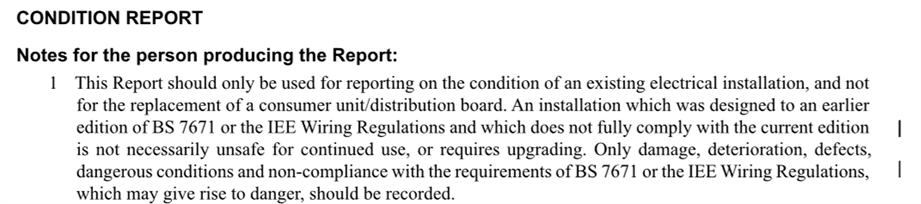
Then again, if you follow the advice given in Appendix 6 7671 with respect to producing an EICR, you should only record issues that could give rise to danger. That is another fuzzy example of wording in 7671. My take is that something that "may give rise to danger" is something that could be potentially dangerous, which a code 3 is definitely not.
Lookin at NAPIT code breakers under section 4.18 they say (Code C2)
RCD fitted is type AC and has pulsating DC currents present from connected equipment such as EV, PV, switched mode power supplies, domestic appliances with VSD's etc, which may/will mask fault current and prevent the type AC RCD from operating.
As it's more or less impossible to recreate worst case scenario for DC leakage while carrying out a RCD test during an EICR, if following this for nearly all domestic environments the code would have to be C2. Nearly all homes will contain many devices with SMPS as they are in everything from TV's, radios, computers, phone chargers etc.
I do wonder how many manufacturers just relabeled their type AC rcd's as type A because they were compliant, but won't inform the outside world because they want to sell new equipment.

Lookin at NAPIT code breakers under section 4.18 they say (Code C2)
That has to be wrong. That would render a vast number of simple installations obsolete.
My take is that something that "may give rise to danger" is something that could be potentially dangerous, which a code 3 is definitely not.
Agreed. lyledunn makes a good point.
On the next page(522) we have, "GUIDANCE FOR RECIPIENTS". C2 (as well as C1) means, "the safety of those using the installation is at risk" (emphasis in the original) and accordingly that remedial work should be undertaken "as a matter of urgency".

That has to be wrong.
I think it's certainly more nuanced - surely it'll take a significant amount of d.c. residual current to blind even the simplest of AC type RCD - I would have thought d.c. a mA or two would at worst de-sensitize it a bit (e.g. maybe tripping at 29mA instead of 27mA - but still within spec) - with increasing d.c. residual currents of course there comes a point where it becomes a problem. The question is how likely is it that a typical domestic will produce enough d.c. residual current to be a problem? Even A types aren't a complete panacea to this issue - they're only good up to 6mA d.c. - after that their performance is as undefined as AC types.
- Andy.
Considering the time it take to write/publish a BS like BS7671 the lifecycle should start to consider the recommendation of of type B as a minimum for BS7671 Ammendment 5 or 19th edition. Ideal for EV chargers, solar PV (inverters).
Lets not forget the type F as well for inverter driven loads like washing machines and heat pumps.
I am sure that will be an interesting debate for the JPEL Team.
I think it's certainly more nuanced - surely it'll take a significant amount of d.c. residual current to blind even the simplest of AC type RCD - I would have thought d.c. a mA or two would at worst de-sensitize it a bit (e.g. maybe tripping at 29mA instead of 27mA - but still within spec) - with increasing d.c. residual currents of course there comes a point where it becomes a problem. The question is how likely is it that a typical domestic will produce enough d.c. residual current to be a problem? Even A types aren't a complete panacea to this issue - they're only good up to 6mA d.c. - after that their performance is as undefined as AC types.
I suspect you are probably correct but unless someone actually publishes data on what the real performance is or gives more specific guidance it's very difficult as an electrician to make an informed engineering decision other than in most cases a type AC RCD in a domestic install is a C2, especially as a NAPIT member where the organisation has published a document that states it's a C2. Even if we had a DC leakage meter, given the different types of DC leakage the challenges with creating a worst case scenario the measurement results will be difficult to interpret at best. Then we have no idea on what our limit is, according to the standard presumably 0 DC leakage.
It's the same or maybe worse than deciding if its ok to install a third party MCB in to a consumer unit, at least with the consumer unit you can check that the bus bar slots are lined up and won't put stress on the connections.
Is there any published data on the typical amount of DC leakage in a domestic installation?
From my limited experience, a type AC RCD still works fine in a modern house, despite almost everything containing a switch mode power supply these days. I had to replace my oven recently, because it kept tripping the one RCD that covers all the sockets in the house and garage.
We're about to take you to the IET registration website. Don't worry though, you'll be sent straight back to the community after completing the registration.
Continue to the IET registration site

